

























































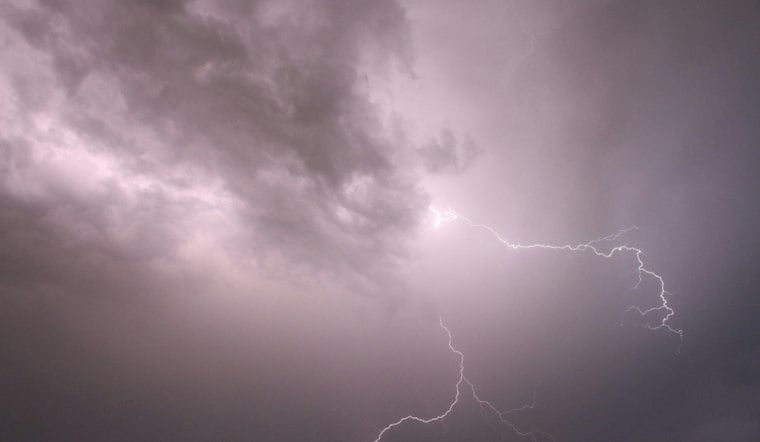
Kevin Sosa was playing soccer on a field near his Boynton Beach home when lightning struck him and sent him into cardiac arrest. His father began CPR immediately, while his mother called for help, and doctors now credit that quick response with helping save the teen's life.
According to WPTV, paramedics arrived and took over CPR before rushing Kevin to Delray Medical Center, where he stayed for weeks. Palm Beach Fire Rescue told the station that only about 10% of people who go into cardiac arrest survive, underscoring how precarious Kevin's situation was in those first minutes. Dr. Angela Jones said that without the CPR performed before paramedics arrived, the time Kevin's brain went without oxygen would have been much longer, and he likely would not have recovered as much.
A Father's Instinct Kicks In
Kevin's father, Roberto Sosa, was close by when the lightning struck and started compressions right away. The South Florida Sun Sentinel reports that Roberto had no medical background and learned how to do chest compressions from television shows, a detail he shared himself. The Palm Beach Post reports that the Sosa family was playing soccer when the weather turned cloudy and lightning struck, and that a sheriff's deputy, Claudia Abreu-Perez, took over CPR after Roberto began it, finding Kevin's pulse about four minutes later.
Dr. Pedro Gonzalez said Kevin's father felt electricity run through him during the strike, but that the main impact went to Kevin. The Palm Beach Post reports that Dr. Jones said the CPR performed by Roberto, the deputy and first responders was crucial for Kevin's recovery. Reports differ on Kevin's exact age at the time of the strike: WPTV describes him as 14, while CBS12 reports he was 13.
Weeks in the Hospital, Then a Reunion
Kevin ended up spending his birthday in a hospital room during his weeks-long stay at Delray Medical Center. He later reunited with his parents, first responders and medical team at a ceremony at the hospital, telling them, “Thank you for saving my life.” Heather Havericak said Kevin's outcome depended on everyone in the room that day, a sentiment that speaks to how many hands were involved in his survival chain, from his father's first compressions to the deputy's intervention to the paramedics who took him to the hospital.
Dr. Jones said Kevin's ability to walk and talk afterward demonstrated the value of the pre-hospital care delivered by his parents and first responders. The South Florida Sun Sentinel notes that Kevin still goes to physical therapy three days a week as he continues his recovery.
Why Minutes Matter in Cardiac Arrest
The emphasis on those first few minutes isn't just sentiment — it's backed by data. A study of witnessed out-of-hospital cardiac arrests from 2013 to 2022, highlighted by the American Heart Association, found that bystander CPR begun within two minutes was associated with an 81% higher rate of survival to hospital discharge compared with no bystander CPR at all. Even CPR started up to 10 minutes after cardiac arrest was linked to a 19% greater likelihood of surviving to discharge and a 22% greater likelihood of a favorable neurological outcome, according to the same release — though the association's group cautioned that the findings were preliminary since the research abstract had not been peer-reviewed.
The South Florida Sun Sentinel, citing the Red Cross, reports that immediate CPR after cardiac arrest can double or triple a person's chance of survival. Locally, the stakes of fast resuscitation have been documented before: a JEMS account of Palm Beach County's emergency medical system found that survival from out-of-hospital cardiac arrest averaged 17.4% in 2014, but rose to a sustained 36.0% after the county's EMS medical directors instituted a bundle-of-care approach in 2015 — one that emphasized continuous chest compressions, early transition to mechanical CPR devices, and transport with the head and thorax elevated.
For the Sosa family, those statistics translated into a real outcome. Kevin's reunion with the people who helped save him served as a reminder, as WPTV's report emphasized, that knowing CPR — and being willing to use it, even if learned from a television screen — can be the difference between life and death.



