

























































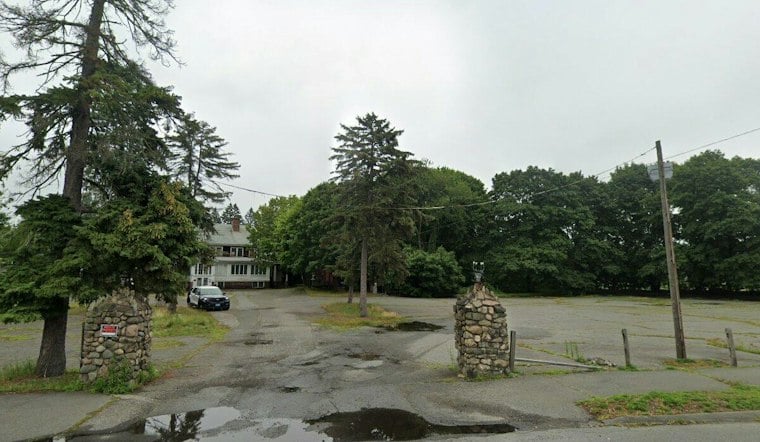
The Swampscott Planning Board has unanimously approved Glover LLC’s 140-unit residential development near Vinnin Square, clearing a major hurdle for a project that has been years in the making on the historic Gen. John Glover farmhouse property. But the approval comes with an unusual wrinkle: representatives of the neighboring Tedesco Country Club are warning that stray golf balls could pose a real risk to the new buildings going up along the course’s boundary.
The board’s vote, confirmed by Swampscott Tides, came after the board considered the proposal at its October 19 meeting, according to seed reporting cited in this story. The approved plan splits the development across two towns, with 44 units on the Marblehead side and 96 on the Swampscott side, Swampscott Tides reported. The project still needs separate approval from the Marblehead Planning Board before it can move forward on that portion of the site, per the seed reporting.
The development, which stretches along the boundary with Tedesco Country Club, will include 144 parking spaces split between above-ground and underground spots, and no building will rise above 50 feet, the station reported. The plans also preserve the Glover farmhouse, a structure that predates the Revolutionary War, and weave it into the development with pathways connecting it to each new apartment building, the same outlet noted.
A Golf Club Raises the Alarm
Tedesco Country Club, which has operated on land straddling Marblehead and Swampscott for more than 125 years, abuts the Glover development site directly. At the board meeting, attorney Chris Drucas represented the club and urged town officials to conduct additional due diligence before the project proceeds, according to the seed reporting behind Boston.com’s coverage of the meeting, authored by Abby Patkin.
Drucas told the board that stray golf balls have crossed onto the neighboring property for decades and that club representatives asked developers to consider the reality that balls do leave the course. He went further, suggesting the club should receive its own peer review of the project and be allowed to retain its own engineering firm, and he even raised the possibility of a prescriptive easement covering stray balls that land on the neighboring land. Drucas also suggested removing balconies from the proposed buildings as a precaution.
Other voices at the meeting weighed in on how real the risk might be. Michael Schaefer said at the board meeting that he had personally hit golf balls over the boundary line. Jer Jurma suggested that trees planted between the club and the new development could reduce the potential for golf-ball strikes, noting that trees slow the speed of golf balls. Spencer Cassell countered that other holes on the course sit closer to buildings than the tees at the second hole, which is the one nearest the Glover site, and he noted the club has two tees at that hole, including a farther option that could be used to put more distance between golfers and the new homes.
Conditions Attached to the Approval
The Swampscott Planning Board’s approval isn’t unconditional. Beyond the golf-ball concerns, neighbors and Tedesco representatives also called for a peer review of the project’s traffic study, Swampscott Tides reported. The developer’s traffic consultant had estimated the project would generate about 30 additional outbound vehicle trips during the morning peak hour and a similar number of inbound trips in the evening, per the same outlet’s reporting.
The approval also requires a planned emergency access point on Vinnin Street with a right-turn-only exit, and the developer must address any adverse impacts the town’s Department of Public Works identifies while reviewing civil plans, stormwater reports, and geotechnical studies tied to the site. The project has evolved considerably since earlier iterations: a 2022 proposal detailed by Marblehead Beacon described two Swampscott buildings with 51 and 40 units respectively, while a more recent concept reported by Marblehead Independent described three residential buildings with 220 parking spaces before the plan settled into the 144-space, 140-unit version now approved.
A Legal Precedent Looms Over the Debate
The concerns raised by Tedesco Country Club aren’t without precedent in Massachusetts courts. In Tenczar v. Indian Pond Country Club, a Kingston couple, Erik and Athina Tenczar, sued a nearby golf course after they said their home was struck by 651 golf balls over several years, breaking eight windows and damaging siding and a deck railing, according to the Massachusetts Supreme Judicial Court opinion published via FindLaw and reported by The Boston Globe.
A jury sided with the couple, though accounts of the exact award differ: the court opinion states the jury awarded $100,000 for property damage and $3.4 million in emotional-distress damages, while Boston.com reported the jury awarded $3.5 million for damages and emotional and mental suffering, totaling roughly $4.9 million with interest. The Massachusetts Supreme Judicial Court ultimately overturned that verdict, finding the trial judge had not properly interpreted the subdivision’s covenants and restrictions as a whole, per the court’s opinion. The court held that while some errant golf shots are inevitable, a predictable pattern caused by unreasonable course operation is a different matter, and the case was sent back to Plymouth Superior Court for a new jury to decide whether the golf-ball strikes amounted to an unreasonable intrusion, as reported by The Boston Globe. The parties ultimately settled after the verdict was overturned.
That case centered on a course design that let an aggressive shot from the 15th tee travel between 192 and 241 yards and still reach the house, with trees meant to buffer the fairway from the home having been thinned out over time, according to the same court opinion. Before mitigation measures were put in place, 130 balls were found on the Kingston property in 2018 alone, Boston.com reported, and fewer balls struck the house once changes were made. Whether any comparable mitigation will be required at the Glover site in Swampscott remains an open question as the project moves toward construction.





