

























































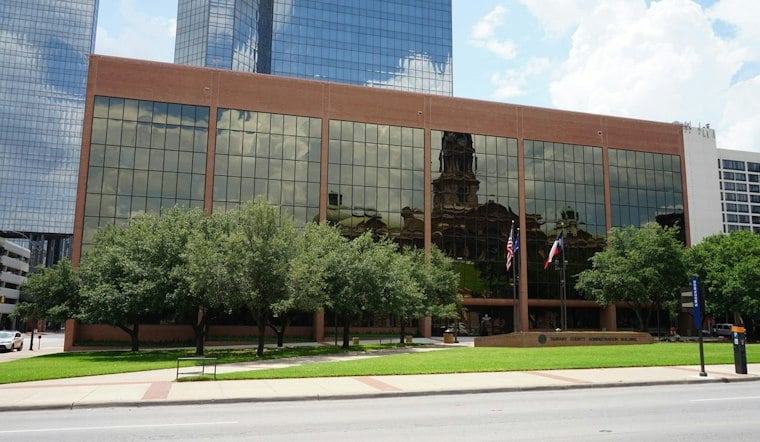
A coalition of Fort Worth-area activist groups wants Tarrant County to rip out its Flock automated license plate readers entirely, and they are modeling the push on a 2019 state ban on red-light cameras. The groups sent a resolution to Tarrant County commissioners on Oct. 2 calling for an end to county spending, contracts, property use and grants tied to what they call mass-surveillance systems like Flock, but the measure never showed up on the commissioners court agenda.
The resolution was submitted by DeFlock Fort Worth and DeFlock DFW, and would terminate the county’s own cameras along with any contract that gives law enforcement access to Flock’s database, according to the Fort Worth Star-Telegram. Steven Lawrence, founder of DeFlock Fort Worth, said getting shut out of the agenda will not stop the campaign. “Not getting the resolution on the agenda is the beginning of the effort, not the end,” Lawrence said, according to the Star-Telegram. The groups say they will keep pushing through public comment, and they are also asking Fort Worth to adopt a city charter amendment targeting the cameras.
What Flock Cameras Actually Capture
Flock cameras are automated license plate readers used by law enforcement, photographing every passing vehicle and capturing its plate, make, model and color, per the Star-Telegram and Fort Worth Report. Any agency with a Flock contract can enter a plate number and a stated reason to find where that vehicle has been spotted, even outside its own jurisdiction, the Star-Telegram reports. Agencies that contract with Flock can search the database without a warrant, according to information the Star-Telegram cited from the Texas Tribune.
There are more than 1,200 Flock cameras across Tarrant County, according to DeFlock Fort Worth’s own map, as cited by the Star-Telegram. Retention policies vary: the Star-Telegram reports collected data is deleted within 30 days, if not seven, while the Fort Worth Report specifies that the Tarrant County Sheriff’s Office deletes its Flock data every 30 days unless marked as evidence, separate from Flock Safety’s own stated seven-day deletion window for data its cameras collect.
Sheriff Points to Arrests and Drug Seizures
Tarrant County Sheriff Bill Waybourn has called Flock cameras the county’s most valuable law-enforcement tool, a position he stated in September. The Sheriff’s Office owns just six Flock cameras, which the Fort Worth Report says have aided roughly 800 serious arrests. From January 2025 through August 2026, Waybourn said the Sheriff’s Office recovered 259 stolen vehicles, identified a capital murder suspect and intervened in multiple instances of drug trafficking, per the Star-Telegram. The Fort Worth Report adds that the same stretch produced seizures of 100 pounds of methamphetamine and 150 fentanyl pills.
Waybourn also credited the Fort Worth Police Department, which has used Flock cameras since 2020, with about 2,200 serious arrests over six years. Roughly 130 Sheriff’s Office staffers have access to the Flock camera data, the Fort Worth Report notes. A Fort Worth Police technology briefing from June 2024 put the city’s camera count at approximately 250, while a February 2026 contract package preserved an annual agreement cap of $631,000 and reproduced 2023 figures of 117 leased cameras and 141 city-owned cameras integrated through Flock software, according to DeFlock DFW.
A Coalition Spanning the Political Spectrum
The push against Flock in Tarrant County draws support from groups not often aligned, including the Tarrant County Republican Liberty Caucus, Clear Rule of Law, and both DeFlock chapters, all of which are demanding that the county and its cities remove the cameras. Joe Palmer, chair of the Tarrant chapter of the Republican Liberty Caucus, said the goal is a statewide ban modeled on the 2019 red-light-camera law that Gov. Greg Abbott signed. “Flock cameras have no place in a free society,” Palmer said, adding that the focus should be on government accountability. Both the Republican Party of Texas and the Libertarian Party of Texas oppose automated license plate readers, and grassroots groups say they are building a broader effort to end what they describe as mass surveillance.
The Fort Worth fight is part of a larger reckoning playing out statewide and nationally. As reported by the ABC News, more than 50 cities and counties nationwide have canceled or deactivated ALPR cameras, and Flock cameras have been vandalized in at least 36 states. In Texas alone, an estimated 13,000 Flock cameras were operating as of late August, even after a state agency had directed at least $30 million toward installing more than 3,200 of them, according to the Texas Tribune. Abbott paused that state funding and directed the Texas Department of Transportation to pause installing license plate readers along state roads, the Tribune reported.
Mixed Responses Across Texas and Beyond
Reaction to the funding pause has split Texas communities. The Texas Tribune reports at least 14 cities and counties shut off more than 900 Flock cameras after the state funding was rescinded in late August, with Plano, Robinson and Kendall County ending their contracts entirely, while Houston and Dallas shut down only grant-funded cameras and kept much of their networks running. Kyle’s City Council instead voted 6-1 to continue its Flock contract despite losing its 2026 state grant, and Laredo planned to ask voters whether the city should spend $1 million a year to keep 165 cameras operating, per the Tribune.
Closer to the Metroplex, the Dallas Observer reports the San Marcos City Council voted against renewing a contract that would have expanded its camera count from 19 to 33, and all of that city’s cameras were removed by early February. In northwest Arkansas, the Fayetteville City Council approved an outright ban on purchasing or using automated license plate readers by a 7-0 vote on Tuesday, while Greenwood, Centerton and Pea Ridge each separately canceled or ended their Flock use in recent months, according to nwaonline.com. In the Philadelphia area, Abington Township is ending its Flock Safety contract and removing three cameras over data-security concerns, and Cherry Hill, New Jersey, plans to remove 10 cameras when its contract expires at year’s end, per NBC Philadelphia, which also notes some Pennsylvania and New Jersey lawmakers are weighing proposals ranging from added oversight to outright bans.
For now, the fate of the Tarrant County resolution remains unresolved after its absence from the commissioners court agenda, and no county or city vote has been scheduled. DeFlock organizers say they intend to raise the issue through public comment and continue pressing for the Fort Worth charter amendment as the broader statewide debate over Flock cameras keeps expanding.



