

























































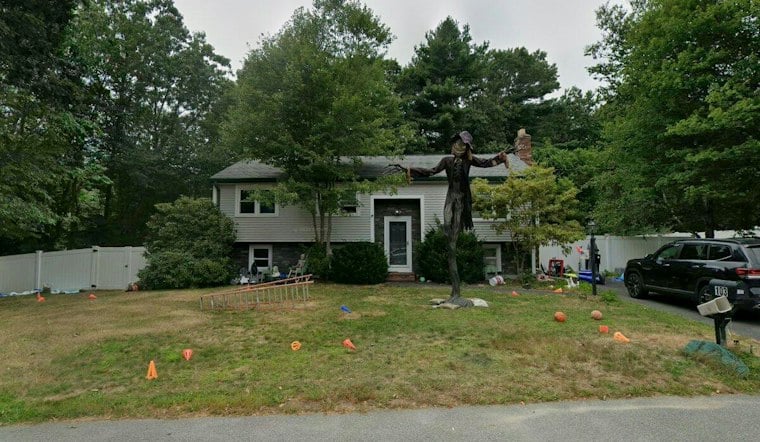
Each October, the yard at 103 Duffy Drive in Taunton becomes a fenced-in walkthrough with more than 50 animatronics and thousands of lights. The Balderrama family’s Duffy Drive Haunts also raises money for pediatric cancer research, linking its Halloween display to a cause beyond the season.
The Balderramas use a QR code at the display to let visitors donate to The MTJ Effect, which supports pediatric cancer research, according to 1420 WBSM. Kendall Balderrama said she hopes visitors enjoy the Halloween attraction while supporting the cause, the report said.
From Youth Sports Injury to Community Fundraising
The MTJ Effect encourages young athletes to play with purpose by dedicating a game or season to a child affected by pediatric cancer. Its fundraising began after 10-year-old athlete Miller Townsend Jones broke his elbow and could not play lacrosse; he then collected scrap metal and organized community drives. Those efforts have raised more than $25,000 for pediatric cancer research, according to PledgeIt. The Balderramas took part in The MTJ Effect this year, bringing its mission to their Halloween tradition.
PledgeIt says donations raised through the Duffy Drive QR code ultimately go to the Pediatric Cancer Research Foundation. The foundation cites data that the federal government directs about 4% of its total cancer research budget to pediatric cancer, a gap that makes nonprofit and community fundraising an important source of support.
Two Ways Community Fundraising Supports Research
The MTJ Effect is one documented example of a community fundraising organization directing proceeds to pediatric cancer research: its scrap-metal collection and community drives provide a year-round model, while Duffy Drive Haunts raises money through a seasonal Halloween attraction. PledgeIt describes the MTJ Effect’s fundraising and the destination of the Duffy Drive QR-code donations. For regional context, Dana-Farber/Boston Children’s Cancer and Blood Disorders Center says it has more than 200 active clinical trials. That figure is general context and does not mean Duffy Drive donations go to the center.
A National Health Picture Behind the Local Effort
The scale of the need is significant. Survival rates have improved dramatically over the decades, climbing from about 58% in the mid-1970s to 85% today, though cancer remains the leading disease-related cause of death among American youth, according to National Cancer Institute.
Even survivors often carry lasting consequences. More than 60% of childhood cancer survivors develop at least one chronic health condition. That finding underscores why researchers are increasingly focused on gentler, more targeted therapies rather than the blunt treatments of decades past.
Two Months of Building for One Night of Trick-or-Treating
The display takes shape over several weeks. According to 1420 WBSM, Kendall, Jamie, Logan, and Hunter start building in late August and aim to have the street display fully lit by the end of September. They continue adding fog machines, props, and other finds, with a major building push in the week before Halloween.
Kendall Balderrama told the outlet that the finished display has more than 50 animatronics and props, thousands of lights, jump scares, and a fenced-in walkthrough that expands each year. The family also enjoys seeing visitors stop to take pictures, the report said.
A Tradition That Reaches Beyond the Yard
Kendall Balderrama said the display has connected her family with others and helped teach her sons gratitude and compassion, according to the same account. The National Retail Federation projected U.S. Halloween spending would reach a record $13.5 billion in 2026, with 74% of the population taking part, as reported by National Retail Federation. Nearly half of consumers said they planned to start shopping in September or earlier, and costume spending alone was projected to reach $4.4 billion, outpacing the $4.1 billion expected to go toward candy, according to the retail federation's survey data.
Duffy Drive Haunts pairs elaborate seasonal theater with a cause the Balderrama family has made personal, one QR code scan at a time.





