

























































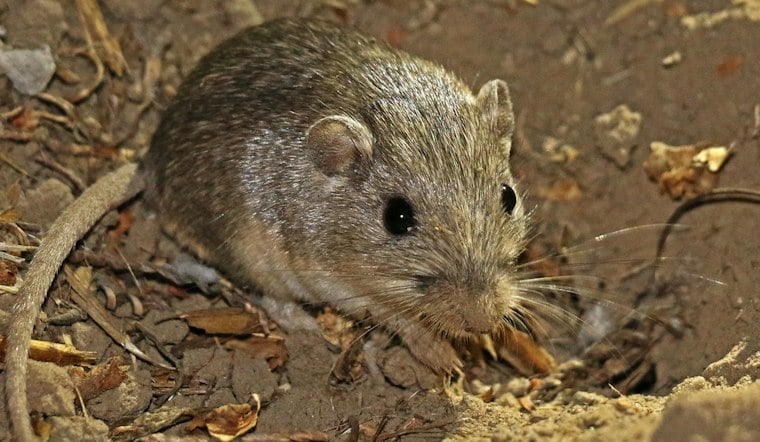
A mouse small enough to perch on a human thumb now has a new foothold at Marine Corps Base Camp Pendleton, where conservationists released a third reintroduced population of the endangered Pacific pocket mouse into a stretch of shrubland called North San Mateo. The release brings the total number of known wild and reintroduced Pacific pocket mouse populations to six, a milestone for a species that spent decades presumed extinct.
San Diego Zoo Wildlife Alliance conservation scientist Debra Shier released a Pacific pocket mouse at North San Mateo in July, according to KPBS. Shier said the mice are on their way to becoming self-sustaining, per the same report. The alliance has run its Pacific Pocket Mouse Conservation Program since 2006, and it describes the North San Mateo release as its third wild reintroduction group, as San Diego Zoo Wildlife Alliance announced.
North San Mateo sits inside Camp Pendleton, and the first of these reintroduced populations was established at Laguna Coast Wilderness Park in Orange County back in 2016, with a second following at Camp Pendleton in 2024, according to 10 BM News. That Laguna Coast group began breeding independently by 2017, the alliance noted in a release about the Camp Pendleton reintroductions.
A Species Written Off, Then Rediscovered
The Pacific pocket mouse was listed as endangered, per KPBS. Human encroachment and habitat degradation reduced its numbers, and the species was believed extinct for two decades, the outlet reported. Researchers rediscovered the species in 1993, Shier told KPBS, and it had once ranged along the coast between Los Angeles and the Mexico border, according to the same report. Today only three original wild populations persist, found at Dana Point, Santa Margarita and South San Mateo in Camp Pendleton, per the alliance's announcement.
The mouse weighs no more than three pennies and is endemic to coastal scrublands, dunes and rivers within about 2 miles of the ocean. The animal is also considered a key seed disperser, and its burrows under sandy earth shelter other species while improving soil health through nutrient cycling and water movement, according to KPBS and the alliance.
Training Captive Mice To Act Wild
Because so many reintroduced mice have never faced a predator, researchers train captive-bred animals to display wild behaviors before release. Scientists simulate owl attacks by flying taxidermy owls over cages and spraying the mice with water, and they work to teach the animals to fear predators like snakes, per KPBS's reporting.
The breeding effort, added in 2012, aims to produce genetically diverse mice fit for release, the alliance has said.
The Genetics Problem Driving The Whole Program
The urgency behind all this behavioral coaching traces back to genetics. A study published in Science found effective population sizes of just 12.3 in Dana Point and 21.3 in South San Mateo, compared with a more modest 254.8 in Santa Margarita. Heterozygosity in the South San Mateo population declined 18% between 2012 and 2020, the study found, and mice from Dana Point and South San Mateo showed lower genome-wide heterozygosity and higher inbreeding coefficients than those from Santa Margarita.
Researchers have used genetic analysis to avoid breeding overly similar animals and have bred individuals from different populations together, KPBS reported. That cross-population breeding reflects findings from San Diego Zoo Wildlife Alliance's science division, which reported that interbreeding with larger, more diverse populations boosted offspring fitness relative to the smallest population, though it came at some cost to the larger one. Geographic and urban isolation can prevent beneficial interbreeding and make inbreeding more likely. Habitat fragmentation remains a threat to the species.
Boosting An Existing Population, Too
The North San Mateo release was not the only recent move by the alliance. Nine Pacific pocket mice were separately reintroduced into an existing Camp Pendleton population to help boost genetic diversity and increase resilience there, according to a San Diego Zoo Wildlife Alliance story describing the mice as the smallest in North America. The alliance has said it has released more than 500 Pacific pocket mice into new and existing populations since the program's 2006 launch, while a separate report from 10 BM News puts the cumulative reintroduction figure at more than 530.
Looking ahead, the research team plans to test offspring in spring to assess genetic diversity in wild populations, KPBS reported. Shier hopes to expand the program to Dana Point — the population KPBS described as the most threatened — if that offspring testing proves successful. The mouse is also a key seed disperser in its coastal habitat.




