

























































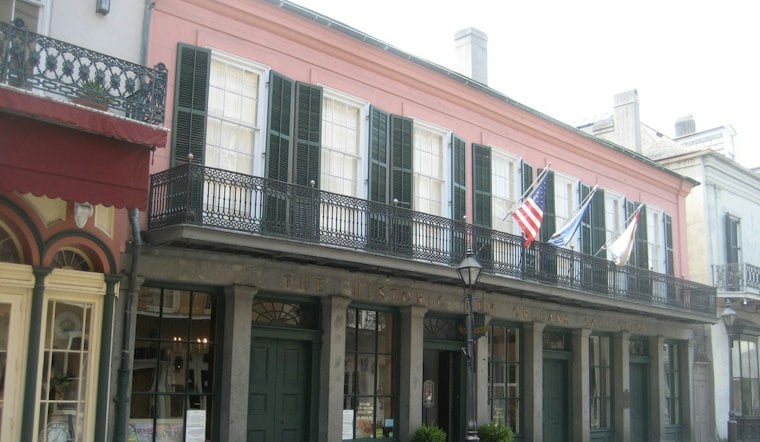
Two exceedingly rare paintings by Julien Hudson, a 19th-century artist with six known works, have found a permanent home at the Historic New Orleans Collection. The 1835 portraits, one of a Creole boy and the other of an African or African-descended man, are now on view at the organization's Williams Research Center in the French Quarter, with no museum admission required to see them.
According to the Historic New Orleans Collection, only six of Hudson's works are known to exist, and the organization acquired two of them last year through a bequest from the Robert and Martha Bolton Living Trust, given in memory of James D. (Don) Didier. The pieces, titled Creole boy with a moth and Free Black man wearing a turban, will be added to HNOC's permanent collection, according to Biz New Orleans.
HNOC president and CEO Daniel Hammer said the organization is honored to receive the paintings and steward them for posterity, per the same report. The two portraits are displayed on the second floor of the Williams Research Center at 410 Chartres St., which is open Tuesday through Saturday from 9:30 a.m. to 4:30 p.m., Biz New Orleans notes.
Who Was Julien Hudson?
Hudson holds a singular place in American art history: he was Louisiana's first native-born portraitist and the second-known portraitist of color in the country, according to the hnoc.org exhibition page. He was born in New Orleans in 1811, the son of a property-owning free woman of color and a white English merchant, ironmonger and ship chandler, per Biz New Orleans.
His path to painting was anything but direct. Hudson began as a tailor's apprentice, completing a two-year stint under tailor Erasme Logoaster before he started working with husband-and-wife miniature painters Antonio and Nina Meucci, according to the Louisiana State Museum. He began his painting career in the mid-1820s, training first in New Orleans and later in Paris, where he traveled at least twice — first between the summer and late fall of 1831, and again sometime between 1835 and 1837, according to a review published by 19thc-artworldwide.org. The Louisiana State Museum records that he was back in New Orleans by August 16, 1837. Hudson died in 1844 at age 33, according to The New York Times.
A Fragmented Legacy, Still Being Pieced Together
Hudson's surviving work centers on portraits of people from New Orleans's community of gens de couleur libres, or free people of color, before the Civil War, according to an article published by the Harvard Art Museums. Little is known about his personal life beyond scattered details in public documents and two early-20th-century reminiscences, per hnoc.org's publishing page for the exhibition catalog Julien Hudson: Free Artist of Color in Pre-Civil War New Orleans, edited by Erin M. Greenwald and listed at 116 pages on that same page — though a review in 19thc-artworldwide.org lists the publication at 114 pages with 74 color illustrations, and HNOC's own book listing elsewhere cites 128 pages for the hardcover edition.
The exact number of Hudson paintings known to survive is itself disputed across sources. HNOC's exhibition page states that only six of his works are known to exist. But The New York Times, reporting in 2011 on the traveling exhibition In Search of Julien Hudson: Free Artist of Color in Pre-Civil War New Orleans, reported that a total of eight known and attributed works dating from the 1830s had been found, while the 19thc-artworldwide.org review states that his artistic reputation rests upon only five secure paintings and a group of attributed works.
That exhibition, described by Biz New Orleans as the first retrospective of Hudson's work, brought together all of his known paintings under one roof. It opened at the Historic New Orleans Collection before traveling to the Gibbes Museum of Art in Charleston, South Carolina, and later the Worcester Art Museum, according to The New York Times. Exhibition curator William Keyse Rudolph wrote that Hudson's story is alluring, frustrating and poignant, as he only left behind a fragmented body of work when he died, Biz New Orleans reports.
Open Questions About the Sitters
Wall text accompanying the new Williams Research Center installation will explore what is known and remains mysterious about both the sitters in the two paintings and about Hudson himself, according to hnoc.org. The identities of the Creole boy and the African or African-descended man in the newly acquired portraits are not resolved in the materials the organization has released.
That kind of uncertainty isn't unique to these two works. The Harvard Art Museums recently acquired Hudson's 1840 portrait Portrait of a Young Woman in White, and the identity of the woman depicted in that painting is likewise unknown, according to the museum's own account. For now, the Historic New Orleans Collection — which describes itself as home to the world's largest collection of materials related to New Orleans history and culture — is inviting the public to view the two new acquisitions for themselves at no cost.





