

























































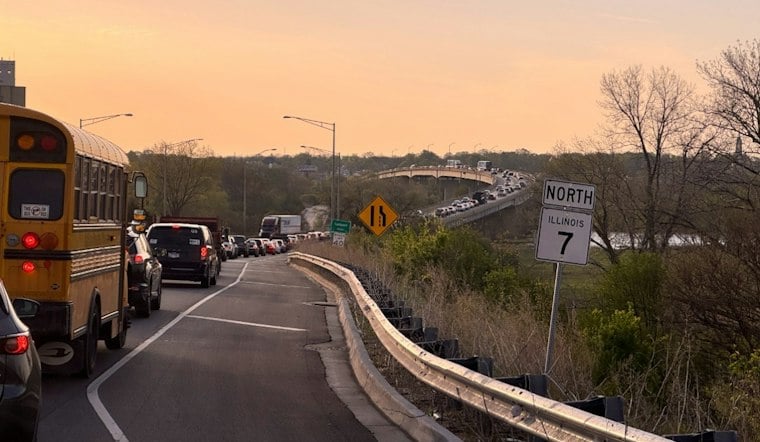
Four years after shelving a $617.6 million bridge plan over the Des Plaines River Valley, Will County Board members gathered for a special meeting this week to breathe new life into the long-stalled proposal. No formal action was taken, but the renewed conversation signals growing alarm over traffic bottlenecks that officials say will only worsen as a major reconstruction looms over one of the area's few existing river crossings.
The special meeting, held Wednesday, revived discussions that county officials and affected municipalities had set aside in 2022 after concluding they simply could not fund the project, according to the Chicago Tribune. The proposed 11-mile corridor would stretch through Crest Hill, Lockport and Homer townships, connecting U.S. Route 30, Gaylord Road and Caton Farm Road in Crest Hill with Cedar Road and 159th Street in Homer Glen. Jeff Ronaldson, director of the Will County Division of Transportation, has said the project's cost has likely climbed well above that 2022 estimate.
The idea itself is not new. Will County has discussed some version of the Caton Farm-Bruce Road regional transportation corridor for more than 25 years, with talks dating back to 2001, per the same report. The plan calls for new bridges over the Chicago Sanitary and Ship Canal, the Des Plaines River and the Illinois and Michigan Canal, along with roughly 157 acres of right-of-way acquisitions spanning agricultural, commercial and residential land on both sides of the river.
Why the Project Stalled in the First Place
When the Will County Board voted in 2022 to convert the stalled effort into a Planning and Environmental Linkages study, it relinquished direct county sponsorship of the project — a technical maneuver that preserved roughly 20 years of planning data without discarding it, according to documentation from the Illinois Department of Transportation. That pivot came after more than $6 million in tax dollars and two decades of Phase I engineering work, and it allows officials to pick the project back up without starting from scratch — though Ronaldson has cautioned that information from the earlier study may now be outdated.
Federal Highway Administration records show Will County had previously secured a $1,602,360 federal earmark to begin Phase II engineering and pre-construction work on the bridge, but those funds remain unobligated unless active engineering or construction phases move forward. Per the Tribune's reporting, IDOT has not expressed interest in funding the project, and neither the municipalities nor the townships along the corridor have been able to cover their share of the costs.
Crest Hill Mayor Points to Water Bill Strain
Crest Hill Mayor Ray Soliman has said his city cannot afford its portion of the bridge and corridor improvements, telling the board that Will County or IDOT needs to sponsor the project instead. The reason traces back to a separate, massive infrastructure commitment: in June 2024, Crest Hill joined five neighboring southwest suburban municipalities to form the Grand Prairie Water Commission, committing local resources to a $1.4 billion regional pipeline project meant to deliver Lake Michigan drinking water by 2030.
That transition away from depleting groundwater aquifers is already underway with federal backing. The U.S. Environmental Protection Agency announced in March 2026 a $610 million Water Infrastructure Finance and Innovation Act loan to help the commission build a 62-mile regional water transmission network serving Crest Hill and surrounding communities. With that kind of debt load on the books, board members say there is little room left for a nine-figure bridge project.
A Looming Deadline at the 9th Street Bridge
Part of the urgency driving renewed talks is the scheduled reconstruction of the 9th Street Bridge near downtown Lockport, which faces a major construction project in the coming years. IDOT has estimated the bridge replacement alone at $80 million to $100 million, with construction several years away, according to the Tribune. Other east-west crossings over the river valley exist only in Romeoville and Joliet, and officials have not said whether a new bridge could realistically be completed before work begins on the 9th Street span.
Dave Oxley, a Lockport Republican and Will County Board member, said traffic congestion is only going to get worse, adding that fire departments and paramedics already feel the strain of congestion on each side of the river. Mark Revis, vice-chair of the county's Public Works and Transportation Committee, suggested forming a committee to study the project and sending letters to state and federal lawmakers requesting funding. “This is a perfect opportunity for us to be bridge builders,” Revis said.
Other board members floated their own funding ideas. Steve Balich suggested the bridge could become a toll road and said partnerships with the Illinois Tollway should be explored, while Julie Berkowicz said the board should lobby federal and state representatives directly for funding. The push for outside help echoes a 2021 traffic study conducted with the Chicago Metropolitan Agency for Planning, which evaluated concept designs for a new Bruce Road interchange at Interstate 355 to accommodate regional traffic growth through 2050.
Fairmont Residents Fear a Divided Neighborhood
Any revival of the corridor also runs into concerns from the unincorporated Fairmont community in Lockport Township, home to roughly 800 homes.
Sherry Williams told the board the project should not adversely affect Fairmont, raising concerns that a new road could split the neighborhood in half. Revis said he does not want to see the area negatively impacted. Lockport Township also has an environmental infrastructure project, as described by the U.S. House of Representatives.
The renewed bridge discussion arrives against a backdrop of other major Will County infrastructure spending. Illinois's $45 billion Rebuild Illinois capital plan has already poured $17.2 billion into statewide highway and bridge work through 2024, including a $1.3 billion multi-bridge reconstruction along Interstate 80 in Will County, as Hoodline previously reported. For now, though, the Caton Farm-Bruce Road corridor remains exactly where it was left four years ago: not fully designed on paper, and without a single dollar of dedicated construction funding behind it.


