

























































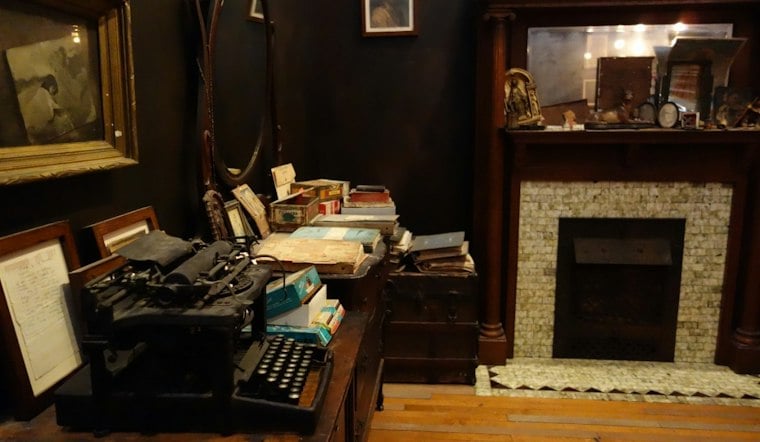
For decades, the fate of one of Chicago's strangest artistic legacies sat quietly in a trunk inside a Lincoln Park apartment. Now a federal jury will decide who actually owns it. Henry Darger, the reclusive janitor who secretly filled his one-room home at 851 W. Webster Ave. with hundreds of watercolors and a 15,000-page fantasy novel, left no will when he died on April 13, 1973. More than fifty years later, his distant relatives and his former landlords are headed to trial over who legally controls his art, his writings, and the valuable copyrights and trademarks tied to his name.
U.S. District Judge Thomas Durkin has set March 8, 2027, for the jury trial, which is expected to last about a week, according to the Chicago Sun-Times. The case pits Darger's estate against Kiyoko Lerner, whose late husband Nathan Lerner was Darger's landlord, after a 2022 federal lawsuit accused the Lerners of falsely claiming the reclusive artist had gifted them his life's work, according to court records.
Darger never married and had no children, and he was completely unknown as an artist during his lifetime, the Sun-Times reports. The Lerners were his landlords from roughly 1960 to 1973, and after he moved into a Catholic nursing home, they kept possession of his paintings, manuscripts, journals and personal records. Nathan Lerner died in 1997, but Kiyoko Lerner, who now lives in Japan, went on to sell, reproduce, donate, exhibit and license Darger's work for decades afterward.
A Disputed Gift From a Dying Man
At the center of the case is a claim that Kiyoko Lerner testified Darger told Nathan Lerner he no longer wanted his art and that Nathan could have it. But the court has ruled that whether that exchange actually constituted a legal gift is a question only a jury can resolve, since the evidence supports more than one interpretation of Darger's words, according to VitalLaw.
The same ruling found that Darger leaving his belongings behind when he moved to the St. Augustine Home for the Aged in December 1972 does not, on its own, prove he meant to abandon them. Whether abandonment occurred is likewise left for the jury to decide, per the same account. Darger's death certificate lists senility as a cause of death, and Judge Durkin has ruled that diagnosis is relevant to the case but does not by itself establish that Darger lacked the legal capacity to make a gift, the Sun-Times reports.
Alan Jay Mandel, the attorney representing the would-be heirs, is considering calling a mental-health expert to testify at trial. Ron and Fawn Slattery tracked down a potential Darger relative in 2019, laying the groundwork for the estate's claim; Ron Slattery died earlier in 2026. The Slatterys said in 2022 that they believed the former landlords should not profit from Darger's talent, while Kristin Klein said that same year she believed Darger's relatives deserved part of his estate.
From Forgotten Trunk to Museum Walls
Supporters of the Lerners counter that Darger would likely have remained unknown without their efforts to preserve and publicize his work. The Lerners worked with the Hyde Park Art Center to mount Darger's first exhibition in 1977, according to The Art Newspaper, a show that helped launch his posthumous reputation as one of the defining figures of outsider art.
That reputation has since translated into serious money. Kiyoko Lerner sold at least 22 Darger pieces to the American Folk Art Museum in New York for a total of $1 million in 2000, the Sun-Times reports. Darger's work is now estimated to be worth millions of dollars overall, and a single illustration from In the Realms of the Unreal regularly sells for $200,000 to $400,000 — and has fetched as much as $750,000, according to court filings cited by courtlistener.com. A separate Darger painting offered through Christie's carried an estimate of $400,000 to $600,000, per ARTnews.
His pieces now hang in major institutions, including the Art Institute of Chicago, the Intuit Art Museum and New York's Museum of Modern Art. A distant relative, Christen Sadowski, was approved as administrator of Darger's estate in June 2022, formalizing the family's pursuit of the art and copyrights that had spent decades in the Lerners' hands. When the jury finally convenes next March, it will have to untangle more than fifty years of ambiguity to decide who, if anyone, Henry Darger meant to leave his strange and valuable world to.


