

























































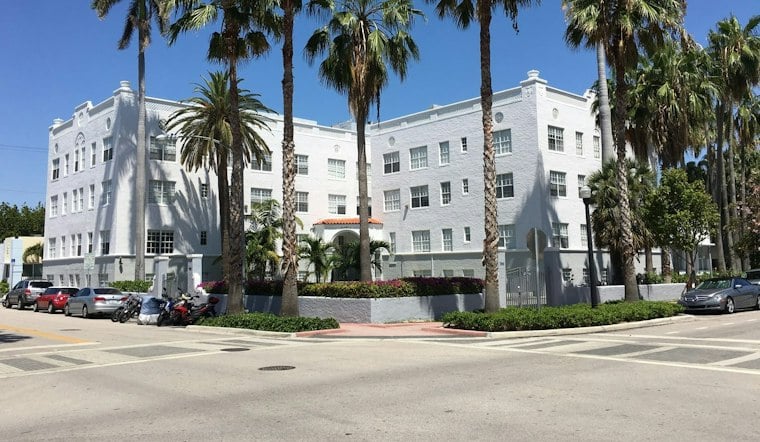
A 112-unit apartment community aimed at teachers, nurses, first responders and other workers priced out of South Florida's housing market has officially opened in unincorporated South Miami-Dade. Beacon Hill at Princeton, located at 23855 and 23955 South Dixie Highway, reserves every one of its units for households earning no more than 120% of area median income, with rents starting at $1,850 per month.
The project's developer, Beacon Hill Development Group, describes it as Florida's first ground-up Live Local Act development to go from concept to completion, according to Florida YIMBY. The company has separately described Beacon Hill as the first project in Miami-Dade County to be fully conceived, designed and approved under the law and ready to break ground, per its own account on the Beacon Hill Development Group website. As Florida Politics reported, the development was planned under the Live Local Act from the outset.
Construction on the two three-story buildings began in June 2025 and wrapped roughly 14 months later, with an official ribbon-cutting held on November 5. The complex sits on 2.6 acres and contains 41 one-bedroom units measuring about 621 square feet and 71 two-bedroom units measuring about 914 square feet, the same Florida YIMBY report notes. Beacon Hill's stated development cost is $20 million, according to the Miami Herald.
Income Limits and Amenities
Florida law defines workforce or affordable rent as income capped at 120% of area median income, and for Miami-Dade County, the Florida Housing Finance Corporation's 2026 schedule sets that threshold at $114,480 for a one-person household and $130,800 for a two-person household, effective May 1. Beacon Hill's leasing website advertises in-unit laundry machines, quartz countertops and stainless steel appliances, and the community includes a pool, a gym and 145 parking spaces, per Florida Politics reporting.
Beacon Hill CEO Matt Martinez said all 112 apartments are dedicated to workforce housing and that the project was built in the spirit of the Live Local Act, telling Florida YIMBY that working people deserve affordable homes near jobs, schools and communities. Martinez also said, per Florida Politics, that Beacon Hill was especially proud to exceed the law's baseline affordability requirement — the Live Local Act requires developers to reserve 40% of units at the specified affordability rate to qualify for its benefits, and property owners must maintain that threshold for 30 years. Still, Martinez was candid about scale, saying 112 apartments would not solve the housing shortage but that the project represents progress.
State Officials Turn Out for Opening
The November 5 opening drew attention from Tallahassee. State Sen. Alexis Calatayud, who sponsored the Live Local Act in the Senate, attended and said the law aims to let people live near where they grew up, work and send their children to school, according to Florida Politics. Rep. Ana Maria Rodriguez, who co-sponsored the law, was represented by Christine Del Portillo. Gov. Ron DeSantis signed the Live Local Act in 2023, and Rep. Vicki Lopez carried it in the House.
Letters of congratulations arrived from Washington as well. U.S. Sen. Rick Scott, represented at the opening by Mary Carmen Davila, wrote that the opening marks an investment in Homestead and will help Florida families access safe, high-quality housing. Florida Attorney General Ashley Moody, represented by Daniel Zuñiga, described the opening as the first completed Live Local Act project in Florida, according to the same Florida Politics account.
A Tiny Dent in a Big Gap
The celebration comes against a backdrop of stark numbers. Miami-Dade has an estimated shortfall of roughly 17,000 workforce homes, and the gap for low-income housing — defined as households earning under 80% of area median income — sits at about 90,000 units, according to the Beacon Hill Development Group's own account of local housing data. A Florida State University DeVoe L. Moore Institute study was separately reported as finding that South Florida needs more than 30,000 new housing units just to meet current demand, per the same source.
The gap between Live Local proposals and projects that actually break ground is wide. Developers have proposed more than 200 Live Local projects statewide, but fewer than 20 had broken ground, according to Florida Housing Coalition figures cited by Beacon Hill Development Group. Florida Politics, citing the South Florida Business Journal's own citation of the same coalition, reported that developers had proposed 228 Live Local projects totaling more than 68,000 apartments statewide, with just 25 having broken ground as of the week of publication. Separately, none of the high-rise, high-density Live Local projects in Miami-Dade discussed in the Beacon Hill account had begun construction or announced a start date at the time of that reporting.
Other Live Local Projects in South Florida
Beacon Hill is not the only Live Local-linked project to reach residents recently. Laguna Gardens, a 341-unit garden-style apartment development in Miami Gardens, received its temporary certificate of occupancy and began move-ins, according to South Florida Agent Magazine, which described it as among the first in Florida to be developed under the law. That project was originally planned as 341 market-rate apartments before developer Cymbal DLT retooled all of the units to meet Live Local's income limits before construction finished, per the Beacon Hill Development Group account.
The Dune in Boynton Beach has also been described, in that same Beacon Hill account, as South Florida's first mixed-income Live Local project to reach construction, with plans for 298 apartments and 38 townhouses, 59% of them set aside for residents earning 120% of area median income or below and the rest at market rates. Beacon Hill Development Group acquired the Princeton property for $2.55 million in 2024 and obtained a $17 million construction loan, according to the South Florida Business Journal's reporting cited by Florida Politics. The firm's development partner on the project is L.M. Sandler & Sons, an affiliate of Wakefield Development; CTD Architecture designed the buildings, and Coastland Construction, based in Pinecrest, built them. Martinez told the Business Journal that the company used Live Local's financial incentives and faster approvals without requesting additional height or density allowances, and the project received site approval in six months. Beacon Hill Development Group says it aims to build 1,500 workforce apartments across Florida over the next five years, with additional projects already underway in Miami Gardens and Boynton Beach.
Debate Over the Law Continues
Not everyone is satisfied with how the Live Local Act is playing out. Developer Russell Galbut has cited local resistance to Crescent Heights' proposals, after that company pulled three Miami Beach tower proposals from consideration last month. Lopez, per reporting from WLRN cited in Florida Politics, has said the law needs reform to add protections for barrier islands. More broadly, proponents say the law can boost housing inventory amid scarcity and rising costs, while detractors contend that preempting local control can produce construction that clashes with surrounding neighborhoods and that the affordability provisions still fall short of what working Floridians can afford. Qualifying developments on eligible land can receive administrative approval without the usual public hearings — a provision Miami-Dade County's own March 2026 memo confirms applies to qualifying Live Local projects, which are not required to obtain rezoning. Lawmakers have updated the law every year since DeSantis signed it in 2023.



