

























































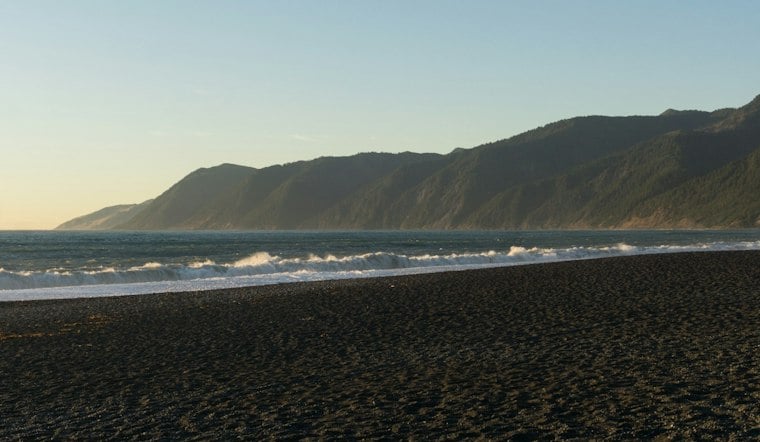
Local naturalist Kyle Keegan has documented birds and marine mammals gathering around schools of baitfish near shore in an extraordinary ocean feast unfolding right now along Shelter Cove's surf in Southern Humboldt County. The scene, visible from shore in recent days, has turned a stretch of coastline into a crowded wildlife buffet as seabirds and marine mammals converge on an unusually dense concentration of small fish near the beach.
According to a report from Redheaded Blackbelt, seabirds and marine mammals have gathered around an abundance of small fish near shore. Keegan's images show many birds in distant views.
A Warm-Water Surge Behind the Frenzy
Keegan attributes the nearshore concentration of baitfish to a warm-water surge associated with this year's El Niño, a pattern that is reshaping ocean conditions well beyond Humboldt County. NOAA's October marine heatwave forecast assigns an 80 to 100 percent likelihood of marine heatwave conditions off California and Baja California through early 2027, and the agency's California Current Marine Heatwave Tracker has said coastal marine heatwaves are expected to spread progressively northward as El Niño-driven warming develops over the coming months, the same report notes.
That same tracker reported that coastal temperatures from Northern California through Washington have fluctuated between below and above average recently, as upwelling periodically pushed colder water toward the surface. Meanwhile, NOAA's Climate Prediction Center expects a strong to very strong El Niño to remain likely through January to March of 2027, underscoring that the Shelter Cove gathering is unfolding amid a broader, months-long climate pattern rather than a one-off event.
Record Warmth Creeping North
Weather West reported record-warm ocean temperatures extending north to Point Reyes or possibly Point Arena in Mendocino County, as cited in the same account from late October. Further south, Weather West reported that MBARI researchers had detected the first signals of an extreme El Niño in Central California, including an influx of warm water and sightings of southern species, and attributed record-breaking coastal water levels primarily to thermal expansion of seawater combined with a coastally trapped Kelvin wave.
The warming trend's reach is also showing up far to the south. The Los Angeles Times reported that unusually warm Pacific waters have been bringing tropical species, including bullet tuna, mahi-mahi and wahoo, to Southern California's coast. NOAA fish biologist Owyn Snodgrass told the paper that the arrival of such unusual species indicates the entire ecosystem has shifted.
Echoes of a Decade-Old El Niño
The scale of change is visible in the numbers anglers are reporting farther south. Dana Wharf's last comparable yellowfin tuna catch occurred in 2014 and 2015, when the water was similarly unusually warm and the company caught nearly 10,000 fish, the Los Angeles Times reported. Through September this year, commercial passenger fishing vessels had caught 10,980 yellowfin tuna and 2,440 skipjack tuna, compared with 101,610 yellowfin and 9,200 skipjack by the same point in 2014 — though a preliminary analysis cited by the paper also found 25 percent fewer anglers making trips on boats like the Dana Pride than in 2015.
NOAA Fisheries says El Niño can change where fish and other marine animals are found, and the agency has identified risks that can accompany these shifts, including harmful algal blooms, emaciated sea lion pups and potentially more whale entanglements, according to the same Redheaded Blackbelt account.
Why Sea Lions and Whales Team Up
The pairing of sea lions and humpback whales seen off Shelter Cove echoes patterns documented elsewhere on the California coast. Research covered by Discover Wildlife found that across 1,808 lunge-feeding events in Monterey Bay, humpback whales foraging alongside California sea lions showed a 23 percent higher feeding rate and 16 percent shorter intervals between feeding lunges. Researchers suggested the sea lions may help bundle anchovies into denser bait balls that whales can capture more efficiently, though it remains uncertain whether whales actively track sea lion activity or whether both predators simply converge on the same schools of fish.
A related study indexed at doi.org noted more broadly that marine predators frequently form temporary multi-predator feeding aggregations around dense patches of prey, a dynamic that appears consistent with the mixed gathering of birds, pinnipeds and whales now crowding the water off Shelter Cove.
For now, Keegan has recommended a drive to the ocean for anyone hoping to witness the wildlife activity firsthand, with the feeding frenzy still unfolding along the Humboldt County shoreline.



