

























































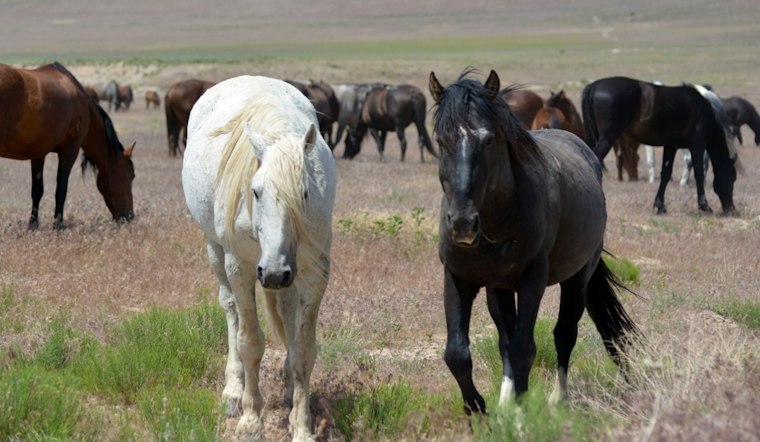
Helicopters are once again working the skies above Tooele County's Cedar Mountain range, pushing wild horses toward corrals as the Bureau of Land Management carries out its first gather of this herd in roughly four years. The agency says the Cedar Mountain Herd Management Area near Dugway is now home to about 660 horses, far more than the land can support, and crews plan to remove around 500 of them.
The gather, which KSL reports is underway near Dugway, comes as the BLM says the area's appropriate management level is only about 200 to 400 horses. FOX 13 similarly reported the BLM's target range at 190 to 390 horses against a current population estimated at roughly 660, with the agency citing drought and rangeland-health concerns in authorizing the operation. A Bureau of Land Management announcement indicates its Salt Lake Field Office issued a decision record authorizing the gather and removal of up to 500 wild horses from the area.
Chad Hunter, who leads the BLM's wild horse and burro program in Utah and has worked with the animals for more than 50 years, said the math behind these gathers is unforgiving. Left unchecked, he said, horse numbers can double in about four to five years. Tami Howell, a BLM wild horse and burro specialist, said that without management, the herd's body condition suffers and the range itself deteriorates.
Why Officials Say the Range Can't Keep Up
Hunter said removing horses is meant to bring animal numbers back in balance with available habitat, protecting both the horses and the land they depend on. When numbers climb too high, he told FOX 13, “the forage gets too small and the cover and the space, basically habitat, then these horses can lose body condition, their health can go down.” The BLM has said the previous roundup in this specific area took place about four years earlier.
Per the same FOX 13 report, pilots use a pressure-and-release method during the gather, intended to ease stress on the animals as they're moved. KSL describes the roundup process as relying on a helicopter to drive horses into chutes and a corral. Once captured, the horses get food and water at a temporary holding site before being hauled to corrals near Delta and Axtell, where veterinarians examine them ahead of adoption or other placement, according to KSL.
A Small Team Managing Fertility Control Across Hundreds of Horses
Not every effort to manage the herd involves a helicopter. Jan Drake, executive director of Wild Horses of the West, regularly visits the range to help administer dart-based birth control to mares, working alongside the BLM. She says just four people currently handle fertility-control work across a herd numbering in the hundreds, and that rugged terrain and the difficulty of approaching Cedar Mountain's horses limit how many mares can actually be treated, per the BLM.
Fertility-control workers have concentrated their efforts on one section of the herd, and Drake said that targeted area now has an appropriate share of treated mares while still allowing enough births to maintain genetic diversity. Since 2023, the BLM and its partners have conducted more than 100 dart-based fertility-control treatments, FOX 13 reported. Drake said she wants to see wild horses remain wild and stay on the range, but in numbers the land can sustainably support — and she's said she simply enjoys showing people the wild horses of Utah's west desert.
Opposition and a Pattern Across Utah's Desert Herds
Animal advocacy groups have pushed back hard against both the roundups and sterilization efforts, calling them cruel and inhumane, and such groups have filed lawsuits this year seeking to halt BLM plans. The Cedar Mountain operation is not an isolated case: Utah has nearly 5,000 wild horses and burros spread across 19 BLM herd management areas covering roughly 2.5 million acres, according to FOX 13.
A similar gather played out this past summer at the Confusion Herd Management Area in central-western Utah, where the BLM began removing horses on Aug. 24 from a herd described as just under 500 animals, aiming to gather about 360 against a management level of 70 to 115, as reported by Deseret News. A BLM public affairs specialist told that outlet a wild horse herd can nearly double in size roughly every four years — echoing Hunter's account of the Cedar Mountain numbers.
Cedar Mountain itself has been through this before. A 2022 roundup in the same area, detailed by the American Wild Horse Campaign, concluded with 638 horses captured and eight deceased, after the BLM had estimated the population at 938 horses that year. Wild Horse Education separately reported that a single day of operations at the Dugway military proving ground that September saw 78 horses captured and four deaths. The current gather's outcome, including how many horses are ultimately removed and where every animal ends up, has not yet been reported.





