

























































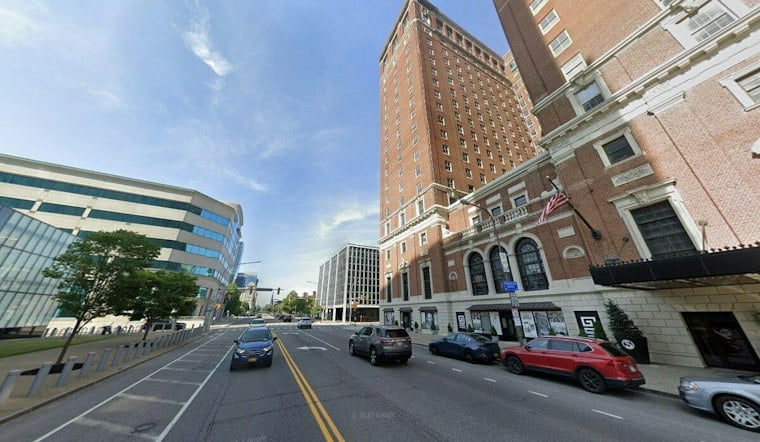
Buffalo developers are seeking New York State help for downtown redevelopment projects.
Buffalo's city government and developers are seeking aid for downtown projects, according to a report from The Buffalo News.
State Support for Downtown Revitalization
The push comes amid state investments and revitalization programs.
Kyle Ciminelli is president of Ciminelli Real Estate Corporation. Downtown redevelopment discussions include historic-building and Statler projects.
The Statler's Widening Funding Gap
The Statler project is valued at $140 million, and Jemal has requested up to $30 million in state aid, according to the Buffalo News.
A Proposed Conversion at 10 Fountain Plaza
A proposed Ciminelli conversion at 560 Main Street, also known as 10 Fountain Plaza, would create about 160 apartments.
The Norstar/10 Fountain Plaza project received a $1 million grant through the state-administered County Infrastructure Grant Program, launched in 2024.
What's Planned for the Remaining Commercial Space
The building is in a city accustomed to brutal winters.
How Other Rust Belt Cities Have Closed the Gap
Buffalo's predicament is not unique among mid-sized American cities wrestling with half-empty office towers. In downtown Pittsburgh, officials have quantified the exact problem developers describe: Pittsburgh Downtown Partnership official Cate Irvin said there is a disconnect of about $162,000 per apartment between development costs and what rental income can support, according to the Pittsburgh Post-Gazette. Construction alone makes up between 62% and 77% of a project's development budget downtown there, and five conversion projects totaling 356 apartments ran up nearly $146 million in construction costs.
The payoff for Pittsburgh has been real, though incomplete: buildings that opened since 2020, nearly all office-to-residential conversions, are 94.6% occupied, compared with 93.1% for older apartment stock, even as the city's downtown office vacancy rate sits at 18.9%, or roughly 4.5 million square feet. Downtown Pittsburgh's population has reached 7,307 residents, about 49% of the way toward a 15,000-resident goal, and the city overall grew to roughly 307,000 residents as of the July 2025 census.
Cleveland leads the Midwest in office-to-residential conversions with 4.5 million square feet converted, according to a study reported by Crain's Cleveland Business.
Hartford offers perhaps the closest parallel to what Buffalo developers are asking for: public financing that actually closed a gap. A developer completed an $84.5 million conversion of Hartford's former Bank of America building into 285 apartments in 2015, backed by a $17.7 million low-interest loan from the Capital Region Development Authority, according to Hartford Business Journal. More recently, Spinnaker completed a roughly $67 million conversion of a former state office complex at 55 Elm St. into 160 apartments. Hartford officials have since identified up to seven underused downtown office properties that could accommodate between 1,200 and 1,500 more apartments, with Economic Development Director Jack Benjamin noting that only about 40% of downtown Hartford's roughly 7 million square feet of office space is currently occupied.
Whether Buffalo's developers get a similar lifeline remains an open question. For now, downtown developers are waiting to see what Albany decides.




