

























































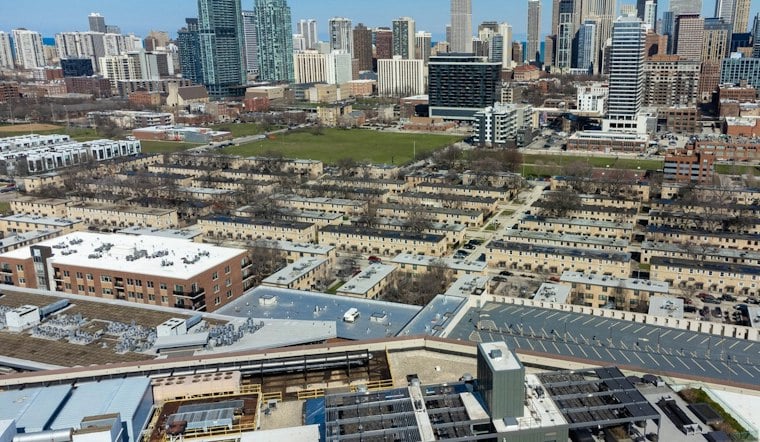
The Chicago Housing Authority has released its final blueprint for redeveloping the last of the land once occupied by Cabrini-Green, calling for approximately 4,100 mixed-income homes spread across 43 acres and 16 former public-housing sites on the Near North Side. The framework, known as Cabrini NOW, divides that land into four distinct zones — Rowhomes, Division, Larrabee and Sedgwick — each with its own mix of building types, unit counts and green space.
A Framework Years in the Making
According to the Chicago Housing Authority, the final report outlines the development framework for the approximately 43 acres of CHA-owned sites remaining for redevelopment in Cabrini. As Chicago Construction News reports, the plan is intended to guide the next redevelopment phase across the remaining CHA properties in the area. CHA says the document followed a year-long planning and community engagement process involving hundreds of residents, developed alongside the Cabrini-Green Local Advisory Council, the Near North Unity Program, the 27th Ward and city agencies.
The agency notes it held three community meetings and roughly 30 stakeholder meetings and engagements during that process, with a draft version open for public comment from May 30 through June 15, 2025, per CHA's own announcement. CHA has said the review and approval process needed to finalize the report was delayed during an extended leadership transition period for the agency.
Four Zones, Different Scales
Per details reported by ChicagoYIMBY, the Rowhome sites are planned for roughly 1,100 new units and 400 parking spaces spread across townhomes and low-, mid- and high-rise buildings, with a handful of existing rowhomes retained and renovated rather than demolished. The Sedgwick sites would hold around 650 units in mid- to high-rise buildings, while the Division sites are slated for about 1,000 units, mostly in mid- and high-rise construction, plus roughly an acre of new public open space. The Larrabee sites, spanning six parcels, would bring around 1,200 units and an additional acre of green space, primarily through low- to mid-rise buildings.
Chicago Construction News reports that the plan calls for preserving and rehabilitating vacant historic rowhomes elsewhere in the footprint, and that the proposed housing mix ranges from townhomes to taller residential buildings depending on the site. The same outlet notes the framework also calls for community programming recognizing Cabrini-Green's history and legacy.
Parks, Sidewalks and a School Route
Green space is a recurring theme in the final framework, which identifies about 9.1 acres of new public open space citywide, per Chicago Construction News. The Rowhome sites plan specifically calls for extending Durso Park toward Seward Park, the same ChicagoYIMBY report notes, creating a unified seven-acre park. Chicago Construction News adds that the green corridor connects Durso Park, the Jesse White Community Center and Seward Park, and that planned street improvements include rebuilding sidewalks and establishing safer routes around Skinner North Elementary School.
The Court-Mandated Housing Mix
Any new construction in the Cabrini footprint still has to answer to a federal consent decree. According to CHA, the court requires that 33% to 40% of units be designated CHA housing, with no more than 20% as affordable housing and no more than 50% as market-rate — a structure the final framework adopts directly, designating 33 to 40 percent of units as CHA housing while capping affordable units at 20 percent and market-rate units at 50 percent.
That legal backdrop traces back decades. A 1969 federal judgment in the long-running Gautreaux litigation found that CHA had engaged in a pattern of racial discrimination in selecting public-housing sites and ordered a comprehensive remedial plan, according to a U.S. District Court for the Northern District of Illinois opinion published via Justia. A 2000 court authorization allowed revitalization of the Cabrini-Green site.
What Officials Are Saying
CHA official Keith Pettigrew framed the stakes in blunt terms, according to Chicago Construction News: “Every year that CHA-owned land sits vacant in Cabrini-Green, it's a cost to the families waiting to come home and to a city that needs housing.” Pettigrew also said the framework establishes development expectations for prospective partners and provides a basis for moving projects forward, the outlet reported.
Next Steps and a Rocky Recent History
CHA plans to begin applying for zoning changes and releasing site-specific solicitations for development partners on the first sites throughout 2027, according to the agency's own account. Any partners will be recommended by CHA and the Near North Working Group, but will still need approval from the CHA Board of Commissioners, Chicago Construction News reports.
The push for new partners comes after past financing setbacks on the same ground. A Hunt Development Group-led team walked away from a deal in August 2024 after failing to secure financing, according to the Chicago Sun-Times. That outlet also reported that an earlier partnership had pursued 480 units in mid-rise buildings but could not line up financing. David Block of the newer Cabrini New Vision team cited shifting tariff policies and persistent interest-rate pressure as factors complicating construction costs and said the team sought to avoid similar financial pitfalls. A newer proposal known as Cabrini New Vision, approved by CHA, calls for about 450 apartments across four buildings — at least 180 of them CHA-subsidized — plus roughly 75 condo and townhome units, developed in five phases over a proposed five- to six-year timeline, per the Sun-Times.
CHA says it has brought back more than 3,500 homes to the community since the early 2000s, a tally that separate reporting from Construction Connect put at 3,500 rental and saleable units across 25 mixed-income sites, including 1,226 low-income units and 867 affordable units. That same report detailed Parkside Phase 5, a 99-unit project across four buildings with a community and fitness center, part of the broader rebuild that began in 2000 under former Mayor Richard M. Daley's Plan for Transformation after the last Cabrini-Green high-rises came down in 2011.
Figures on the overall size of the master plan have shifted slightly in public reporting — the Sun-Times described an earlier version of the Cabrini Now plan as calling for 4,080 mixed-income units across roughly the same 43 acres, while the finalized framework and ChicagoYIMBY both cite approximately 4,100 units.





