

























































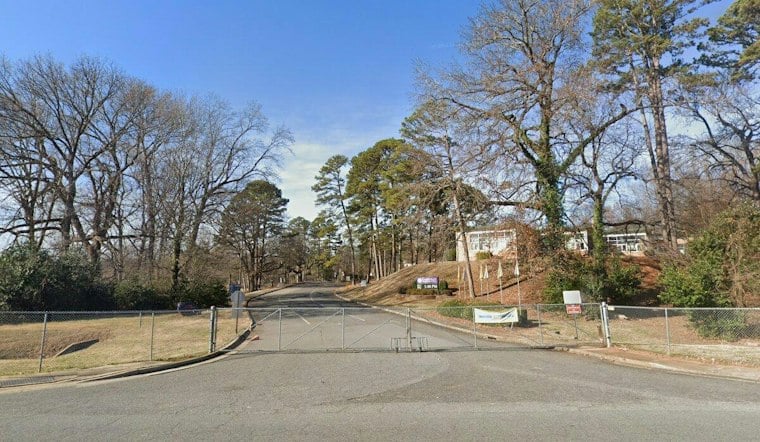
Sasha Vater's son has an autoimmune thyroid condition, and when his physician recommended an independent environmental assessment of his classroom in September, she decided she wasn't going to wait on Charlotte-Mecklenburg Schools to do it for her. “The school wouldn't do it right, so I did it,” Vater said. In October, she commissioned her own mold testing at Chantilly Montessori, the roughly 300-student school on East Independence Boulevard where her son is enrolled.
The results, according to the Charlotte Observer, came back far from reassuring. Dust samples pulled from her son's classroom and another classroom were sent to EnviroBiomics, a Texas-based laboratory, and returned ERMI scores of 20.4 and 24.4 — numbers the lab classified as very high. That stood in stark contrast to what CMS had told families two months earlier: that its own assessment, conducted after the district hired an outside contractor to perform air sampling on August 28, found no visible active mold growth or other conditions of concern, and that humidity levels were within an appropriate range.
Vater began contacting school and district officials in August, months before she ultimately paid for the outside testing herself. “I did everything I could possibly do to get the school system to help,” she said. Her frustration, she said, grew out of a lack of clear answers. “When they're not giving you information, you fill in the blanks,” Vater said.
What the ERMI Scores Actually Mean
The ERMI test Vater used analyzes a dust sample for 36 mold species and produces a single relative score, according to EnviroBiomics. But the lab is explicit about the limits of that number: the scores indicate relative moldiness within the sample itself, not whether a building is safe to occupy. “They do not establish whether a building is safe to occupy,” the lab states, adding that “ERMI is an environmental analysis and does not diagnose disease.”
The underlying index behind the ERMI score, the EPA Moldiness Index, was designed for research use and has not been validated for routine use in schools or other buildings, per the same reporting. Laboratory interpretations tied to the test results caution that they cannot establish whether mold is actively growing, where it may have originated, or whether it affected any student's health. Separately, third-party testing at the school found that indoor airborne mold concentrations were significantly below outdoor levels at the time of sampling — a data point that complicates any simple narrative in either direction.
A Teacher's Account of Sweltering Classrooms
Vater's push for outside testing surfaced alongside accounts from a former Chantilly teacher. Nathalie Thompson, who began teaching at the school in 2024 and did not renew her contract for the 2026-27 school year, said her classroom temperatures ranged from 80 to 95 degrees over six consecutive weeks in March. She warned families to send their kids with extra water and changes of clothes, and said administrators reprimanded her for sending that message home.
Thompson said a request for portable heating and cooling units was denied. She later found her classroom had reached 80 degrees again in August, and that it hit 92 degrees during the school's open house week that same month. Chantilly principal Sandra Noel acknowledged building problems with the heating and cooling systems on August 24, and said a supplemental cooling unit had been ordered; Noel also said classrooms could be temporarily moved to cooler spaces or provided with fans in the meantime.
CMS's Response and the Testing Timeline
CMS associate superintendent of operations Nicole Portee said the district's environmental health team assessed temperature, humidity, and conditions conducive to mold growth on August 31. That team observed dust on air distributors and intakes during its visit. CMS has said it selected its testing locations based on maintenance work orders submitted by school staff, and that additional cleaning had been completed in certain areas by October.
The district did not respond to requests for comment on the conditions at the school, its testing methods, or its plans for addressing parents' concerns.
A Building Nearing the End of Its Life
The Chantilly Montessori building dates to 1951. The school is scheduled to move into a renovated building in August 2027, after which the existing campus is slated for demolition. That timeline means whatever is resolved — or left unresolved — about air quality and temperature control in the current building will likely be a moot point for future students, even as the current cohort finishes out the building's final stretch.
Chantilly is not the only CMS school where mold concerns have surfaced in recent years. At Clear Creek Elementary in 2024, the district confirmed it was aware of mold reports and had initiated professional cleaning procedures, with a CMS representative saying there were “no indicators that conditions are unsafe for students or staff,” according to WBTV. And Mecklenburg Health Department inspections of Providence High cited moldy ceiling tiles in 2014, 2015 and 2016, though a March 2017 inspection noted water-damaged ceiling tiles without flagging mold, according to earlier Observer reporting on that case. Those episodes don't resolve what's happening at Chantilly today, but they reflect a pattern of mold and water-damage complaints surfacing across the district over more than a decade.
For now, Vater is left holding two lab reports with alarming numbers and a district that insists its own inspection turned up nothing of concern. Neither set of findings, on its own, settles the question of whether the building poses a health risk — but for a mother whose son has an underlying health condition, the uncertainty itself has become the problem.





