

























































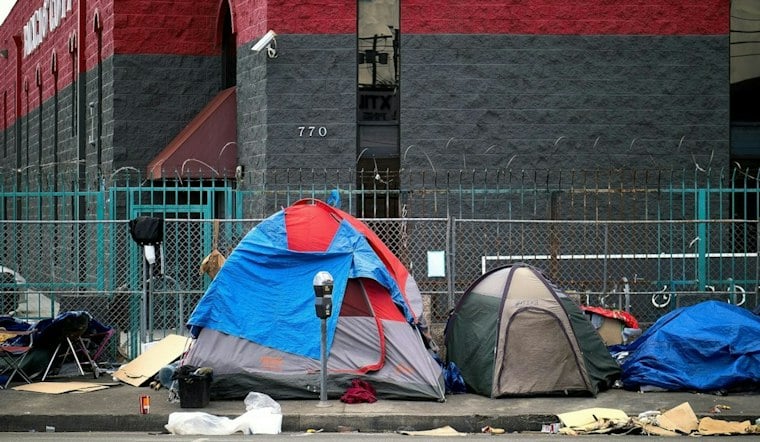
Chula Vista's City Council wants city staff to study banning homeless encampments everywhere within city limits, including on private property, a shift that would go far beyond the buffer-zone rules the city adopted two years ago. Councilmember Jose Preciado is pushing the idea, arguing that property owners currently have no way to force encampments off their own land under existing law.
The council reached consensus Tuesday to have staff consider a new ordinance banning all encampments citywide, according to the San Diego Union-Tribune. That consensus does not amount to passage of a new law — it directs staff to examine the proposal as part of the city's first homelessness strategic plan, with a council workshop expected in early 2027 and a draft plan due by mid-2027.
Why the Current Rules Fall Short, Supporters Say
Preciado said the current rules cannot reach encampments on private property.
He said a citywide ban would give police a clearer tool to disperse encampments when property owners call for help, and that the proposed expansion is specifically meant to address encampments sitting on private lots. Preciado also said some owners have faced severe property damage that could force a sale just to fund cleanup, and that others may need to spend tens of thousands of dollars on hazardous-material remediation. He added that the actions being pursued are not intended to punish the community.
Private Property Enforcement Gaps
The city currently has five active code-enforcement cases involving encampments on private property.
The council also agreed to have staff study shallow rent subsidies as a tool for preventing homelessness before it starts.
A Falling Count, and a Recent Freeway Deal
The debate comes as Chula Vista's unsheltered population has dropped sharply. The city's unsheltered count fell about 24.5%, from 470 people in 2025 to 355 in 2026, according to the city. That mirrors a broader countywide trend: the January 2026 point-in-time count found street homelessness down 11% year-over-year across San Diego County, alongside a 12% increase in people staying in shelters, per Voice of San Diego.
Tuesday's discussion follows a separate move in September, when the council voted 5-0 to approve an Encampment Delegated Maintenance Agreement with Caltrans, allowing the city to clear encampments along roughly 3.2 miles of Interstate 5 between Main Street and E Street, the Union-Tribune reported. Caltrans agreed to reimburse the city up to $200,000 for cleanup costs through June 2027.
How Other California Communities Handle Encampments
Chula Vista's push to tighten its rules sits against a backdrop of wildly inconsistent policy statewide. A CalMatters review found California cities and counties take sharply different approaches to clearing encampments, with some lacking any formal policy at all — Mendocino County, for instance, has no encampment management policy and does not track removals.
Other jurisdictions have adopted detailed procedural rules. San Diego limits removals to daylight hours and requires at least 24 hours' notice, with confiscated belongings photographed, logged and stored for 90 days. A legal settlement requires Chico to confirm enough shelter beds are available before a clearance and to give residents a seven-day warning followed by a 72-hour notice, while Santa Cruz County's draft policy would put removal decisions under its county executive office and require 90 days of storage for seized property. CalMatters also notes the next round of state homelessness funding, expected in the 2026-27 budget year, is anticipated to require cities and counties to adopt their own encampment policies to qualify.




