

























































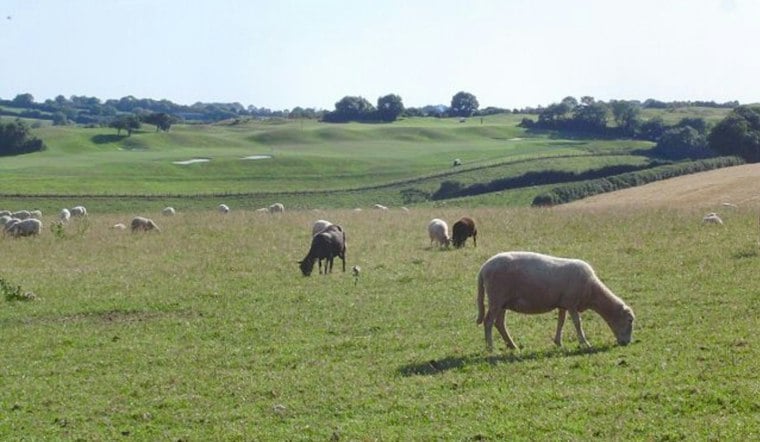
A sheep named Kiki can't walk, but a motorized wheelchair could give her greater independence and make it easier for her to move around. At a small nonprofit sanctuary in Dartmouth, Massachusetts, founder Deb Devlin spent years building Kiki a motorized, joystick-controlled wheelchair, and the sanctuary says she's the first animal in the world to use this kind of technology.
A Sanctuary Built Around Animals With Complex Needs
The sanctuary, called Don't Forget Us, Pet Us, currently cares for 40 rescued farm animals, according to Boston 25 News. It's a 501(c)(3) organization run entirely by volunteers, and its focus is specifically on animals with disabilities and complex medical needs — including Kiki, who is unable to walk on her own.
Kiki’s wheelchair story began with a different kind of device: after the sanctuary took her in at 11 days old, a New Hampshire company donated a full-support wheelchair that helped her stand during therapy. The joystick-controlled chair is a later step—from being supported by a cart to steering one herself. That earlier wheelchair was intended to help Kiki work toward walking, a goal her therapists hoped she might eventually reach. CBS Boston’s 2022 account of her first wheelchair documents that earlier chapter.
Devlin is the one who founded the sanctuary, and she's also the one who spent years developing Kiki's wheelchair. The sanctuary's website states that Kiki's journey helps other animals and inspires rehabilitation patients worldwide to use adaptive equipment, per the same report.
Kiki’s condition has also been linked to Cache Valley virus, a mosquito-borne infection that can affect lambs before birth. In sheep, infection during pregnancy can result in stillbirth or congenital abnormalities affecting the nervous system and musculoskeletal system. That background helps explain why Kiki’s needs have involved more than a mobility aid: her early care included support and therapy as well as equipment. The Washington Post’s account of Kiki’s condition and the Merck Veterinary Manual’s overview of Cache Valley virus in sheep describe that connection.
What Comes Next for Kiki
Devlin isn't stopping at a joystick. Per a Facebook post cited in the report, she hopes to explore head-array technology for Kiki next — a system that would let the sheep steer her wheelchair using sensors activated by small head movements instead of a joystick.
Animal mobility carts are used beyond farm sanctuaries, though research has largely focused on companion animals and carts that caregivers operate or fit. A 2024 survey-based study of dogs, cats and rabbits found caregivers reported improved ability to perform daily activities, while 64% also reported at least one complication, most often a wound. The study did not examine sheep or self-steered powered chairs, so it offers context—not a direct measure of Kiki’s device or its risks. The University of Florida researchers’ study in Frontiers in Veterinary Science details those findings and limitations.
That kind of upgrade could give Kiki even more independence and make getting around simpler. The sanctuary accepts donations through its website to help support the rescued animals in its care, including Kiki and the 39 others who call the Dartmouth farm home.





