

























































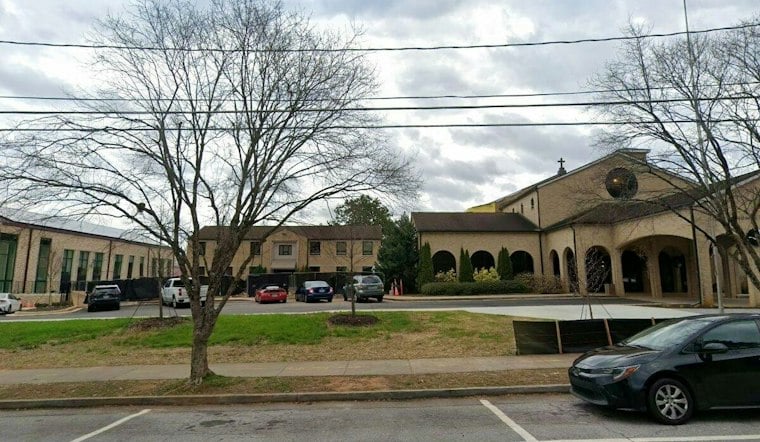
Students at St. Thomas More Catholic School in Decatur got a rare shot at talking directly to someone living 250 miles above Earth, connecting with astronauts aboard the International Space Station through old-fashioned ham radio. Seventh grader Petra Molchan spoke with Luke Delaney, pilot of NASA's SpaceX Crew-13 mission, and said the moment did more than satisfy her curiosity about space — it pushed her closer to a goal of becoming an astronaut herself.
The contact was arranged through ARISS, or Amateur Radio on the International Space Station, a program that lets students talk directly with crew members aboard the orbiting lab through amateur radio, according to CBS News Atlanta. Molchan said she was initially skeptical the astronaut conversation would even connect, but was excited once it actually happened. Heather Upton, a kindergarten teacher at St. Thomas More, said the Catholic Schools Office reached out to the school last May about the opportunity to speak live with an astronaut.
From there, St. Thomas More submitted a comprehensive proposal developed over the summer alongside four other schools, per the same CBS News Atlanta account. Separately, ARISS had confirmed scheduling for a radio contact between an ISS astronaut and students at the Archdiocese of Atlanta Catholic Schools based in Smyrna, Georgia, noting that four schools from four separate metro Atlanta counties were working together on STREAM activities ahead of the contact. ARISS said the combined student population across those four schools totaled 1,465, and that St. Thomas More specifically was focusing its studies on medical technology with support from the CDC and a major medical university.
A Ten-Minute Window Into Orbit
The contact itself was scheduled by ARISS for 11:34 a.m. Eastern on Nov. 19, with students set to ask their questions directly of astronaut Luke Delaney, whose amateur radio call sign is KJ5PPF. ARISS describes these exchanges as voice-only communications via amateur radio that typically run about 10 minutes, a tight window that puts pressure on students to make the most of their time on the line.
That preparation matters: according to the ISS National Laboratory, students choose their questions in advance and practice proper radio protocol and clear enunciation before ever keying the microphone. Decatur students used the project to learn about broader opportunities in science, technology, engineering and mathematics, and St. Thomas More students will continue learning about space throughout the school year, per CBS News Atlanta's reporting.
Other Metro Atlanta Schools Also Got Their Turn
St. Thomas More wasn't the only Archdiocese school on the line that day. WSB-TV reported that students from four Catholic schools in the Archdiocese of Atlanta took part in the live conversation with Delaney, after spending months studying STEM and space topics to get ready. At Saint Catherine of Siena Catholic School in Kennesaw, students asked Delaney everything from what Earth looks like from orbit to how astronauts stay healthy in space, the station reported.
Students at Saint Jude the Apostle Catholic School in Sandy Springs also chatted with astronauts on the ISS that day through the same long-distance ham radio link, as reported by Rough Draft Atlanta. At exactly 11:34 a.m., Saint Jude students in the school's STREAM program asked astronauts what it's actually like to do the job. Rough Draft Atlanta also noted that ARISS is a joint venture by NASA, the Center for the Advancement of Science in Space, the American Radio Relay League and the Radio Amateur Satellite Corporation, built specifically to facilitate these kinds of contacts between ISS astronauts and schools and communities around the world.
Why Schools Keep Lining Up For These Contacts
ARISS says it conducts 60 to 100 of these special contacts every year between students around the globe and ISS crew members holding ham radio licenses, a volume that underscores how competitive and coordinated the scheduling process can be for a single school district to land a slot. The program's founders have said the goal is to inspire students and encourage STEM learning and careers, a mission echoed by the ISS National Laboratory's description of the experiences as meant to spark engagement in STEM studies and interest in STEM careers.
For Upton, the payoff goes beyond rocket science. She said the program aims to interest and encourage students in STEM, space-related and other careers, and that the year-long project will help students connect with their broader community. For Molchan, the ten minutes on the radio already feels like a turning point toward the career she wants.





