

























































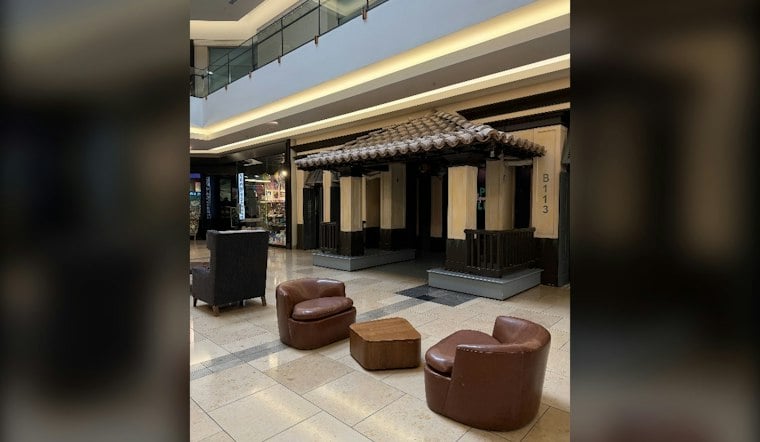
Zero Empty Spaces has turned the former Half Price Books storefront on Shattuck Avenue into a mix of artist workspaces and a retail marketplace. After the store sat empty for months, the organization divided the space into small studios where artists pay around $550 a month to make and sell their work. Its opening event included a ribbon-cutting, a pop-up exhibition and a musical performance; the group calls the Berkeley site its 35th location nationwide.
The Berkeley spot marks Zero Empty Spaces’ first retail arts marketplace, a shift from the studio-only model the organization has run elsewhere, according to Daily Cal. Evan Snow, the organization’s cofounder and managing partner, said the company divides large commercial properties into micro-retail spaces of 96 to 144 square feet, according to Snow. He described the operation as evolving into co-retailing hubs, retail incubators and retail marketplaces meant to serve creatives beyond painters and visual artists. Zero Empty Spaces is a national initiative based in South Florida that turns vacant real estate into affordable artist studios, and it was founded in 2019.
Rent and retail support
At the Berkeley site, rent includes utilities, insurance and internet, as well as marketing support, career development help and workshops on financial literacy, contract law and intellectual property. Zero Empty Spaces takes no commission on artists’ sales. Snow said the arrangement gives artists a store without requiring them to shoulder its operation alone.
Artists can rent studio space, display and sell work in the marketplace and take part in showcases. The open-concept layout differs from the private studios Zero Empty Spaces has used elsewhere, and some artists said that shared setup was a draw.
Working in a shared space
Sonoma County sculptor Paige Pedri said the shared space lets artists observe and learn from one another. San Francisco-based artist Jenny Situ described the open layout as a refreshing change that makes the studios feel communal rather than divided into separate rooms.
Dan Bach, a longtime Berkeley resident, retired math teacher and artist, applied to show mathematics-inspired art and geometric prints at the opening showcase. He said more viewers coming to appreciate his work is better, and that he hopes people will stop to ask about the mathematics behind his pieces so he can explain it. Bach said he misses teaching and enjoys the chance to explain mathematics to people who stop by his studio.
A downtown bet on shared retail
Visit Berkeley and the Downtown Berkeley Association support the project locally. Zero Empty Spaces says it hopes the marketplace will draw people downtown and support artists, small businesses and other creatives. Snow described the organization’s approach with the tagline “we’re unlocking closed doors to create new opportunities.”
An earlier account of the project from Berkeleyside described 24 cubicle studios inside the former bookstore, with sizes ranging from 96 to 156 square feet and most rents falling between $500 and $600 per month — a slightly different size range than the 96 to 144 square feet Daily Cal attributed to Snow. That earlier reporting also said the building’s owner was offering the Shattuck Avenue space at a discounted rate for an initial six-month run, and that limited ventilation at the site rules out sawdust-heavy woodworking, spray paint and epoxy resin pours. Artists knew they might need to move, per the same account.
Temporary studios can require a move
A separate account of the Legacy Place site in Palm Beach Gardens illustrates the uncertainty of temporary space: WLRN reported in September 2025 that more than 20 artists had to leave their studios by Sept. 26. The report said artists paid $3 per square foot, including utilities, for studios ranging from about 96 to 250 square feet, according to WLRN.
Part of a Bigger Pattern
Berkeley’s downtown has wrestled with storefront vacancies for years. The San Francisco Business Times reported a 10.8% ground-floor vacancy rate downtown, up from 5.1% in 2019 before the pandemic, while a city dashboard snippet lists downtown rates of 10.8% in 2023 and 10.9% in 2024 — figures that don’t line up exactly, suggesting the two sources may be measuring different timeframes.
Since its 2019 founding, Zero Empty Spaces has activated 34 spaces across five states, according to Berkeleyside; Daily Cal’s earlier reporting put the count at 35 locations. Snow told ICSC Exchange that many opportunities now come from property owners, public agencies and community groups. At Legacy Place, a Palm Beach Gardens shopping center, the organization converted a former day spa into studios for more than 20 artists beginning in August 2020. The center was 93% occupied when it sold for $101.66 million in May 2026, after Zero Empty Spaces had been there for more than five years.





