

























































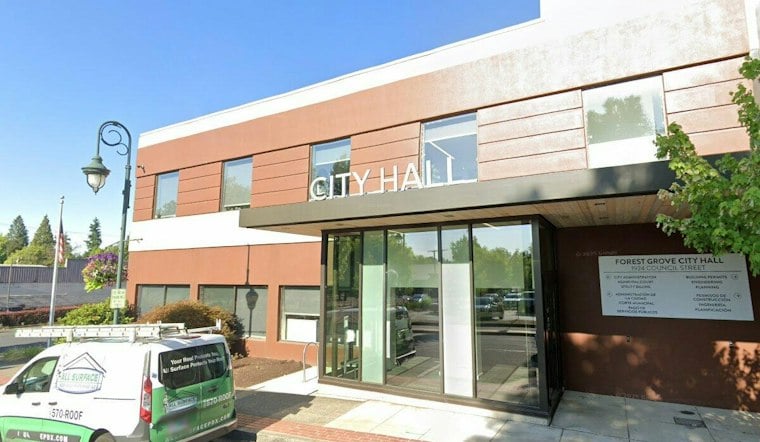
Forest Grove city planners have proposed keeping future data centers at least 1,000 feet from schools and 250 feet from homes, as officials race to finish new development rules before a temporary building freeze expires in February. The city has made no final decision on the proposed restrictions, and the ideas are still being hashed out between city staff, the Planning Commission and the City Council.
The proposals emerged from a Nov. 9 discussion, according to KATU, which reported that city councilors also asked staff to study whether residential buffers should stretch as far as 500 feet, beyond the 250 feet planners initially floated. Those numbers were on the table again Monday, when the City Council and Planning Commission held a joint work session on the proposed development-code changes, though the session included no formal vote and no public comment period.
A Moratorium With a Ticking Clock
Forest Grove temporarily stopped accepting applications for new data-center developments in October, after the City Council adopted a 120-day moratorium on Oct. 12 through Resolution No. 2026-47. That moratorium also covers expansions of existing data centers of 20% or more, and it is set to expire Feb. 9, 2027, unless city officials take further action — a deadline that is now driving the push to finalize new rules. As it stands, the city's development code allows data centers in all industrial zones without facility-specific regulations.
The resolution itself points to a list of potential concerns, including air and noise pollution, waste heat, localized temperature increases and wastewater chemicals. The city has not established that those listed impacts will occur at the Crane Data Centers project, the development that has become the focal point of the debate. Officials have also said they are concerned data centers could gobble up industrial land needed by other businesses, and that their electricity demand could strain infrastructure shared with other customers.
The Crane Project Next Door to a Middle School
Crane Data Centers already holds city land-use approval for a campus on Heather Street near Neil Armstrong Middle School. Company information describes the project as including multiple phases and more than 100 megawatts of capacity, using air-based cooling and biodiesel-fueled backup generators. Under the city's enterprise zone agreement, the development represents an estimated $275.3 million in qualified property investment, with a five-year property-tax exemption and negotiated financial contributions toward community services and schools.
Matt Knight, a Forest Grove community advocate and former City Council candidate who published research on the project, has acknowledged that some earlier concerns about water use and noise mitigation have been addressed. Knight has said more information is still needed about backup generators, emissions controls and health-risk assessments, but he has not claimed that the Crane project has been proven to pose a health hazard.
How Forest Grove Compares to Its Neighbors
Forest Grove is hardly alone in grappling with the issue. Nearby Hillsboro unanimously approved permanent data-center regulations on Oct. 20, after adopting its own 120-day moratorium in July, according to OPB. Hillsboro's new ordinance, which took effect Nov. 19, limits standalone data centers primarily to Industrial Park and Industrial Sanctuary zones and caps total permitted acreage at 608 acres, per Your Oregon News. That ordinance also adopted a temporary 1,000-foot school buffer set to expire in October 2027 unless the council extends or reenacts it, and it now requires public hearings for any new standalone data center.
Just how much land Hillsboro's existing data centers already occupy depends on who's counting. OPB reported that existing facilities take up about 570 acres, leaving roughly 30 acres for new development under the citywide cap, while OregonLive separately reported that Hillsboro data centers occupy close to 500 acres across 21 sites. Hillsboro is now drafting a second phase of regulations addressing building standards and environmental requirements, according to OregonLive's Washington County coverage.
The scrutiny extends beyond Hillsboro's borders. Salem and Woodburn have also adopted data-center moratoriums, while Clackamas County has begun a formal process to consider one, according to a separate KATU report. OregonLive has reported that Eugene, Springfield, Clackamas County, Salem, Portland and other western Oregon jurisdictions are readying votes that would limit new data centers or require more transparency about their operations. In Hillsboro, the stakes of inaction were underscored when Digital Realty submitted a land-use application for a data center less than 200 feet from Liberty High School just before the city's moratorium took effect, KATU reported — a roughly 15.7-acre, 496,540-square-foot project valued at more than $5 million. North Plains has gone further still, with its City Council voting unanimously to direct staff to begin the land-use process for a permanent data-center prohibition, though OregonLive noted state law requires public hearings and advance notice before any such ban could take effect.
What Comes Next in Forest Grove
Forest Grove officials say they are working toward adopting new regulations before the moratorium expires in February 2027, though the Nov. 23 work session did not include a formal vote. City staff presenters at the session included Senior Planner Daniel Riordan and Community Development Director Bryan Pohl. Separately, officials have said they anticipate a housing capacity study will find insufficient buildable residential land to meet demand over the next 20 years, a factor that could shape how much industrial land the city is willing to set aside for facilities like data centers going forward.





