

























































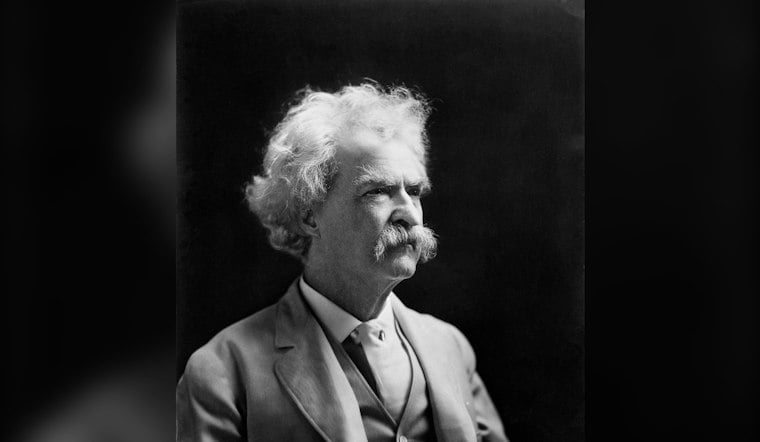
This weekend, a St. Louis stage puts Mark Twain in the middle of Bharata Natyam. Dances of India St. Louis presents its 49th annual performance, “From the Mississippi to the Ganges: Mark Twain's Journey to India,” Nov. 13-15 at the Skip Viragh Center for the Arts in Frontenac, with local actor Isaiah Di Lorenzo portraying the famed Missouri writer.
The production imagines Twain's real 1896 visit to Benares, India, now known as Varanasi, which he made during a thirteen-month global lecture tour of the British Empire, according to St. Louis Public Radio. Twain himself wrote about the stop in his travel memoir, recalling that he and his companions “crossed the Ganges just at dawn, made our connection, and went to Benares, where we stayed twenty-four hours,” according to an excerpt hosted by Telelib. The Library of America notes that the journey was part of a thirteen-month lecture tour Twain began in 1895.
Nartana Premachandra, president of Dances of India St. Louis and the writer behind the new production, said Twain traveled widely and wrote lyrical passages about India that genuinely amazed him, per the station's report. She said the show is meant to celebrate America's 250th anniversary while bringing Western and Eastern consciousness together, the same account notes.
Benares Myths Take the Stage Alongside Twain
The production leans heavily into the mythology Twain encountered on his brief Benares stopover. Premachandra said that in Indian mythology, sages hold immense power, and the city of Benares itself is closely associated with the Hindu god Shiva, per the same account. Thomas Proctor performs as Shiva, while Sanjay Shantaram plays Agastya, a revered Hindu sage described in the production as devoted to Shiva.
Shantaram also contributes classical Indian singing throughout the show, the station reports. At one point, his vocals are arranged to meet the same note as the production's old-time musicians, blending two very different sonic traditions into a single scene.
Fiddle, Guitar and a Hoedown Set the American Half of the Story
To root the production in Twain's own era, Dances of India brought in musicians Ellen Gomez and John Ellis, who perform several old-time tunes from the late 1800s, including a waltz and a hoedown, according to the station's account. Gomez plays fiddle and Ellis plays guitar, giving the Mississippi side of the story its own distinct sound before the narrative crosses over to the Ganges.
Dances of India St. Louis was founded in 1976, and the company has staged productions inspired by subjects as varied as Italian opera, ancient Indian epics and a 16th-century Mughal emperor, the report notes. Every fall since that founding year, the company has presented shows combining movement and storytelling, according to an earlier STLPR report on the company's 2024 production.
A String of Historical and Literary Subjects
The Twain production follows a recent run of history-driven shows from the company. In 2024, Dances of India staged “Dreams of the Dark Prince,” based on the Mahabharata and centered on the epic's Prince Duryodhana, with performances held Nov. 8-10 at Chaminade College Preparatory School, according to STLPR's earlier coverage.
Last year's 48th annual performance turned to a different historical figure entirely. STLPR described that production's title as “Nine Jewels: Music, Art, & Splendor in the Court of Akbar the Great,” while theSTL rendered the title as “Nine Jewels: Art, Splendor, and Music in the court of Akbar the Great, Renaissance Emperor of India.” Either way, the 2025 show focused on Akbar's 16th-century court and its welcoming of different nationalities, religions and perspectives, and featured classical Indian dance numbers from students, guest artists and Shantaram, per STLPR's 2025 preview.
This weekend's performances follow a familiar schedule for the company: Friday and Saturday shows begin at 7 p.m., with a Sunday matinee at 3 p.m., according to Dances of India St. Louis. The nonprofit says it has taught Bharata Natyam, a style of classical Indian dance, to St. Louis-area dancers for more than 40 years, and the narrated dance-theater production makes up the second half of each performance, a format theSTL has also described in its own coverage of the company.





