

























































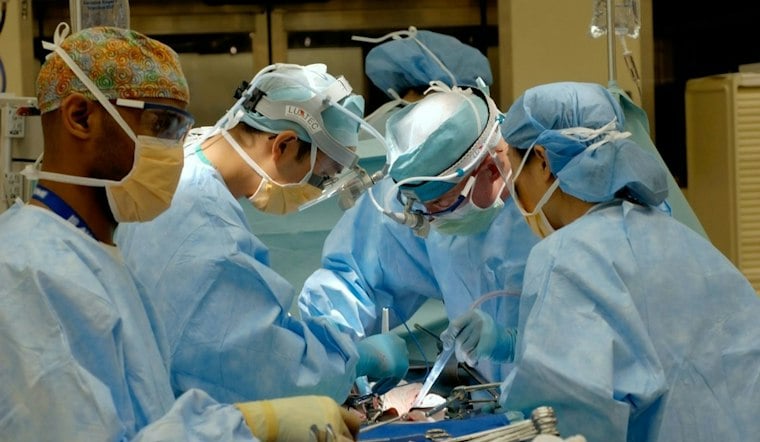
Annette Wagner felt an excruciatingly sharp pain tear through her chest while visiting a patient on July 22, 2025. Her aorta measured 4.2 centimeters that day, above the stated healthy range of under 4 centimeters, but by the early hours of the next morning, her heart had stopped on the operating table at Endeavor Health Elmhurst Hospital. She came back. Within six months, three of her six children would need the same kind of surgery.
Wagner, a 66-year-old pediatric dermatologist who lives in Glen Ellyn, and three of her six grown children have Loeys-Dietz syndrome, a genetic condition that weakens connective tissue and increases the risk of an aortic dissection, according to the Daily Herald. The surgeon performing her initial repair consulted colleagues by FaceTime during the procedure, the paper reports, and Wagner was placed on ECMO life support afterward. She remained on it for more than the standard three-day period doctors typically use to judge whether a patient is likely to recover meaningful brain function, and after about two weeks, she began to breathe on her own.
She was then transferred to Northwestern Memorial Hospital in Chicago, but her ordeal was not over. Three days after being released, Wagner was brought back to Northwestern due to heart failure and essentially needed a redo of the heart surgery, which Dr. Christopher Mehta performed, the Daily Herald reports. Today, she says she has about 30% heart function. “Most days I can walk, I can ride a bike, I can't go up hills very well, but I'm able to function perfectly normally in life,” Wagner said, according to the same report.
A Family History Written in Aortic Tears
Wagner's own family history reads like a grim warning that went unheeded for decades. Her father died from an aortic dissection, and her brother suffered one at age 38 in 1992 before later dying from the condition as well, per the Daily Herald's reporting. It wasn't until 2011 that a lab identified the culprit: a mutation in the SMAD3 gene. “In 2011, Wagner got word that the lab had found a gene dubbed SMAD3,” according to CNN, which reports she carried the mutation, as did three of her six children.
That diagnosis kicked off more than a decade of annual monitoring. Dr. Elizabeth McNally of Northwestern Medicine's Bluhm Cardiovascular Institute has monitored the Wagner family for more than 10 years, the Daily Herald reports, and has said that identifying the causes of sudden death in a family matters because other relatives may also be at risk. Loeys-Dietz syndrome affects roughly 1 in 50,000 people, though CNN notes the real number may be higher since the diagnosis can be missed, and the gene affects one in two children of a carrier.
Three Siblings, Three Surgeries, Six Months
After her near-death experience, Wagner urged her affected children to undergo surgery rather than wait. Within six months of their mother's initial operation, all three of the children with the syndrome — Charlie, Gavin and Kirstin — underwent successful aortic root replacement operations, the Daily Herald reports. According to the paper, the three siblings' aortas were just one millimeter from the diameter at which their mother's had dissected when they made the decision to go under the knife preventively.
Mehta, the same surgeon who performed Wagner's follow-up operation, also handled the procedures for 28-year-old Gavin and 33-year-old Charlie in the Chicago area. Kirstin, who lives in Paris, France, had her operation overseas, with CNN reporting that she underwent a successful surgery there as well. Preventative aortic surgery can strengthen aortic walls and reduce the risk of tearing, though the Daily Herald notes that open-heart aortic surgery itself carries risks including infection, bleeding or death.
No Single Number Decides When to Operate
Just two days after Wagner woke up from her coma, her ex-husband and the father of her six children passed away, according to the Daily Herald's reporting. It was a brutal stretch for a family already reckoning with how much of its future might be shaped by a single gene. Wagner and her children's descendants with Loeys-Dietz plan to pursue IVF and genetic selection to try to avoid passing the condition on, per the same report.
Doctors who treat patients like the Wagners have pointed to 5 centimeters as a threshold where prophylactic surgery is recommended, Dr. McNally has said, while a standard healthy aorta measures under 4 centimeters. But a 2026 commentary published by the European Society of Cardiology suggests prophylactic aortic root surgery may be considered at approximately 4.0 to 4.5 centimeters for people with TGFBR1-, TGFBR2- or SMAD3-related Loeys-Dietz syndrome, with higher thresholds generally considered for less aggressive genotypes. The same commentary stresses that these figures are not rigid cutoffs — rapid growth, family history of early dissection, previous vascular events, body size, sex and pregnancy plans may all justify operating earlier or later.
That nuance echoes across the medical literature on aortic disease generally. For Marfan syndrome, a related connective-tissue disorder, the threshold discussed for surgery is around 5 centimeters, while the 2022 ACC/AHA guideline published by the American Heart Association's journal states that the surgical threshold for sporadic aortic root and ascending aortic aneurysms has been lowered to 5.0 centimeters in selected patients treated at centers with multidisciplinary aortic teams and experienced surgeons. That same guideline recommends aortic imaging to screen the first-degree relatives of anyone diagnosed with an aortic aneurysm or dissection, and defines rapid growth in sporadic aneurysms as at least 0.5 centimeters in a year or 0.3 centimeters per year over two consecutive years.
Living Under Watch
Wagner began annual health monitoring for herself and her affected children following the 2011 diagnosis, and that surveillance continues today. CNN reports the family now undergoes yearly imaging of their aortas using MRI scans and echocardiograms, along with blood pressure monitoring and preventive blood pressure medication. The 2026 ESC commentary describes a similar standard of care more broadly for Loeys-Dietz patients: baseline cross-sectional imaging from head to pelvis, generally repeated about every two years when findings are stable, alongside early treatment with an angiotensin-receptor blocker or beta-blocker, with dual therapy considered if aortic growth continues despite one medication.
The commentary also cautions that much of this guidance rests on observational evidence and expert consensus rather than randomized trials specific to Loeys-Dietz syndrome, underscoring how individualized these decisions remain for every family carrying the mutation. For the Wagners, the hope now is simpler than any clinical guideline. The family hopes their story encourages conversations about family health history, according to the Daily Herald, the kind of conversation that, in their case, took three generations and a brush with death to finally happen.





