

























































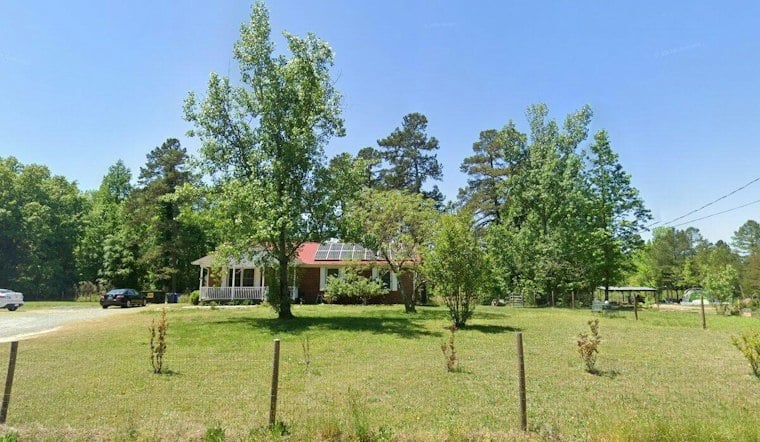
Seven small houses in Graham now sit apart from one another, none of them facing a neighbor's front door. Benevolence Farm cut the ribbon on Nov. 12 for a community meant to give women and gender-expansive people leaving North Carolina prisons a household of their own, with peers still close enough to call.
The nonprofit has housed people on the Alamance County property since December 2016. The new homes double its on-site capacity, North Carolina Health News reported. WUNC described the project as the state's first tiny-home community for incarcerated women and said residents were expected to move in by winter.
Seven Doors That Do Not Face Each Other
Each home is 400 square feet. Inside, Health News reported, there is a bedroom with a full-size bed, a full bathroom, a kitchen, a living area, and a washer and dryer. The News & Observer reported that Roll Construction built the houses on the farm's 13 acres. The exteriors are lilac and butter-yellow, and each house carries its own barn-quilt design.
The interiors read like a list of things people asked not to lose. Natural light. Cordless window coverings. Artwork by formerly and currently incarcerated people and their loved ones. A private bedroom on the ground, rather than a loft that has to be climbed by ladder. The houses are arranged so that no home looks directly at another.
That layout is the point. On its tiny-homes page, Benevolence Farm says community members can practice managing a single household there, with a safety net of supportive peers around them. Former and current program participants helped design the houses. The News & Observer reported that getting from that collaboration to a ribbon took seven years.
The People Who Shaped the Floor Plan
Deb suggested that people recently released could benefit from housing that combined lived experience, privacy and support. She died of cancer nearly five years after her release, the News & Observer reported. The suggestion outlasted her.
Linda Cayton was sent to prison in North Carolina at 50. She said incarceration cost her both her freedom and her home. She now works as a certified peer support specialist, is pursuing a bachelor of social work at Appalachian State University, and hopes to become an addiction counselor. In her account, the tiny homes can offer people a place to call their own, and a second chance.
Kristen Powers put the same idea in broader terms. Formerly incarcerated people, she said, deserve life-affirming opportunities and the decision-making power to build lives around safety, autonomy and belonging. The farm's version of that sentence is easier to walk through: a key, a ground-floor bedroom, and neighbors who already know what coming home takes.
A Farm That Already Pays for the Work
Tanya Jisa founded Benevolence Farm after seeing women return to prison because they lacked stable housing or employment, the News & Observer reported. The first resident arrived in December 2016.
The older arrangement is still the one most residents know. The organization says most people live in the Farm House for six months to two years after release from a North Carolina prison, and that applicants with all conviction histories and incarceration lengths are welcome to apply. Participants are expected to work about 24 hours a week on the farm, and they are paid for that work. In 2019 the farm launched a body-care line.
The tiny homes do not replace that structure. They add a next room to it: an independent household on the same property, still inside a peer community, still tied to paid work on the land. Capacity on the property doubles with the seven additions. A stay is still measured in months and years, not in a night's shelter bed.
A State Check and a Donated Hammer
The North Carolina Housing Finance Agency contributed $1.1 million toward the project, Health News reported. Community partners donated more than $50,000 in labor and materials, according to the News & Observer. The build had already been in development for seven years, with Roll Construction on the job and program participants in the design conversations. The donated labor sits beside that public money as the part partner groups put in by hand.
Scott Farmer spoke at the Nov. 12 ceremony. He said the seven homes may be small in size, but not in impact. At 400 square feet, that claim is easy to picture. A full kitchen and a washer are not a policy. For someone leaving a cell, they are the difference between a room and a household.
The Counts These Seven Homes Cannot Cover
Set the Graham houses against the state's release figures, and keep the figures apart. They do not describe the same year or the same measure.
In fiscal year 2025, more than 4,200 people left North Carolina prisons without housing, a 38 percent increase from the year before, Health News reported in its account of the farm. A separate Health News review of 2024 found that 5,610 people, or 28 percent of those leaving North Carolina prisons that year, were identified as homeless. Of that group, 83 percent, or 4,647 people, were released on community supervision.
The Wilson Center for Science and Justice at Duke Law says about 18,000 people return to North Carolina communities from state prisons each year. Interview participants in that work said meaningful preparation takes more than the standard 30-day planning window. The center recommends investing in peer-support programs led by people with lived experience, which is closer to the Graham model than to a checklist issued a month before the gate. Prism reported in 2024 that more than 2,500 women return home from North Carolina state prisons annually.
Other programs make the same point at a different scale. The Charlotte Observer described A New Way of Life as a six-bed home for formerly incarcerated women, with legal and employment support, transportation and education. The Center for Community Transitions in Charlotte has 30 beds in its transitional housing program for women. In Lincoln, Nebraska, Bridges to Hope broke ground on July 30, 2025, for Hope Village, planned as 18 tiny homes of 250 to 500 square feet for formerly incarcerated people and their families.
Winter Is the Next Test
WUNC, reporting the day after the ceremony, said residents were expected to move in by winter of this year. The Nov. 12 ribbon marked the opening of the community. The calendar is the remaining piece: seven finished houses, and the people the farm says helped design them.
What the organization is offering, in its own words, is practice at a household, with peers nearby. In Graham that practice now has lilac siding, a barn quilt, and a bedroom that does not require a ladder. Seven of those doors will not move a fiscal-year count of more than 4,200 people leaving prison without housing. They will change the week for whoever gets the key.



