

























































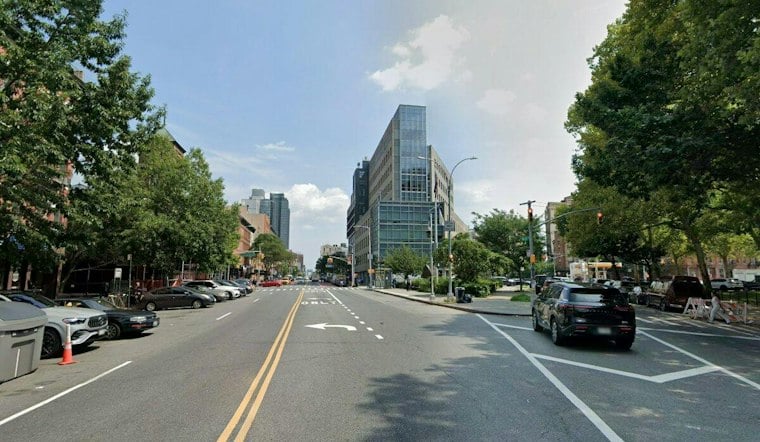
The New York Amsterdam News, the city's oldest Black newspaper, has unveiled new renderings for a $44 million renovation that would turn its four-story Harlem headquarters into a public center for Black journalism history while keeping its newsroom intact. The plan centers on 2340 Frederick Douglass Boulevard, between West 125th and West 126th streets, and includes a new elevator, restored historic finishes, and a free, two-story public exhibition space called The Citadel of Black Truth.
The renovation is being pursued by the Amsterdam News Educational Foundation, which according to The New York Times is embarking on the fundraising campaign to reinvent the underutilized four-story walk-up as an educational institution and community hub, all while retaining space for the newspaper's own offices. The designs come from AYON Studio and Jerome Haferd Studio, per reporting from New York YIMBY, which notes the project also includes exhibitions and a research library. The building sits a short walk from the 2 and 3 trains at the 125th Street subway station on St. Nicholas Avenue, according to the same report.
Sources differ on exactly when the paper settled into the Harlem building: the Times reports the publication acquired the property in 1939, while the New York Amsterdam News itself describes occupying the structure, built in 1888, since 1941. Either way, the paper's roots trace back much further — the Times reports the Amsterdam News got its start in 1909 in an apartment in the old San Juan Hill neighborhood, once home to New York City's largest Black population before it was razed in the 1950s to make way for Lincoln Center, according to New York YIMBY.
What the Renovation Would Actually Change
If the fundraising goal is met, construction is expected to begin in 2029, with the Times reporting a grand opening targeted for 2030. The scope is substantial: plans call for installing an elevator, replacing outdated electrical and plumbing systems, and adding an event and exhibition space on the roof, the Times reports. New York YIMBY describes that rooftop fifth-floor space as including a terrace covered by a sloped timber canopy.
Exterior work would restore old brickwork, windows, signage, and wall murals, according to New York YIMBY, while AYON Studio describes plans to restore the façade, neon sign, murals, marble staircase, and mosaic floors. AYON Studio's materials also describe preserving the 1940s publisher's office and the original newsroom — though that timeline doesn't fully match an earlier 2025 plan reported by the Times, which described restoring the fourth floor as a 1930s newsroom complete with an archival research room.
A Free Public 'Citadel' and Café
The centerpiece of the public-facing renovation is The Citadel of Black Truth, described by the Times as a double-height space lined with LED panels that could be programmed with headlines and photographs from the newspaper's past and present. New York YIMBY similarly describes it as a two-story exhibition space that will display rotating historic photographs and articles from the paper on LED panels. The campaign aims to keep that space, along with a planned café, open to the public for free, the Times reports — and New York YIMBY adds that the café is meant to honor the civil rights sit-ins that gained nationwide attention in the 1960s.
Funding so far includes $500,000 from the Mellon Foundation to support the plans and renderings themselves, plus a separate $520,000 Mellon grant intended to pay for an archivist to sort through the building's contents, per the Times. Construction commencement remains contingent on the foundation realizing its full fundraising goals, New York YIMBY notes.
Part of a Broader Harlem Cultural Building Boom
The push fits into a wider pattern of major capital projects remaking Harlem's cultural landscape. The Amsterdam News notes that the National Urban League relocated from Lower Manhattan in 2025 into a $242 million building on 125th Street, and that the Studio Museum reopened last year in a new $300 million facility. The same report notes the Apollo Theatre complex is currently closed for a $65 million restoration, while the National Black Theatre's $80 million complex is due to open in two years.
That context underscores what's at stake for a publication that, per 6sqft, rose to prominence among nearly 2,000 Black newspapers nationwide at its peak but today is one of roughly 200 Black newspapers left in the United States. For a paper built around telling Harlem's story, the renovation represents an attempt to make its own history as visible, and as permanent, as the building it has called home for more than eight decades.



