

























































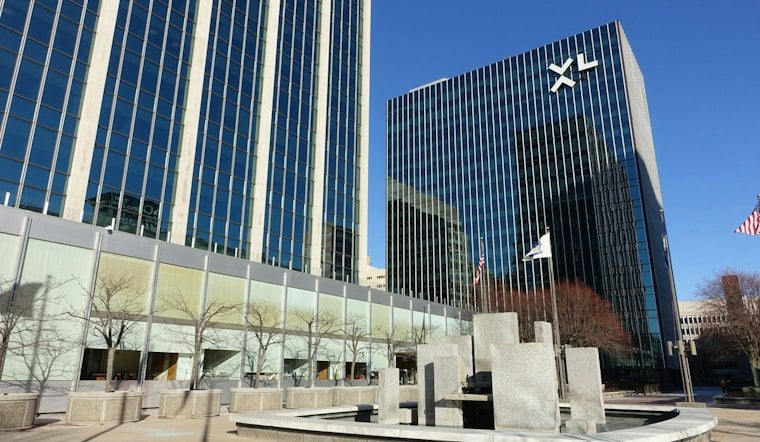
Hartford officials have zeroed in on as many as seven underused downtown office buildings that could together hold somewhere between 1,200 and 1,500 apartments, part of a push to turn empty desks into housing and shore up the city's shrinking tax base. The candidates range from the hulking Class A towers at Constitution Plaza to smaller, older office buildings scattered across downtown, with a study of the findings expected to be released by year-end.
The city worked with economic development consulting firm Goman+York to estimate redevelopment costs and likely apartment counts for the properties whose owners might actually go along with a conversion, according to Hartford Business Journal. Hartford and Goman+York evaluated nearly two dozen downtown properties in all, examining floor plates, utility systems, occupancy levels and whether owners were even willing to participate, before narrowing the list to roughly 12 or 13 properties that could realistically be converted with financing and other assistance. Among the strongest candidates: the 20-story tower at 1 Constitution Plaza, the 18-story tower at 100 Constitution Plaza, and portions of the 844,000-square-foot State House Square complex.
Constitution Plaza's Foreclosure Complicates the Picture
Mayor Arunan Arulampalam has called 1 and 100 Constitution Plaza the two most convertible buildings downtown, per the report. The 1960s-era complex overlooking the Connecticut River includes six buildings and roughly 1,743 parking spaces across its garages, with 1 Constitution Plaza holding 276,000 square feet across 20 stories and 100 Constitution Plaza holding 219,000 square feet across 18 stories.
The complex has also been tangled up in foreclosure proceedings. Lenders claiming a $50.87 million debt filed a foreclosure action against Constitution Plaza Holding LLC in early 2024, and Ian Lagowitz of Trigild IVL was appointed receiver that September 23, according to a separate Hartford Business Journal report. That listing described the complex as a six-building, 662,106-square-foot property being marketed for sale, while The Connecticut Courant put the same six buildings at about 671,000 square feet. The listing also noted that current zoning allows multifamily development as-of-right, meaning a conversion wouldn't need a special approval process.
State-Owned Towers Also in the Mix
Arulampalam is separately hoping to persuade the state to sell its two-tower, 575,000-square-foot office complex at 450 Columbus Blvd. for residential redevelopment, renewing a proposal first publicly discussed in 2024. Connecticut bought the complex for $34.5 million in 2013 to consolidate government agencies and cut down on leased office space. The mayor has described the property as an ideal residential site by the water near Constitution Plaza, and has said the relatively small number of state employees working there could allow agencies to consolidate elsewhere, with those workers relocated to leased downtown space instead. A sale for apartments, he's argued, could create housing, return the property to Hartford's tax rolls and boost demand for the office space that remains.
Portions of State House Square, the Class A complex at 10, 50 and 90 State House Square, are also being examined for residential use, Arulampalam said. The scale of downtown's problem helps explain why officials are casting such a wide net: only about 40% of downtown Hartford's roughly 7 million square feet of office space is occupied, Jack Benjamin said at an HBJ conference, and he estimated the city needs only about 2 million square feet to meet existing and future office demand. A separate Courant report put downtown office vacancy at 41%.
Financing Remains the Biggest Hurdle
Not every building on the list is actually a good candidate for apartments, and bankers and brokers caution that the appeal of a conversion can be deceiving. Mark Duclos cautioned that many office buildings simply aren't suitable for residential conversion, adding, “In fact, most buildings aren't.” Large office towers often have broad floor plates with interior space poorly suited to apartments since units need window access, while narrower floor plates of roughly 65 to 75 feet, as Frank Caico said at the same HBJ conference, allow apartments to line exterior walls around a central hallway. Converting a big tower can also require extensive mechanical-system overhauls that drive up redevelopment costs.
Financing has gotten harder to find, too. Christopher Arnold, senior vice president and head of commercial real estate lending at Liberty Bank, said construction costs, interest rates and the risks tied to struggling office buildings have complicated lending. Any conversion still has to pencil out financially, generating enough rental income to cover acquisition, renovation and operating costs. Jack Benjamin said about half a dozen candidate properties could move relatively quickly if public financing comes through, and that conversions overall could remove surplus office space, consolidate remaining tenants, bring in new residents and help restore property values.
A City Still Shadowed by Its 2017 Fiscal Crisis
Arulampalam has described declining office property values and the tax revenue lost with them as Hartford's greatest fiscal challenge, warning that the losses affect the city's ability to provide basic services even as he calls housing development a major regional opportunity. The city nearly faced bankruptcy in 2017, a backdrop that colors how urgently officials are pushing the conversion idea now. Demand for downtown office space has fallen sharply amid pandemic-era remote and hybrid work.
The Capital Region Development Authority, a quasi-public state agency that finances housing and economic development around Hartford, is separately seeking to double its annual state bond allocation from $25 million to $50 million. Arulampalam has said advancing the conversion projects will require substantially more state funding, and that the state needs to fundamentally rethink how it views the resources housing production requires.
What's Already Been Built
Hartford's office-to-apartment conversions so far have mostly involved smaller, older Class B buildings rather than major towers, often requiring public assistance to bridge the gap between private financing and total development costs. The Capital Region Development Authority has helped finance several of those tower conversions and has helped fund more than 3,300 apartments in and around downtown since its creation in 2012, with CRDA-funded developments generally running occupancy rates above 90%.
The best-known example is the former Bank of America building at 777 Main Street, a vacant 26-story tower that developer Bruce Becker converted into apartments with an $84.5 million redevelopment backed by a $17.7 million low-interest CRDA loan. Accounts of the project differ: the Hartford Business Journal and the Courant date the $84.5 million redevelopment's completion to 2015, with the Courant citing 286 rentals, while Connecticut Public and the Connecticut Mirror both place the conversion's completion in 2014 with 285 units, 226 market-rate and 59 affordable for households earning up to 50% of area median income.
More recently, Spinnaker Real Estate Partners completed the conversion of the former state office complex at 55 Elm St. into 160 apartments in 2025, a roughly $67 million project spanning a century-old seven-story main building and an attached four-story annex overlooking Bushnell Park; the firm is also pursuing additional apartment construction on the surrounding property. Hartford's former state office buildings at 20 and 30 Trinity Street are being converted into 104 mixed-income apartments, 83 market-rate and 21 reserved for renters earning 50% or 60% of area median income, with completion expected in early 2027 after the project received a state brownfield remediation grant and a historic rehabilitation tax credit, Connecticut Public reported. Two historic buildings at 275 Pearl St. and 525 Main St. were also under restoration as of 2023, expected to add more than 70 apartments once finished.
A Regional and National Trend
Hartford isn't alone in chasing this strategy. In Stamford, RMS Cos. paid $13.2 million, or about $65 per square foot, for job-search company Indeed's former 200,000-square-foot office building, with plans to convert it into 231 apartments. RMS Cos. CEO Randy Salvatore said declining office values can create redevelopment opportunities through discounted acquisitions, noting that the per-square-foot acquisition cost was comparable to what the company might have paid for vacant land on another residential project in Stamford.
Goman+York, the firm advising Hartford on its study, said it had performed about three market analyses per month two years earlier, according to a separate Hartford Business Journal report. Still, a study cited by the Courant estimated that converting Hartford's prime downtown office space more broadly would require $450 million in public financing over three years, underscoring how far the city's current tools may be from matching the scale of the problem Arulampalam says Hartford is facing.



