

























































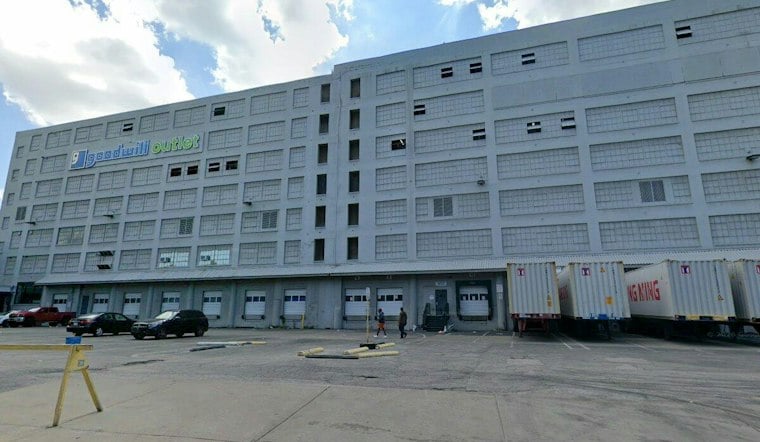
A St. Louis judge on Thursday stripped two conditions from the path of a planned Midtown data center: an on-site renewable-power mandate and a requirement that aldermen sign off on the project's community benefits agreement.
22nd District Judge Christopher McGraugh granted a motion from TerraWatt partner David Lambiaso, according to St. Louis Public Radio. The ruling lands on a planned $3.1 billion, 120-megawatt project inside the old Famous-Barr warehouse on Market Street, pitched as part of a technology district, and it turns on how far a city board can go when it attaches policy to a permit.
What The Court Removed
McGraugh removed a power-supply mandate that required TerraWatt to supply at least 2.4 megawatts of the project's own power through renewable sources. He also removed the requirement that the community benefits agreement be approved by the Board of Aldermen.
The legal hook was institutional, not technical. McGraugh ruled that the Board of Adjustment's functions are strictly administrative and that it cannot make policy. He further ruled that the board exceeded its authority and that its actions were illegal and void.
That is a narrower kind of victory than a finding that the data center is a good idea, or even that the energy target was the wrong number. The court treated the conditions as something a permit board was not allowed to invent. Whether City Hall writes a different rule, through a body that does make policy, is a separate question the order does not settle.
An 11-Acre Warehouse And A September Suit
TerraWatt sued the city in September over the conditions placed on construction. Lambiaso argued that the two provisions — the renewable-energy requirement and aldermanic approval of the benefits agreement — were illegal and practically impossible. The complaint called the challenged conditions "practically impossible on the 11-acre site."
The scale makes the complaint's point concrete. A planned 120-megawatt facility on 11 acres is not a suburban campus with room for its own generating plant. The 2.4-megawatt figure was a slice of that load, not the whole thing, and it was framed as power TerraWatt itself would have to supply from renewable sources, not merely buy from the grid.
The dollar figure and the megawatts describe the plan, not a finished building or a proven operating load. The suit asked the court to take conditions off the permit. Thursday's order did that for the two provisions Lambiaso challenged.
The Benefits Deal And Who Approves It
The community benefits agreement is a different instrument from the permit condition the judge voided. The city's Land Clearance for Redevelopment Authority approved the agreement in September. At that point it still needed the Board of Aldermen.
As described by The Independent, the agreement committed TerraWatt to using renewable energy for at least 50 percent of the data center's energy load within five years of opening. That is a larger share, on a later clock, than the 2.4-megawatt on-site mandate the court removed. One was a construction condition attached to a conditional-use permit. The other was a redevelopment agreement that, until Thursday, still had a legislative gate.
McGraugh took that gate off. The September LCRA approval remains the local action on the agreement itself. What Thursday changed is the extra requirement that aldermen approve it.
A Second Lawsuit, From The Other Direction
TerraWatt is not the only party in court over this site. The Missouri Coalition for the Environment and other plaintiffs are suing Lambiaso and the city, arguing that St. Louis illegally granted a use permit for the project.
The two cases pull in opposite directions. Lambiaso's suit said the city attached illegal conditions to a permit it had the power to issue. The coalition's suit says the permit itself should not have been granted. McGraugh's order addresses the conditions Lambiaso challenged. It is not a ruling on the coalition's claim that the use permit was unlawful.
That split matters for anyone reading Thursday's decision as a green light. One court action removed two requirements from the developer's side of the ledger. A separate challenge to the underlying permit is still a lawsuit, with plaintiffs who say the city got the approval wrong in the first place.
Benefits Deals, And A City Still Writing Rules
Community benefit agreements are showing up more often as states try to manage the data-center boom, POLITICO reported in September. Pennsylvania Gov. Josh Shapiro, Illinois Gov. JB Pritzker and Michigan Gov. Gretchen Whitmer have called on developers to enter legal agreements with communities. The form is older than the current wave of server halls. About 25 years ago, a coalition of Los Angeles community groups negotiated one with the developers of what was then the Staples Center.
The bargains are not uniform, and they are not always popular. In Olyphant Borough, Pennsylvania, a proposed agreement would pay the borough $101 million over 15 years in exchange for letting Project Triboro skip public hearings, The Times-Tribune reported. ERCOR Triboro LLC sued the borough in June, seeking to bypass zoning and conditional-use hearings for seven data centers and a substation on 470.61 acres. St. Louis is arguing over 2.4 megawatts and an aldermanic vote on an 11-acre warehouse site. Olyphant is arguing over a nine-figure payment tied to skipping hearings. Same tool, very different price of admission.
Nationwide, data-center development has often produced friction between cities and developers, The Independent noted. Locally, St. Louis officials are weighing whether to slow that growth until clearer rules are in place, the St. Louis American has reported. Thursday's order does not write those rules. It says the Board of Adjustment was the wrong author for the two conditions it tried to impose, and it leaves the Famous-Barr warehouse — planned, permitted under challenge, and still not a finished data center — sitting on Market Street while the city decides what a lawful condition would even look like.





