

























































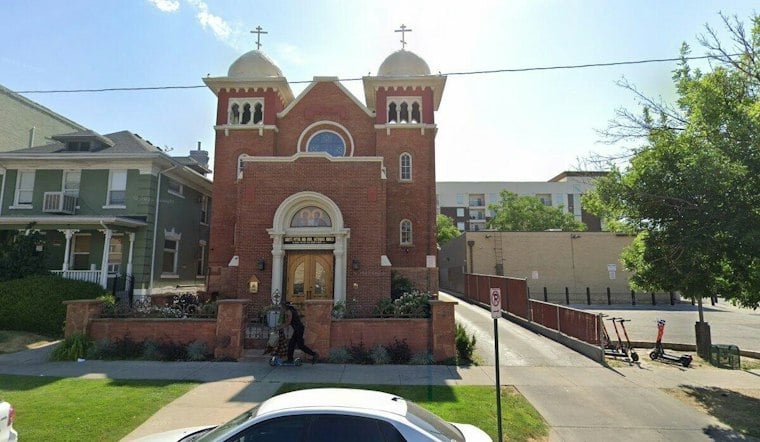
St. Peter and Paul’s Orthodox Christian Church has outgrown its Salt Lake City home — a converted 1903 synagogue — and after more than three years of searching, the congregation has landed on a new site in Kearns where it plans to build a church built for its own growing numbers.
The parish will temporarily use a former meetinghouse of The Church of Jesus Christ of Latter-day Saints in Kearns while it builds a new structure on the attached lot, according to KSL. That new building is expected to hold between 800 and 1,000 parishioners, a dramatic leap from the standing-room-only sanctuary the congregation currently packs into every Sunday.
More than 400 people attend St. Peter and Paul’s each week, and the station reports the sanctuary is literally standing room only. Father Paul Truebenbach, the parish’s presiding priest, said the growth shows no sign of slowing. “We have almost 200 people looking to join the parish right now,” he said, per the same report.
A Synagogue Built for $9,000 Becomes an Orthodox Landmark
The current church building carries its own layered history. Congregation Montefiore, which split from Congregation B’nai Israel in 1895, built the synagogue in 1903 for roughly $9,000, on land donated by Morris Levy and designed by architect Carl Neuhausen, per KSL’s reporting.
Congregation Montefiore later merged with B’nai Israel in 1972 to form Congregation Kol Ami, and the building was eventually sold in 1987 to Metro Fellowship, a Christian church affiliated with the Assemblies of God, before St. Peter and Paul’s Orthodox congregation took it over. Truebenbach has said the Orthodox church’s renovations to the space were mainly aesthetic changes rather than structural overhauls, the station notes.
Space and Parking Problems Forced a Search
The congregation’s current building has struggled with insufficient space and difficult parking, pressures that go back years. A 2018 report from Deseret News described a flock that was growing so fast its priest worried it might soon not fit in the building at all.
That growth has been documented over time. A 2019 report from The Salt Lake Tribune found the congregation’s worshipper count had more than tripled over the previous decade, reaching about 400 — matching the attendance figures KSL cites in its new report. A 2018 Associated Press account carried by the Journal Record described high Utah real estate prices as a broader obstacle for churches looking to expand, noting that the Salt Lake City congregation at the time had a small Bluffdale plot under contract but said buying the full parcel would cost $1 million.
A Playbook Already Tested in Payson
This isn’t the first time the parish has split its growth into a second location. St. Peter and Paul’s helped establish St. Xenia Orthodox Church in Payson, which first opened to worshippers in November 2020 as a second campus before being consecrated as its own separate parish by Metropolitan Joseph on July 16, 2022, with about 200 people attending the consecration, according to the Tribune’s 2022 coverage.
The Payson effort followed a similar path to what Kearns may now see. The Tribune’s 2019 report said the parish purchased a 5.5-acre rural plot in Payson after an 18-month search, with initial plans for a rustic, wooden, Russian-style chapel serving 140 worshippers plus a clergy house. Parishioners had amassed $400,000 toward that project, with a private benefactor committing another $350,000 for the initial phase, bringing the expected cost to $750,000. ABC4 reported separately that the Payson property itself was bought for $400,000, paid off through fundraising, and that the church still needed to raise $700,000 more while hoping to match the $350,000 donor grant within six to eight weeks.
What Comes Next for Salt Lake City
Once the Kearns building is complete, the current Salt Lake City church will likely serve as a Sunday-only location, while the new Kearns site is expected to offer services throughout the week, KSL reports. The arrangement would mirror the dual-campus model the parish already built out in Payson, though unlike that project, Kearns comes after the congregation had already proven it could sustain a second location long-term.





