

























































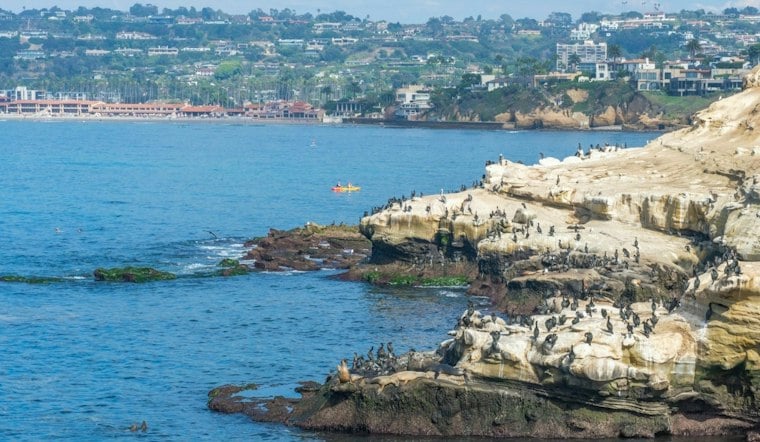
A San Diego diver got the close encounter of a lifetime over the weekend when a 15-foot juvenile gray whale swam right up to him underwater off La Jolla. Dak Anderson said the young whale came within arm's reach and swam past him while he was out diving, a moment he described simply: “A 15-foot juvenile gray whale swam right up to me to say hello.”
Anderson said the whale passed close enough to touch before continuing on its way, telling the story that “he came within arm's reach and swam by,” according to USA Today. The encounter happened as the southbound gray whale migration off Southern California gets underway, with the outlet reporting that vessel and shore sightings are expected to pick up in the coming weeks.
The encounter came as the population’s outlook remained in flux. NOAA Fisheries estimated the eastern North Pacific gray whale population at about 17,750 in 2026, up from about 12,890 the year before; the agency said the reason for the apparent increase remains unclear. The population had declined during a 2018–2023 unusual mortality event linked to changes in Arctic feeding conditions, which contributed to reduced food, malnutrition and increased deaths. NOAA’s latest population estimate puts the close encounter against a backdrop of continuing scientific attention to the species’ numbers.
A Rare Underwater Meeting
While gray whale sightings from boats and beaches become increasingly common this time of year, an in-water encounter like Anderson's is a different story. The report notes that sightings involving scuba divers are extraordinary, even though gray whales migrate close to shore along Southern California's coast.
The close pass also highlights the distinction between an animal approaching a person and a person pursuing an animal. NOAA Fisheries advises people not to swim with, touch or attempt to interact with wild marine mammals, and says viewing should not harass them. Under the Marine Mammal Protection Act, harassment includes conduct that could disrupt behaviors such as migration, breathing, feeding or sheltering. Federal viewing guidance recommends observing whales from a safe distance; it does not establish from Anderson’s account alone whether a violation occurred.
Anderson's own footage from the dive, shared on Instagram, reportedly includes images of the whale gliding over a reef, along with video of a green sea turtle and fish such as yellowtail and kelp bass sharing the same waters that day. For Anderson, the sighting was a sign of what's to come as the season shifts. He said it plainly: “dive season is so on.”
What Comes Next Off San Diego's Coast
The whale belongs to the eastern North Pacific population, which makes a roughly 12,000-mile round trip between Arctic summer feeding grounds and warmer waters off Mexico. The annual journey helps explain why Southern California is a seasonal corridor, not just a destination for whale-watchers: migrating whales pass the coast on their way south and north. NOAA Fisheries’ overview of the population also notes that gray whales recovered from commercial whaling and reached nearly 27,000 by 2015–16 before later population declines.
Gray whales make one of the longest migrations of any mammal, and their southbound journey past San Diego each winter draws whale-watchers to bluffs, piers and boats up and down the coast. With the migration just getting started, more vessel and shore sightings are expected in the weeks ahead.





