

























































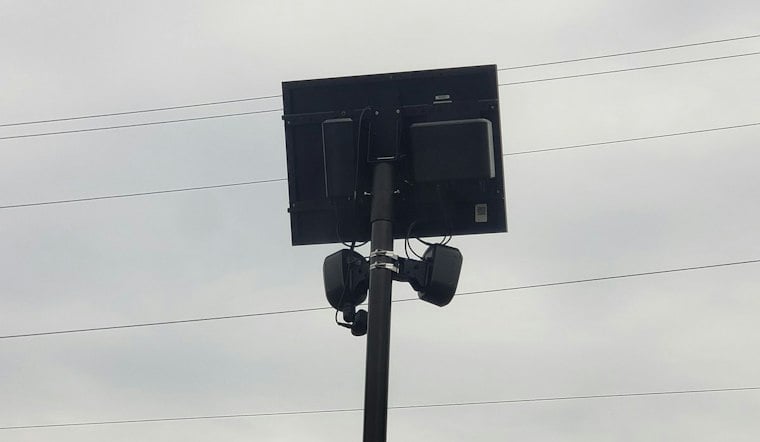
La Mesa police are rewriting the rules for their license plate reader network after outside law enforcement agencies logged more than 3 million scans on the city's 20 cameras between July 1, 2025, and Feb. 2, 2026. The department says it decided to review its policy governing the automated readers in order to provide greater oversight and accountability for how the technology is used.
The scan count, which averages out to roughly 14,412 per day according to one account from the Times of San Diego, reflects activity across La Mesa's participation in Flock Safety's statewide automated license plate reader network. That network lets other participating law enforcement agencies search all cameras for hits, including La Mesa's own readers. A separate account from the same outlet describes that same daily figure as searches rather than scans, and the dossier does not clarify whether the two terms refer to the same measure.
La Mesa Assistant City Manager Amanda Lee has cautioned that the volume doesn't necessarily mean outside agencies are targeting La Mesa specifically. Because searches can query multiple Flock networks at once, the station's report notes, the high figures do not necessarily represent searches specifically directed at La Mesa's cameras or vehicles within city limits. By contrast, La Mesa police themselves conduct slightly more than six searches a day on average, according to city data cited in the same reporting.
What the New Rules Would Require
Under the changes being weighed, outside agencies using La Mesa's cameras would have to sign data-use agreements requiring officers to list their reasons for each search and provide assurances that searches are used only for law enforcement purposes as governed by city code. The police department also says it will provide specific reasons why some license plate reader searches are not shared with the public — a response to the city's existing transparency portal, which shows how often city police initiated searches but, per the same account, does not include the reasons for those searches or allow the public to download the data.
Perhaps the bigger question hanging over the review is whether La Mesa sticks with Flock's shared network at all. The department is reconsidering whether to limit which agencies it shares with or leave the shared network entirely — a decision that would mirror steps already taken elsewhere in the region. The City of San Diego has opted out of the state network, preventing outside agencies from accessing its license plate cameras without direct authorization.
Other Cities Have Gone Further
San Diego's own relationship with the technology remains unsettled. A San Diego City Council committee voted unanimously to turn off the city's automated license plate readers and ban police from using the technology, as reported by KPBS. That committee vote isn't the final word — the full City Council is scheduled to weigh in on the matter Nov. 16, according to The San Diego Union-Tribune.
La Mesa wouldn't be the only California city to pull back from Flock's broader network even without cutting ties completely. In Arizona, Flagstaff removed its data from Flock's national and statewide lookup networks and limited sharing to just two local agencies, and its City Council ultimately voted to end the Flock contract altogether following community concerns, according to NPR. Santa Cruz took a similar path, voting to end its own contract with Flock. NPR's reporting counted at least 30 localities nationwide that have deactivated Flock cameras or canceled their contracts since the start of 2025.
Police Chief Defends the Technology's Value
La Mesa Police Chief Travis Higgins has described the automated readers as valuable for solving crimes, locating vehicles connected to criminal activity, and improving community safety. At the same time, he acknowledged that the technology raises legitimate privacy concerns that the department takes seriously, saying he wants to work with stakeholders, elected officials, and community leaders to build a program people understand and trust.
The scale of Flock's footprint extends well beyond La Mesa. Pew Research Center analyzed 109,577 Flock automated license plate reader nodes listed on OpenStreetMap as of Sept. 17, 2026, and found that roughly 80% of the identified cameras sit in urban areas. Pew also found that, as of Sept. 21, 2026, 1,517 agencies had published their own Flock transparency portals listing 39,465 total cameras — just 36% of all the Flock cameras identified on OpenStreetMap, underscoring how much of the network's reach remains undisclosed to the public.
For now, La Mesa has not announced what its final policy will look like or whether it will ultimately stay in Flock's shared network. The review is ongoing, with the department framing its next steps around the data-use agreements, the promised explanations for withheld search reasons, and broader conversations with the community about how the cameras should be governed going forward.





