

























































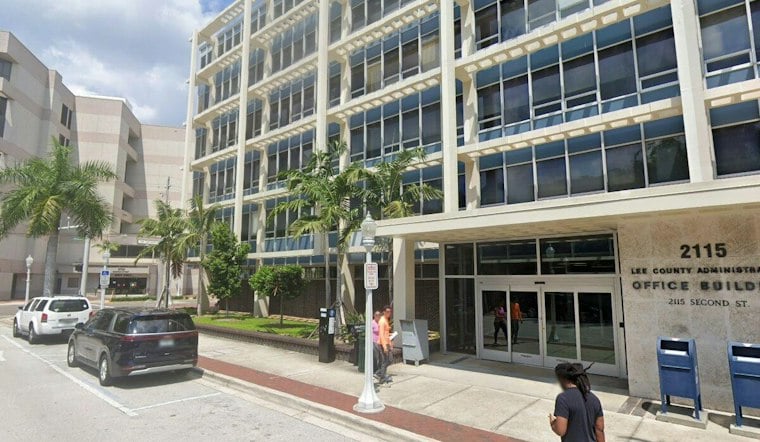
Lee County voters overwhelmingly approved Amendment 3 on Election Day, 199,877 to 90,186, setting in motion a bigger homestead exemption that county officials say could blow a roughly $100 million hole in next year's budget. The Lee County Board of Commissioners has scheduled its first public workshop on the fallout for Tuesday, November 17, giving residents their first real look at how deep the cuts might go.
According to Beach Talk Radio News, which first reported the final vote tally, Lee County officials have said the county will face about a $100 million shortfall in 2027 as a result of the amendment. Fort Myers Beach backed the measure even more decisively, with 77% of voters there casting ballots in favor, per the same outlet. Fort Myers Beach Town Manager Will McKannay and Mayor Dan Allers have said the impact on island residents will not be as severe as in other municipalities, the station reported.
Amendment 3 raises the homestead exemption that applies to non-school property taxes in two stages. Per the Florida Department of Revenue, the exemption will cover assessed value up to $150,000 starting in 2027 and up to $250,000 in 2028, with inflation adjustments after that. The same bulletin notes the amendment takes effect January 1, 2027, and first applies to the 2027 tax roll, and it also reduces the annual cap on assessment increases for non-homestead properties from 10% to 5%.
Property-tax revenue before the amendment
The pre-amendment figures show the scale of Lee County’s property-tax revenue: the Lee County Clerk of Court says the county collected more than $626.9 million in property taxes in Fiscal Year 2025. Separately, Gulfshore Business reported that the county’s 2025-26 millage rate was set to generate $657.5 million in ad valorem taxes. These figures provide a revenue baseline, but do not state what share of the county’s total revenue depends on property taxes.
Commissioner Pushes Zero-Based Budgeting
Commissioner Kevin Ruane has called for a broad review of county spending. In an interview with radio host Trey Radel, he said, “We need to consolidate. We need to look at everything. We need to be more efficient.” Ruane also said the budget should be examined item by item, according to Beach Talk Radio News.
Ruane said he will push for zero-based budgeting and plans to outline his proposal at Tuesday’s workshop, the station reported. He described the plan as radical and said some people would dislike parts of it, while pledging to act on what he believes Lee County residents have asked for. Beach Talk Radio News also reported that Ruane appeared on Fox News Radio to discuss the issue.
Beach Talk Radio News said it will carry the Lee County workshop meeting live on Tuesday. County board meetings are also streamed live on LeeTV, YouTube, or Facebook Live, according to Lee County.
Conflicting Estimates on the Size of the Gap
Just how big Lee County's hole will be depends on which report you read. The roughly $100 million 2027 shortfall cited by county officials is not the only figure in circulation. A September report from WGCU said the county would have to cut $121 million from the budget in 2027-28 and $159 million the following year if the amendment passed.
An October report in the Pine Island Eagle, attributed to Ruane, projected a loss of about $126 million in property-tax revenue in the first year and roughly $240 million in the second year. Separately, Gulf Coast News Now reported that Amendment 3 was expected to reduce Lee County property-tax revenue by $109 million. The dossier does not reconcile these differing figures, which appear to use different time periods or budget assumptions.
Possible responses outlined in the Beach Talk Radio News report include budget cuts, the elimination of jobs, higher fees, an increase in the millage rate, and cuts to services — though none of these has been confirmed as a final decision. Unnamed elected officials cited in the report said Amendment 3 was not well thought out.
Cape Coral's Heavy Residential Exposure
Not every corner of Lee County will feel the exemption the same way. Beach Talk Radio News reported that 91% of Cape Coral's properties are residential and that a large share are homesteaded, meaning the city's tax base is especially exposed to the exemption's growth.
How Other Florida Counties Are Bracing
Lee County is far from alone in confronting Amendment 3's financial squeeze. Central Florida Public Media reported that estimates of the statewide impact vary widely depending on the source: Florida Tax Watch put the five-year loss for Central Florida local governments at about $10 billion, while the Florida Policy Institute estimated nearly $12 billion in losses statewide and about $449.4 million in Lee County specifically.
In Brevard County, Commission Chair Thad Altman said the county could lose half a billion dollars and may have to cut mosquito control, agricultural programs, and parks, per the same report. Winter Park expects to lose about $6.7 million out of its $94 million general fund budget once the full $250,000 exemption takes effect in 2028; a hypothetical budget built around a 90% spending level there closed a fire station, limited pool and library hours, and ended funding for local museums. Florida law now requires local governments to draft hypothetical budgets cutting 10% of spending each year starting in 2027, the outlet noted, and Sanford commissioners have agreed to study a potential fire-services fee before deciding whether to adopt it.
Elsewhere on the Gulf Coast, WGCU reported Florida Policy Institute estimates of $190.8 million in lost revenue for Collier County and $127.5 million for Charlotte County. With Lee County's own workshop just days away, residents are likely to get their clearest picture yet of which of these competing numbers — and which cuts — commissioners actually plan to pursue.



