

























































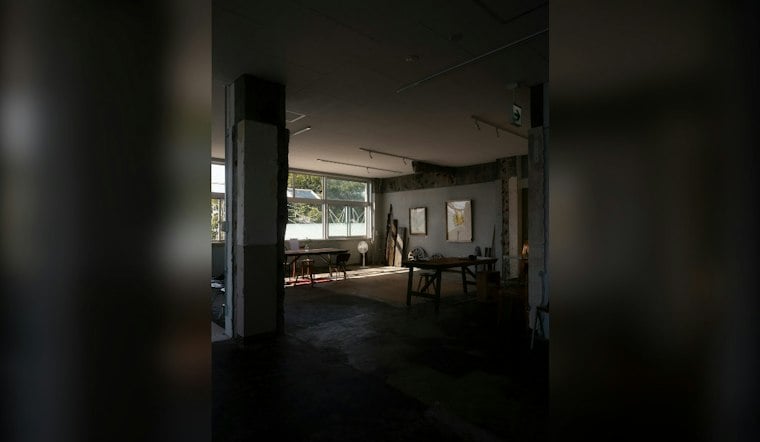
A 1947 Mediterranean-style home on Northwest 67th Street in Liberty City welcomed the public for the first time on Nov. 5. The event marked a new phase for the house, known as the Lindsey House, which had faced demolition before owner Jacqui Colyer began plans to make it a center for art, culture and education honoring the neighborhood’s Black history. Proposed uses include artist studios, exhibitions and educational programming.
Colyer and her sister bought the property in 2019, when it was slated for demolition, according to WLRN. The home was built for Ellis “Peaches” Lindsey and his wife, Anne. Colyer told The Miami Times that the Lindseys owned a pool hall, a haberdashery, a beauty salon and other neighborhood businesses. They hosted Josephine Baker, Nat King Cole and Cab Calloway at the house, which stood on what was once called Millionaire’s Row, home to wealthy Black entrepreneurs and civic leaders at a time when housing policies restricted where Black families could build and live.
From Private Home to Shared Artist Space
Plans call for a redesigned garden and a 55-foot mural on the back wall. The first floor is intended for group gatherings, while three second-floor bedrooms and their attached bathrooms would become individual artist studios, according to The Miami Times. The project aims to adapt the interior and grounds for public use while retaining the historic character of the house’s front.
Colyer said she kept the Lindsey House name to honor Anne and Ellis Lindsey, but she has also said more remembrance is needed for the ordinary Liberty City residents who helped the neighborhood grow, not just its most prominent families. She has described the neighborhood as beginning to decline in the 1960s but said she believes Liberty City is now experiencing a revival, according to the same account.
Artists and Architects Join the Project
Zakiyya White, founder of Love Made Visible (LMV), is guiding the project’s design and commissioning artists to reimagine the space. LMV offers mentorship, relationships and access to emerging artists. Colyer and White envision a shared creative environment across the living room, dining room, Florida room and garden, with artists, architects and designers contributing to the work, The Miami Times reported.
Colyer has said preserving history and making history are both goals of the project. The renovation team is fundraising for both the physical work and on-site staff, and is seeking donors to sponsor individual rooms or contribute unrestricted funds through the project's online donation form.
A Marker Shaped Like a Song
Outside the house, a custom historical marker designed by University of Miami graduate architecture students Adia-Simone Rhoden and Hanah Badran now stands as part of a broader effort to preserve Liberty City's Black history, WLRN reported in September. Its form resembles the sound wave of Baker's song “Paris, Paris,” a direct nod to the entertainer's visits to the home decades ago. Colyer has separately described her vision as restoring the house's 1947 pink façade and turning nearby utility poles into art installations telling the street's story, according to the station's earlier report.
Antonia Williams-Gary, who attended the Nov. 5 event, was born in Overtown and raised in Richmond Heights, visiting relatives in both Overtown and Liberty City as a child. She has described property ownership as prime to preserving legacy, saying Black property ownership is an important part of that legacy, per the Miami Times account of the event.
Part of a Wider Preservation Push
The Lindsey House is part of a wider effort to document Liberty City’s historic places. A Liberty City Historic Survey led by Plusurbia Design and commissioned by Dade Heritage Trust describes 1936 to 1968 as the area’s “golden years,” when homeownership supported church growth and political power, according to the WLRN history report. The $100,000 survey was funded by a $50,000 matching grant from the State of Florida’s Division of Historic Preservation in 2023, with Dade Heritage Trust providing the balance, according to Dade Heritage Trust.
That report identified hundreds of places in the neighborhood eligible for preservation at no cost, and within a year the trust had flagged the Liberty Square Community Center, Liberty Theater, Eureka Barber Shop and Mount Tabor Missionary Baptist Church as eligible for historic designation. Residents have voiced worry that redevelopment, shifting demographics and gentrification could erase the neighborhood's identity, a concern documented by the Miami Herald, which also reported that the nearby Liberty Square public housing complex received a $300 million investment in 2015 through the Liberty City Rising project to convert it into mixed-use housing.
Survey Eligibility Is Not Historic Designation
WLRN reported that the Liberty City survey identified hundreds of places as eligible for preservation, but eligibility is not itself a formal historic designation; documentation and designation are later steps. The reporting cited here does not establish which properties have completed those steps or detail the protections a designation provides, so the survey’s findings should not be read as a list of formally designated sites. See WLRN’s report. A separate effort in Brownsville offers a local preservation precedent. The Historic Hampton House says its community trust began a $6 million restoration of that site in 2015; it now operates as a museum. That restoration-and-museum model differs from the Lindsey House plan for artist studios, exhibitions and educational programming.
The Lindsey House joins a small roster of cultural anchors in the area, including the African Heritage Cultural Arts Center, which has served Liberty City since opening in 1975 with year-round arts education and performance facilities, according to the Miami-Dade County Department of Cultural Affairs. The county agency also notes that the Historic Hampton House, built in 1953, served as a gathering place for Miami's Black community, and the Historic Lyric Theater was built, owned and operated by Black entrepreneur Geder Walker.





