

























































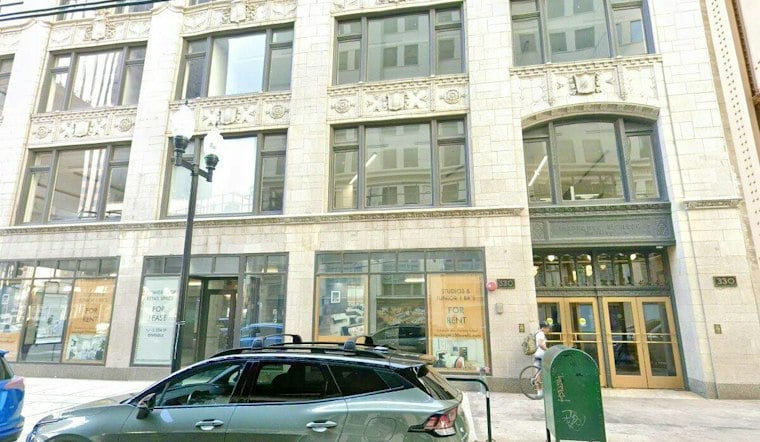
A downtown Chicago apartment building that was once a vintage office tower has changed hands through a sheriff's sale, the latest twist in a yearslong financial saga for one of the Loop's earliest office-to-residential conversions. The property at 330 S. Wells St. had been converted from offices into 132 apartments, but mounting debt eventually pushed it into foreclosure.
An investor took over the Loop conversion in the sheriff's sale. LG Group and Marc Realty began converting the 137,000-square-foot office building into apartments in 2018, finishing the project in 2019, according to Bisnow. The finished building includes 132 apartments, 24,000 square feet of office space on floors two through five, and 5,200 square feet of ground-floor retail, per the developer's project page on LG Group's website.
Debt Outpaced Income Even at Near-Full Occupancy
The financial trouble traces back to a 2021 refinancing of the construction debt. Bisnow's report put that loan at $28.2 million from a Prime Finance affiliate, while The Real Deal described it as a $28 million loan from Prime. The discrepancy between the two tallies has not been resolved in available records.
By the end of 2023, the building was struggling to cover its debt even though units were largely filled. Debt service of $2.4 million outpaced net operating income of nearly $1.9 million that year, despite 97% occupancy, Bisnow's report noted. Occupancy later slid to 88% from that 97% mark, according to the same 2023 figures cited by The Real Deal.
The mortgage matured in February 2025 and was declared in default after the borrowers failed to pay it off, Bisnow reported. A judge subsequently ruled the note was in default and allowed the lender's holding company, identified in the report as Lindy's, to proceed with the sale process — a sequence that ultimately led to this week's sheriff's sale.
Part of a Bigger Wave in the Loop
The building's rocky path reflects the broader bet Chicago has placed on turning empty office towers into housing. At least 11 office-to-residential conversions were planned across the city as of a 2025 report, based on Bradford Allen research and public records cited by the Chicago Sun-Times. Capri Investment Group founder Quintin Primo estimated roughly 3,600 new apartments were in the works, and a CommercialCafe report found nearly 27% of Chicago's office stock has conversion potential, the Sun-Times reported.
High interest rates, financing difficulties, government red tape and building floor plans were cited as obstacles facing these projects, according to the same Sun-Times report. Those are the same kinds of financial pressures that appear to have caught up with 330 S. Wells after its initial conversion success.
City-Backed Projects Offer a Contrast
While 330 S. Wells went through private financing and foreclosure, the city has also been pushing its own conversion efforts. Bellwether Residences became the first office-to-residential conversion completed under Chicago's La Salle Street Corridor Revitalization program, the Sun-Times reported in September. That project delivered 117 apartments, including 41 affordable units, after developers received $28 million in tax increment financing funds. The program as a whole is expected to bring more than 1,000 apartments to the Loop with TIF assistance.
Mayor Brandon Johnson said three more city-led conversions were underway in addition to roughly two dozen private conversions citywide, per the Sun-Times report. Estimates of the eventual housing output from those private projects vary: the Sun-Times put the figure at more than 4,000 Downtown homes once complete, while Construction Dive reported the pipeline was expected to create nearly 4,000 new residential units. A separate proposed conversion at 79 West Monroe Street carried a $64 million budget, including $28 million in city funding, and was planned to include 117 apartments with 35% designated affordable, according to The Real Deal.
Sources also differ on basic details of the 330 S. Wells building itself. Bisnow described it as a 17-story mixed-use property, while Preservation Chicago referred to the structure as the 16-story Insurance Center Building at 330 S. Wells Street and Van Buren Street. Neither discrepancy has been resolved in available records, and it remains unclear who ultimately purchased the property or what terms were attached to the sheriff's sale.



