

























































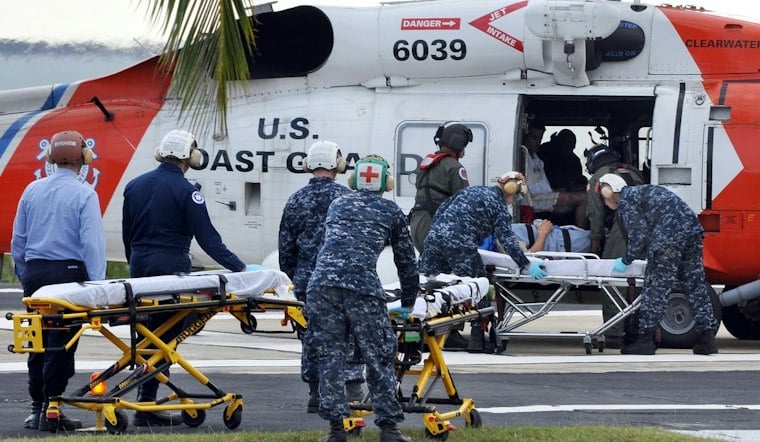
Paintings of fathers fleeing with their daughters hung beside canvases of dancing couples at Florida International University last Friday, as Miami's Haitian community turned art into advocacy for a helicopter service that keeps critically ill patients alive back home. The event, called Haiti-To-Me, brought together artists, musicians and healthcare professionals to raise money and awareness for Haiti Air Ambulance, a nonprofit that says it is the only dedicated helicopter ambulance service in the country.
A Night of Art With a Mission
Haiti-To-Me was organized by Haiti Air Ambulance and featured more than 20 works of art, according to The Miami Times. La Ville d'Art Gallery contributed original pieces depicting Haiti's struggles, natural beauty and hopes for a more prosperous future, the newspaper reported. Gallery owner Nicolas Villedrouin said the exhibition offered a chance to challenge how Haiti is often portrayed, arguing that international media tends to focus on poverty, violence and instability while overlooking the country's creativity and cultural richness. Art, he said, connects people to their homeland and helps pass heritage to future generations.
Among the artists featured was Voltaire Charles Mark, known as Mr. V, whose paintings included a father carrying his daughter while fleeing violence and family separation, and a dancing couple meant to depict joy independent of wealth or social standing. Mr. V said the pieces were intended to convey a message about resilience, according to the same report. Haitian-born musician Oli Duret, who performed with the band T-Vice for roughly a decade before pursuing his own path, told the paper Haiti remains home to him even though he moved to the United States for college.
Why the Helicopters Matter
Haiti Air Ambulance, founded in 2014, says on its website it is the only helicopter air ambulance service dedicated to serving the 11.4 million people of Haiti, flying critically ill or injured patients 365 days a year regardless of their ability to pay. The nonprofit's chief flight physician, Dr. Wesner Junior Jacotin, who is based in Haiti and specializes in emergency and critical care medicine, said the organization conducts roughly 350 to 400 patient flights annually, carrying pregnant women, children and people with traumatic injuries, per The Miami Times. Jacotin described medical workers having to decide how long to remain in a hospital under attack while arranging patient transfers, according to Mark Kaufman, the nonprofit's director of development, who relayed the account to the paper.
Reaching patients in remote communities has become increasingly difficult, the report noted, as gang violence disrupts transportation and threatens healthcare facilities. Rural communities may have hospitals hours away. Those obstacles echo findings from the World Health Organization, which says 4.9 million people in Haiti will require health assistance in 2026. The United Nations Office for the Coordination of Humanitarian Affairs has gone further, projecting that 6.4 million people, more than half of Haiti's population, will need emergency humanitarian assistance in 2026, up from 6 million the year before. OCHA also reported that only 10 percent of Haitian health facilities with inpatient capacity remain fully operational nationwide, a figure that stands at just 11 percent in the Port-au-Prince metropolitan area.
Expanding Beyond the Cockpit
Haiti Air Ambulance has expanded its operations beyond flights to include mobile clinics, vaccinations, healthcare training, and food and medicine deliveries, the nonprofit's report to The Miami Times indicated. The organization's own materials describe helicopters ensuring that vaccines, medications and life-saving equipment reach the most remote corners of Haiti, and the group says it has trained healthcare workers in CPR and basic life support, particularly in rural communities. The nonprofit announced a $2.5 million humanitarian initiative aimed at improving healthcare and nutrition access, particularly for families displaced by gang violence, per the Times report.
Haiti Air Ambulance is also developing something called Lakou Story Corps, an initiative inspired by the Haitian communal tradition of lakou — a communal space where families and neighbors gather and care for one another. The program aims to use storytelling, art and community dialogue to address the emotional toll of violence, displacement and family separation, and the nonprofit is working with Kindbridge Behavioral Health to develop support groups in Miami while planning to train Haitian professionals to facilitate similar storytelling and wellness activities in Haiti itself. Proceeds from the FIU gathering are intended to support the program's implementation in Haiti.
Stories From the Diaspora
Kaufman said Haitian families in Miami have shared stories of displacement and loss with him directly. Some families fled Haiti and left behind livelihoods and investments to save their children's lives, he said, while others described family separation, financial losses and fears of deportation. Kaufman told the paper that Haitian diaspora stories must be amplified and that medical and emotional health need to be connected.
One of those stories belongs to Kristin Vincent, a criminal justice and sociology student at FIU who has not seen her mother in four years and may graduate in December without her present. Vincent said she remains hopeful and believes a new generation can help change Haiti, according to the Times report. Retired Chicago-based wound care specialist Scott Zimmerman, who has been involved with Haiti Air Ambulance for about three years, said a small effort can save many lives.
The Miami metropolitan area is home to approximately 234,000 Haitian immigrants and represents nearly one-third of the Haitian-born population in the United States, according to an analysis the Migration Policy Institute published in September based on U.S. Census Bureau data, as cited by The Miami Times. That concentration helps explain why South Florida's Haitian community gathered at FIU to support relief efforts back home while preserving cultural ties to the island.



