

























































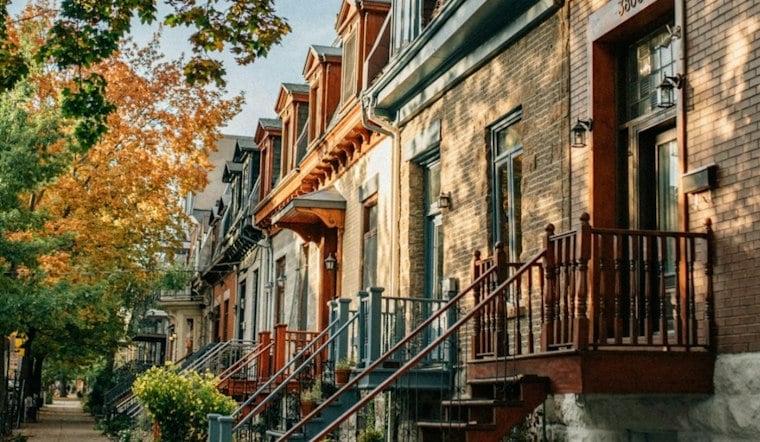
Mountain View's City Council has approved a 36-unit rowhouse development at 924 and 940 San Rafael Ave., clearing the way for five three-story buildings on a 1.8-acre site that currently holds two industrial buildings and a vacant parking lot. The approval came even as several council members pushed back, saying they would rather have seen condos built on the site instead of rowhouses.
A New Neighborhood Takes Shape Near a Future Park
The project, proposed by Prometheus, will sit across the street from a future city park near the junction of U.S. Highway 101 and Highway 85, in an area surrounded by single-family homes, according to Mountain View Voice. Council member Pat Showalter said the site's location next to the park was wonderful, per the outlet's report. The development will include 25 four-bedroom homes and 11 three-bedroom homes, along with 83 parking spaces — 72 for residents and 11 for visitors.
Nine of the 36 units will be set aside as below-market-rate homes, split between two for low-income households, five for moderate-income households and two for above-moderate-income households. Council members broadly supported adding homes in this industrial-heavy corridor, which the city has planned for major housing growth. Council member Ellen Kamei said she believed residential developments like this one would complement and fit with rising density expected in the area, the report states.
Why Some Council Members Wanted Condos Instead
Despite the vote to approve, multiple council members questioned why the project didn't include more affordable homeownership options. Rowhouses are generally single-family residences that share walls with adjacent buildings while still including land ownership, whereas condos typically come with smaller units, no land ownership and association fees — but a lower entry-level homeownership price point, the outlet's reporting notes. Some council members argued condos could have allowed denser housing, more green space and other community benefits compared with the rowhouse format.
Council member Alison Hicks pointed to condo developments in Sunnyvale that she said transitioned well alongside single-family neighborhoods while adding more units than rowhouses would. Council member John McAlister countered that the project still brings in middle-income housing that the region needs, according to the same account. That tension reflects a broader squeeze facing moderate-income residents across Santa Clara County, many of whom earn too much to qualify for subsidized housing but still can't afford to buy a home.
Developer Points to Construction-Defect Litigation
Prometheus representative Mike Ducote defended the rowhouse format, describing it as a better fit for the neighborhood. He said condo projects are often highly litigious because of construction-defect litigation, a dynamic tied to state law that protects condo buyers from bearing the cost of fixing defects in newly built homes for up to 10 years. Mountain View community development director Christian Murdock added that rowhouse developments are highly profitable for developers, which he said has shaped the market toward building more of them rather than condos.
Kamei suggested the city could support reforming condo-liability law through its state and federal lobbying efforts, the Mountain View Voice reported. A state bill aimed at boosting condo construction did not receive a final vote before the legislative period ended this year, leaving that path unresolved for now.
How It Compares to a Nearby Rowhouse Project
The San Rafael Avenue approval follows a similar vote in March, when the council unanimously approved a separate 38-home rowhouse development from City Ventures on San Leandro Avenue in the Stierlin Estates neighborhood. That 1.69-acre project also set aside 25% of its homes — 10 units — as below-market-rate, split among three low-income, five moderate-income and two above-moderate-income households, according to Mountain View Voice's earlier coverage of 38 new Stierlin rowhomes. All 38 Stierlin units were designed as three-bedroom homes ranging from 1,351 to 1,727 square feet, each with a private balcony and two-car garage, and the development is expected to be all-electric with rooftop solar.
Mountain View's Planning Commission had reviewed the San Rafael Avenue proposal, known as the Row House Gatekeeper Project, at its Oct. 21 meeting. During that discussion, staff confirmed in response to a commissioner's question that the project sites were not included on the city's housing-element inventory. A commissioner also noted that a park-in-lieu fee estimate had been calculated using 58 new residents across 29 units, though the estimate was not based on actual bedroom counts, according to the meeting record reviewed on myhamlet.com.



