

























































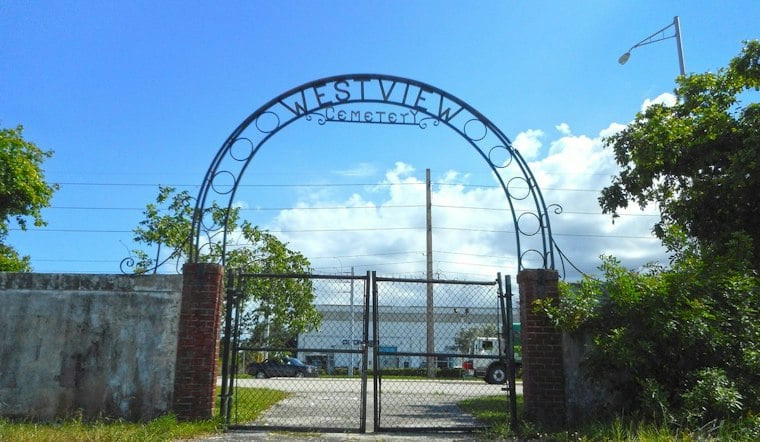
A developer that bought nearly five acres from a historic African American cemetery in Pompano Beach is now seeking to rezone that land, and a new Florida law taking effect this past summer could put pressure on the city to approve it. The parcel traces back to Westview Community Cemetery, a privately administered, community-owned burial ground off West Copans Road that was established in 1952 during the Jim Crow era of segregation.
According to TAPinto Pompano Beach, 1800 Copans LLC is seeking to rezone a 4.5-acre vacant parcel it acquired from Westview Community Cemetery, which sold the land to the company for $1.1 million in May 2022. As part of that same 2022 transaction, 1800 Copans LLC borrowed $850,000 from the cemetery, using the property itself as collateral, with the mortgage referencing a post-closing rezoning payment agreement, the outlet reports. The developer paid that loan off in full in September 2026, and Westview signed a release clearing the debt that same month, per TAPinto Pompano Beach's reporting.
The timing matters because Florida Chapter 2026-87, which took effect July 1, 2026, amends the state's Historic Cemeteries Program and is described as requiring counties and municipalities to administratively approve applications to rezone or change the land-use designation of excess vacant land tied to historic African American cemeteries recorded in the Florida Master Site File, according to tampabay28.com. The same report states that under the law, land must be sold for the express purpose of funding a cemetery's long-term maintenance and upkeep, and any development must be consistent and compatible with adjacent land uses.
A Cemetery Struggling to Keep Up
Per TAPinto Pompano Beach, loan repayment funds are reportedly designated for the long-term care and upkeep of the cemetery under Florida laws protecting historic African American burial grounds. The cemetery board has said burial income — about two to four discounted-rate burials per month, by the outlet's account — is insufficient to maintain the grounds or make needed improvements, which the board has identified as grave restoration, grass, irrigation, landscaping and perimeter fencing.
The board has also said fading graves make it harder for families to identify where their loved ones rest. That description echoes earlier reporting from NPR, which described Westview's grounds as having uncut grass and weeds, with many headstones split or crumbling, and found that about 30 percent of the graves were unidentified, according to records. TAPinto Pompano Beach also reports that the cemetery board said two ground-penetrating radar scans indicated no unmarked burials on the parcel, per a press release — a claim neither Pompano Beach officials nor attorneys for 1800 Copans LLC responded to requests for comment to confirm, according to the outlet.
A Legacy of Disputed Land Deals
This is not the first time a Westview land sale has drawn scrutiny. NPR reported that two members of the Westview Community Cemetery board signed away 4.3 acres of cemetery land to Jacob Zebede and KZ Copans for $1.29 million in 2020, while a separate account from newpelican.com described the old four-member board agreeing that year to sell approximately 4.5 acres to developer KZ Copans for $1 million. The two outlets differ on both the acreage and the price, and the available reporting does not reconcile the discrepancy.
Those same sources differ on the cemetery's original size as well: NPR reported that Black businessman Paul Hunter donated 15 acres for burials in 1952, while New Pelican has described Westview as 14.5 acres total. Four community members filed a lawsuit in 2024 against the cemetery board seeking control and alleging bylaws violations, and NPR reported that the board's validity was being disputed in court by a new board elected in 2022 by community members, with residents claiming the four-member board had run afoul of bylaws that prohibited land sales and required nine members. According to Broward County court filings cited by TAPinto Pompano Beach, that lawsuit is now in mediation for a second time.
Residents Hoped for Expansion, Not Development
Some northwest Pompano residents have hoped the parcel could instead be repurchased to provide room for cemetery expansion, TAPinto Pompano Beach reports — a hope that sits uneasily alongside the developer's rezoning bid. Separately, the Westview cemetery board offered to donate the cemetery to the city of Pompano Beach in October 2025, and city officials held a community meeting about the proposed donation that same month. Pompano city officials have not responded to the donation offer, according to the outlet's reporting, and Westview Community Cemetery remains privately owned rather than city property, controlled by a private board of community members.
What the rezoning decision will ultimately mean for the cemetery's rundown condition remains uncertain, TAPinto Pompano Beach notes. Critics of the new state law have raised concerns well beyond Pompano Beach. Aileen Henderson, founder of the Cemetery Society, told tampabay28.com that the law's language should have required ground-penetrating radar or an archaeological study before development could move forward, and said there is no enforcement mechanism, no required business plan, and no guarantee that sale funds will actually be used for cemetery maintenance.
How Other Florida Cemeteries Have Fared
Florida has made some investments in historic burial grounds elsewhere. NPR reported that a separate state law approved by Gov. Ron DeSantis created a Historic Cemeteries Advisory Council and provided more than $1 million for research, restoration and long-term care of burial grounds, and Florida's Department of State maintains a grant program aimed at helping preserve abandoned African American cemeteries.
Other cases show how long these disputes can drag on. In Deerfield Beach, NPR reported it took three separate archaeological surveys to find remains on land residents said held their relatives before the property was turned into a memorial park in 2015. In Tampa, FOX 13 Tampa Bay reported that the City Council unanimously approved a land-swap deal tied to Zion Cemetery — established in 1901 as the city's first African American burial ground — under which the city would take over land owned by businessman Richard Gonzmart, who would receive property near Ulele in exchange.
Under Florida Statute 497.270, selling, mortgaging, leasing or encumbering land within a licensed cemetery generally requires prior approval from the licensing authority, though no notice or hearing is required if the property has never been used for permanent interment. For cemetery land that has been used for burials and is proposed for non-cemetery use, the statute requires the Department to approve the application in writing only if it finds the change would not be contrary to the public interest, weighing factors including the property's historical significance. Separately, Florida Statute 497.260 requires certain exempt cemeteries larger than five acres to submit to an investigation and mediation procedure if a consumer complaint is filed, with possible administrative penalties for violations including failure to adequately maintain the grounds.



