

























































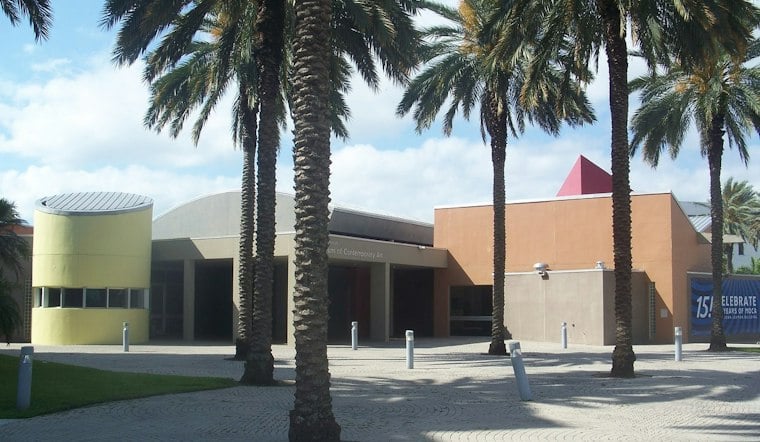
The Museum of Contemporary Art North Miami has opened its entire building to Geoffrey Holder, filling every gallery with more than 60 paintings, drawings, collages and sculptures spanning eight decades of the Trinidadian artist's life. Billed as the first museum survey centered on his visual art, the exhibition, titled Geoffrey Holder: Black Magic, closes out MOCA's 30th anniversary season and runs through April 4, 2027.
Reported opening dates for the show diverge: Vogue lists November 18, 2026, as the start of the run, while the Miami Herald lists November 11, 2026, as its start date. Vogue lists April 4, 2027, as the exhibition's closing date. Vogue describes the show as bringing together more than 60 works across eight decades, pairing the artworks with costume sketches, performance footage, correspondence and memorabilia from Holder's life both on stage and off.
A Survey Eight Decades in the Making
Holder himself was a true multihyphenate — a Trinidadian actor, dancer, musician, director, choreographer and artist, according to Miami's Community Newspapers. His archive traces his journey from Trinidad's Belmont neighborhood, and he went on to work within New York's artistic circles and married dancer Carmen de Lavallade. His Broadway résumé includes the original productions of Timbuktu! and The Wiz, work that made him the first Black man to win Tony Awards for both direction and costume design of a musical, per the same report.
When Holder died in 2014, he left behind a vast trove: more than 250 paintings and 300 collages, according to the Museum of Contemporary Art North Miami, along with drawings, sculptures, photographs, a library and an archive. The museum notes that for much of his career, most of the subjects he painted were Black. MOCA describes the exhibition as the first major museum survey of his work, while Dance Magazine has called it the largest retrospective of Holder's visual art to date, reporting that more than 60 pieces are included, many of which have never before been shown publicly.
Five Sections, One Full Museum
The show occupies the entire museum and is organized into five sections — Portraits, Epistles, The Sacred and the Profane, Genre, and Figure Studies — according to Vogue's reporting. Holder's canon spans biblical allegories, remembered portraits, landscapes and still lifes, per Community Newspapers, with the exhibition contrasting those landscapes and still lifes against his Firebird set design for the Dance Theatre of Harlem. An archive room rounds out the presentation with family photographs, correspondence, early paintings, costume sketches, performance footage and theater memorabilia.
MOCA Executive Director Chana Sheldon said the exhibition presents Holder's visual arts practice comprehensively in a space connected to Caribbean diasporic communities, according to Community Newspapers. She noted that MOCA has previously hosted the first U.S. museum surveys of artists including Tracey Emin, Manuel Mathieu and Michael Richards, and said Holder's artistry touched people worldwide and shifted the 20th-century cultural landscape.
Why 'Black Magic'
The exhibition's title draws from Holder's own words — he once said, “I love magical people!” — and the show aims to reclaim the term “black magic” as a celebration of Black creativity, imagination and cultural power, per Community Newspapers. Guest curator Dr. Erica Moiah James, principal investigator and publication editor for the Geoffrey Holder Project, is credited by Vogue with organizing the survey. James said the exhibition reintroduces Holder as a painter and presents his practice as an opus of connected bodies of work, according to Community Newspapers.
The museum has also credited Holder's son, Léo Holder, a multidisciplinarian, with making the exhibition possible through his involvement and insight. Léo Holder said his father's painting has a distinctive style that deepens with repeated viewing, and that the work carries importance for Black art and Black imagination while holding universal significance. He added that viewers have recognized themselves in his father's images.
Programming Still to Come
MOCA plans to host tours, hands-on art-making sessions, symposiums and intergenerational workshops throughout the run of the exhibition, with program details to be announced later, according to Community Newspapers. The exhibition also acknowledges lead support from the National Endowment for the Arts, per the museum. For North Miami, the show caps a milestone anniversary year with a tribute to an artist whose reach stretched from Trinidad's Belmont neighborhood to Broadway stages and, now, to the walls of a museum built to connect with the Caribbean diaspora he came from.





