

























































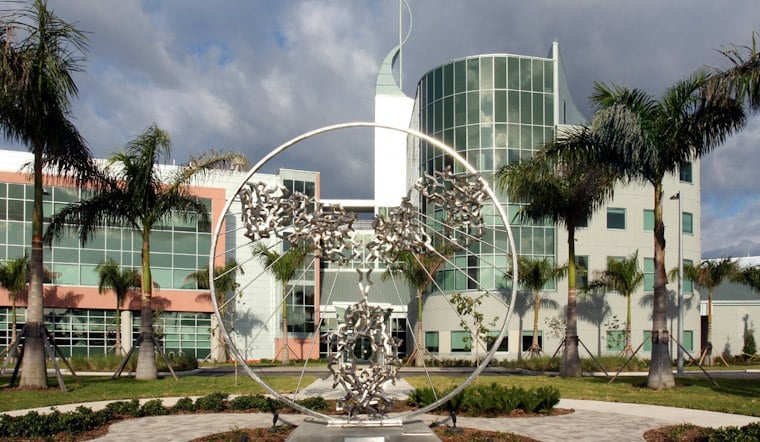
Scripps Research in La Jolla says it received an in-kind computing grant on October 19 through the Jen-Hsun and Lori Huang Foundation and CoreWeave. The institute says the computing capacity will support research on vaccines, antibody therapies and small-molecule drug discovery, and that scientific tools developed through the work will be made openly available to researchers. The grant announcement is available from Scripps Research.
The grant's reported size varies by account. The San Diego Union-Tribune reported that Scripps Research received 14 million computing hours. The institute describes the in-kind award as more than 14 million hours, delivered through the foundation's partnership with CoreWeave using NVIDIA GPUs. Some estimates cited by the newspaper value the computing gift at tens of millions of dollars, though no primary source has provided an official dollar figure.
The Jen-Hsun and Lori Huang Foundation is the personal philanthropy of NVIDIA co-founder Jen-Hsun Huang and his wife, Lori Huang, per the Union-Tribune's reporting.
Two Computational Approaches to Biomedical Research
One strand of the work concerns proteins that existing models may not adequately capture. Scripps Research researcher Stefano Forli's team is building simulations of human proteins that account for their movement and changing shapes under physiological conditions, the institute says. The institute says the work could help identify temporary sites on proteins that might be targeted by drugs, including in diseases considered difficult to treat. Separately, the Union-Tribune reported that Ward is helping lead an effort to map the so-called dark proteome.
Bryan Briney's Antibodies for All project takes a different approach: it aims to computationally model how antibodies develop and are selected during an immune response. According to Scripps Research, the system will draw on millions of paired antibody sequences and structural data to help researchers assess vaccine candidates and search for therapeutic antibodies before laboratory testing.
From Models to Laboratory Testing
The projects are intended to help researchers narrow the field of possibilities through computation; predictions about potential treatments still need to be tested experimentally.
Jen-Hsun Huang said in comments shared by Scripps Research that the scientific tools produced through the work will be openly available to researchers.
Sharing Tools and Data
Scripps Research says the tools will be made openly available and describes large-scale datasets that can support AI research. Its announcement does not specify whether the underlying datasets will be shared or provide details about their ownership.
Computational predictions are not a substitute for experimental validation: proposed candidates still need to be assessed through laboratory work and assays.
Part of a Broader Computing Push in Biomedicine
Scripps Research's grant lands amid a wider wave of AI computing donations aimed at biomedical science. The University of Washington Medicine Institute for Protein Design has received nearly seven million GPU hours through the same Huang Foundation-CoreWeave partnership using NVIDIA GPUs, an allocation expected to support that institute for roughly a year, according to a report from 1950.ai.
Separately, a company called National Compute is building a network intended to pool computing capacity from multiple providers for researchers, companies and government agencies, and plans to donate $100 million worth of computing credits to the Trump administration to advance a federal science initiative, according to POLITICO. Those credits are intended to give researchers in that initiative access to advanced computing resources that smaller labs and companies might otherwise struggle to secure, POLITICO reports.
A Federal Cloud Option for NIH Researchers
A separate route to computing support is the NIH’s STRIDES Initiative, which gives NIH-supported researchers with an active NIH award access to commercial cloud services at discounted rates, according to the National Institutes of Health.
Scripps Research has also pursued smaller-scale computing upgrades on its own. Researchers there used an AI system to analyze roughly 2,000 antibodies from people never infected with HIV and identified an antibody capable of neutralizing the virus, as reported by GEN (Genetic Engineering & Biotechnology News).
Reuters Legal reported on X, citing a filing, that the foundation is buying computing time from CoreWeave and donating it to universities and nonprofit institutes: Reuters Legal.
The filing valued the donations at $108.3 million so far.




