

























































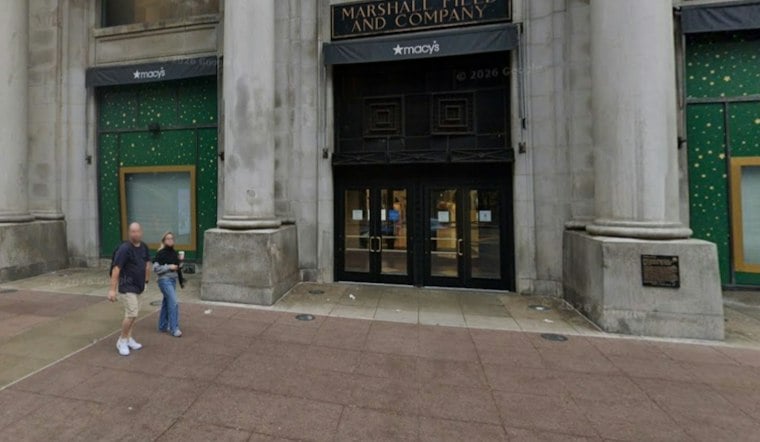
The upper floors of the Marshall Field building, the ornate downtown landmark that houses Macy’s flagship store on State Street, have hit the market. The space above the retailer was converted into offices in 2020, and now those office floors are being shopped to potential buyers as Chicago’s Loop continues to grapple with a battered commercial real estate market.
The office offering sits within a landmark whose retail history stretches back generations: the National Park Service records that the Marshall Field store occupied the State and Washington site from 1868 and that the present complex was built in stages from 1892 to 1907, as detailed in its National Register nomination. Tiffany mosaics and a mosaic vaulted ceiling are among the building’s interior features, underscoring the challenge of adapting an architectural landmark while preserving its historic character.
Crain's Chicago Business reported that the upper floors of the Macy’s State Street flagship were converted into office space in 2020. The building, long a symbol of Chicago retail history, now finds its upper levels caught up in a broader reckoning facing office owners across downtown.
The office floors have already changed hands once: Brookfield bought the upper portion from Macy’s for $30 million in 2018, before undertaking a redevelopment marketed as 24 E. Washington. The first announced office tenant was market-research firm Numerator, which leased more than 60,000 square feet on the 12th floor and planned to move its headquarters from Willis Tower. Macy’s remained on the lower floors, making the project a vertical split between retail and office uses.
A Loop Office Market Still Searching for a Floor
Office sales across downtown Chicago have been landing well below what sellers paid years earlier. According to Bisnow, office buildings larger than 700,000 square feet that had previous sale prices on record have traded at an average discount of 71.4% since 2024. Those large transactions totaled $1.2 billion combined, compared with $4.5 billion when the same properties last changed hands, the outlet reported.
Not every deal has been a markdown story, however. Bisnow also pointed to the $550 million sale of 1 N. Wacker Drive as one of the priciest U.S. office deals of 2026, a reminder that premium, well-located towers can still command strong prices even as older or less competitive buildings struggle to find buyers at anywhere near their former valuations.
Recent leasing data show a market divided between stronger buildings and the broader vacancy challenge. In the third quarter of 2026, downtown Chicago’s direct office vacancy rate stood at 26.6%, while vacancy in trophy buildings was 11.4%, its lowest level since early 2023. CBRE’s quarterly figures also recorded just one downtown office sale that quarter: 55 W. Monroe, which traded for $24.5 million.
Smaller Buildings Face Even Steeper Markdowns
For Class-B and Class-C office buildings specifically, Bisnow’s reporting notes investors have settled into expecting prices in a fairly narrow band — roughly $40 to $70 per square foot — reflecting how far pricing expectations have reset since the pandemic reshaped demand for older office stock downtown.
The listing adds another downtown property to a market where comparable buildings have recently traded well under their prior valuations, even as a handful of trophy towers continue to buck that trend.
Chicago is also trying to turn some underused office space into housing, creating another possible path for struggling properties. The city says six LaSalle Street conversion projects with financial assistance are advancing, representing 1,765 apartments; 30% of the units are to be affordable to households earning an average of 60% of area median income. Fourteen additional conversions in the corridor are moving forward without city financial support, according to the city’s program summary.





