

























































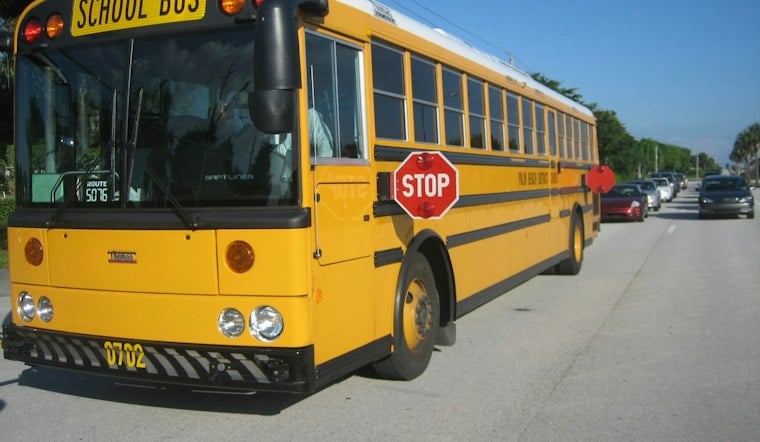
About 750 school buses across Palm Beach County are now rolling with stop-arm cameras built to catch drivers who blow past them while children are getting on or off. The School District of Palm Beach County and the Palm Beach County Sheriff's Office have launched the effort together, aiming to stop a problem that sends tens of millions of vehicles illegally past stopped buses nationwide every year.
The Palm Beach County School Bus Passing Safety Program was built in partnership with BusPatrol, according to CBS12, and the cameras are designed to activate the moment a bus flips on its flashing red lights, capturing images and video of any vehicle that fails to stop. From there, the Palm Beach County Sheriff's Office reviews every flagged incident, and a deputy has to personally confirm a violation before a notice goes out to the vehicle's registered owner.
Drivers won't get hit with a bill right away. Starting Monday, anyone caught on camera illegally passing a stopped bus will receive an educational warning by mail, with no financial penalty attached during this initial stretch, per the same report. That grace period runs out on January 5, 2027, when full enforcement kicks in and confirmed violations will carry a $225 civil penalty — one that, notably, won't add any points to a driver's license.
How the Review and Payment Process Works
Anyone who gets a notice in the mail can pull up the video and photo evidence themselves, entering the violation number and license plate number through the system to see exactly what the camera captured. Payments can be made online, by phone, or by mailing in a check or money order with the notice's payment slip, though online and phone payments come with processing fees. Each notice also spells out how to contest the violation or transfer liability to another driver, if someone else was behind the wheel.
Drivers with questions can reach the AlertBus customer contact center at 1-877-504-7080, which operates Monday through Friday from 8 a.m. to 5 p.m. local time and offers support in English, Spanish, Portuguese, and Haitian Creole.
Why Florida Keeps Chasing This Problem
The scale of illegal passing is why districts across the state keep turning to camera enforcement. The National Association of State Directors of Pupil Transportation Services found that 114,239 school bus drivers nationwide reported 67,258 vehicles illegally passing their buses on a single day during the 2024-2025 school year, projecting that out to more than 39.3 million violations over a full 180-day school year — down from 45.2 million the year before, though the group was careful to note the National Association of State Directors of Pupil Transportation Services still considers the problem far from resolved.
Florida's own numbers help explain the urgency. A single-day survey in the state recorded more than 8,000 illegal passes, and the CBS12 article cites the National Highway Traffic Safety Administration as ranking Florida second in the nation for fatal school-bus-related crashes.
What the Law Actually Requires
Under Florida Statutes section 316.172, drivers are required to stop whenever a school bus displays flashing red lights or extends its stop arm, and they must stay stopped until the signals shut off and the bus starts moving again. That requirement applies to traffic in both directions on two-lane roads, and it also applies to multi-lane roads — including those with a center two-way turn lane — as long as there's no physical barrier or raised median separating the lanes.
There is one exception: drivers traveling the opposite direction on a divided highway are not required to stop if there's an unpaved median at least five feet wide or a raised physical barrier between the lanes, though painted pavement markings alone don't count. Even then, the statute still requires those opposite-direction drivers to slow down and watch for children.
Mixed Results From Other Florida Counties
Palm Beach County isn't the first in the state to try this. Duval County launched a similar BusPatrol camera program on roughly 900 buses and began issuing $225 fines on May 1, 2026, after its own warning period, according to News4JAX. Broward County rolled out a comparable program with its own 30-day warning period before citations began.
Miami-Dade's experience shows how complicated enforcement can get. The county's camera program was suspended in April 2026 but relaunched on May 18, 2026, issuing 7,902 citations worth nearly $1.8 million between May 18 and June 4, with the total climbing past $2.2 million by July 15, according to the Miami Herald. The program faced issues, including notices sent to drivers who were actually on the opposite side of a median from the stopped bus, and a judge dismissed 5,400 contested violations over faulty paperwork without drivers ever being told their cases had been thrown out.
Brevard County's experience points to just how often this happens even on a small scale — a two-month pilot there found that just 10 buses recorded nearly 800 illegal passings, or about two incidents per bus per day, according to the Brevard County Sheriff's Office.





