

























































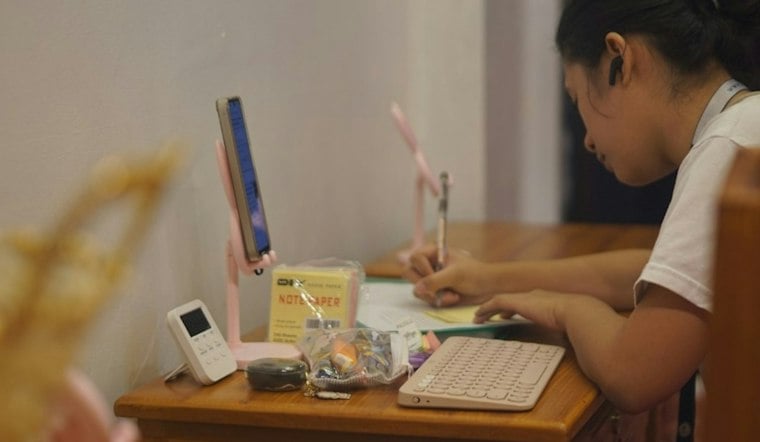
At two Palm Beach County campuses, the person standing at the front of the classroom isn't a teacher — it's an app. Students at Alpha School spend two to three hours each morning working through math, reading, science and other subjects on a computer program that advances them automatically once it senses they've mastered the material. Tuition runs $50,000 a year, and the adults in the room aren't called teachers at all. They're called guides.
That setup is now operating at two Alpha campuses in Palm Beach County, including the Palm Beach Gardens location, according to WPEC. The school's own site lists the Palm Beach Gardens campus as open and enrolling students in grades K-8 at 10350 Riverside Drive, describing a learning path built on Alpha School's adaptive apps that adjust in real time to each student's progress. Scott Dangerfield, a reading specialist at the school, told the station that traditional classrooms often teach to the middle, leaving some kids bored and others behind, while Alpha lets students move at their own level and pace.
Dangerfield said one of his students is working through eighth-grade material while still in second grade. He described his own shifted role bluntly, telling WPEC he feels like he now teaches in two hours what used to take a full school day — because, as he put it, the app is the students' actual teacher. Guides like Dangerfield mostly help kids push through frustration with the software rather than deliver lessons themselves.
A Head Guide's Pitch for Reinventing the School Day
Sean McKenna, Alpha's head guide, told WPEC the model flips traditional schooling on its head, compressing academics into two hours so time opens up for workshops, including gym sessions, puppet shows and nature walks, once students finish their fundamentals. McKenna said the approach teaches life skills alongside academics and predicted it will change society and how children are raised and educated. One student, Lily, told the station she learned the Thriller dance with a professional choreographer, practiced giving and applying feedback, and performed a flash mob with classmates at a mall on a Saturday. Her mother and another parent, Laila's mother, said their daughters have changed significantly since enrolling, with Lily's mother adding that her daughter used to dislike school but now looks forward to it.
Kirsten Berg, who holds the title of dean of parents — a role similar to a principal — told WPEC that some Palm Beach County families sought out Alpha because the traditional education system wasn't working for their kids. She described a school lounge stocked with books, and noted that students also give each other shoutouts for demonstrating good life skills, part of the network's broader emphasis on character alongside academics.
The Network's Own Numbers Tell a More Complicated Story
Alpha markets itself on the promise that it can teach students twice as much material in half the time of a traditional classroom, an ambition detailed by The New York Times, which also reported that the network's roughly 50 private campuses serve about 1,500 students nationwide and that the company hopes to eventually reach one billion students worldwide through its proprietary AI tutor. But the Times found that many Alpha students do not actually hit that twice-as-fast benchmark, and reported that some students who had struggled in public school needed a full day, not two hours, to keep pace with the app. The paper also noted that Alpha's student body includes many children who were already high achievers before they arrived.
Internal figures first surfaced by the Times and detailed by Fortune put numbers behind that gap: only 42% of Alpha students met the network's own goal of learning twice as fast in both math and reading. Fortune reported that about half of K-8 students at Alpha's private campuses missed the math growth target, and roughly one in five missed their reading goals. Scientific American has noted that Alpha has not released the underlying data behind its broader claims about the model, leaving outside researchers unable to independently verify the results.
Rapid Growth, Including a Push Into Public Schools
The company isn't slowing down. Its national network grew from 20 campuses last year to 50 this year, including nine in California, according to the Los Angeles Times, which also cited a University of Colorado policy center estimate that only about one-third of Alpha's guides have education training or degrees. Scientific American reported the company planned to reach roughly 50 U.S. campuses this fall, including 27 newly announced locations. Beyond its private schools, the Times has reported that Alpha's software platform is being introduced into public schools nationwide, and Fortune reported that about 2,600 public-school students in Texas and South Carolina now use the platform, citing company documents. In Houston, Fortune reported, the local school district's superintendent said students piloting Alpha's software at two schools ended up spending more time on the apps than planned, cutting into other activities.
Tuition for the model varies by campus. Alpha's Miami Beach K-8 campus, which opened in August, carries a reported $65,000 annual price tag, according to the Miami Herald, while CBS News has reported Alpha Chicago costs $55,000 a year. Alpha's own published fee listing for its locations totals $65,000 annually before discounts, split between software, on-site tutoring and group workshops — though that listing does not specify it as the Palm Beach Gardens tuition, which WPEC reported separately at $50,000 a year.
What the Research Says About AI Tutoring Broadly
What the Research Says About AI Tutoring Broadly A 2025 randomized experiment in an introductory Harvard physics course, also reported by Scientific American, found median learning gains more than twice as high for students using an adaptive AI tutoring model compared with those using in-class active learning strategies — a result that cuts in the opposite direction and underscores how unsettled the evidence remains on whether AI-driven instruction outperforms well-designed traditional teaching.





