

























































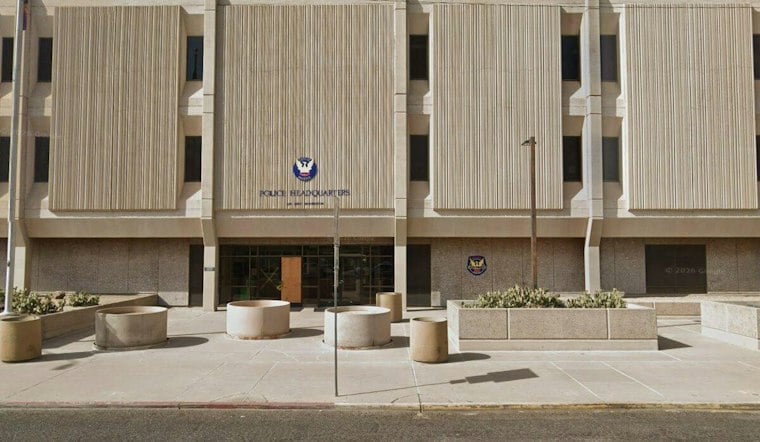
At least eight Arizona law enforcement agencies quietly ran more than 110,000 searches of Flock Safety's nationwide license plate camera network without ever paying for a single camera, and Phoenix Police alone accounted for more than 100,000 of them. The access came through no-cost agreements that let officers tap into a surveillance web Flock says spans more than 120,000 cameras nationwide, all without the public debate or council votes that typically accompany new police technology.
The findings come from an analysis by the Arizona Center for Investigative Reporting, which reviewed roughly four years of Flock audit logs obtained through public records requests and compiled by Have I Been Flocked. AZCIR says Flock gave Arizona law enforcement free access to its nationwide camera network through deals made largely out of public view, and the outlet matched search records using five identifying fields to tally the activity. Then-Phoenix Police Chief Jeri Williams signed the department's memorandum of understanding with Flock Safety on June 21, 2021, and an estimated 200-plus Phoenix officers eventually accessed the network under that no-cost arrangement, according to the AZCIR findings as reported by threesonorans.substack.com. The agreement never went before Phoenix City Council.
A Free Deal That Outlasted Its Own Expiration
Phoenix Police already had Motorola Solutions license plate reader cameras and access to the Vigilant network, but the Flock arrangement opened the door to a much larger pool of nationwide camera data at no cost. The department chose not to renew its Flock agreement in summer 2026, yet officers continued searching the database for months after it expired. A city spokesperson said Flock was slow to cut off the access and has since removed it, the same account notes.
City officials have touted concrete results from the tool. A city spokesperson said Flock cameras helped Phoenix police solve missing persons cases and violent crimes, including murders, and that the cameras were used to identify suspects accused of shooting a police officer and to locate a suspect in a shooting that occurred outside city limits. Phoenix Mayor Kate Gallego and City Council members did not respond to repeated requests for comment, nor did Flock Safety itself, per the same reporting.
Smaller Agencies, Five-Year Access Windows
Phoenix was not alone. Yavapai County, the Maricopa County Attorney's Office, and Pinetop-Lakeside police all signed similar no-cost agreements with Flock that granted five years of search privileges. Yavapai County's Board of Supervisors approved its no-cost memorandum of understanding on a consent agenda in 2022 without public discussion, and the Yavapai County Sheriff's Office went on to conduct more than 2,000 platform searches — results that included license plate sightings as far away as Cobb County, Georgia, and West Seneca, New York.
Pinetop-Lakeside, a town of about 4,000 residents, signed its own Flock agreement in 2022 and gained access to a private subdivision's cameras along with Flock's national database with the subdivision's approval. The department's officers ran hundreds of searches of the national database between September 2023 and April 2025 before Flock ended Pinetop-Lakeside's national lookup privileges under a new company policy requiring paying customers; the department retains access to the subdivision's own cameras. The Maricopa County Attorney's Office, which signed its Flock memorandum of understanding in 2023, said its internal audits found no instances of misuse after detectives there asked Tempe police for camera access when other readers failed to locate a suspect.
County Agencies Leaned on Neighbors' Access
Beyond the agencies with their own agreements, at least four Arizona agencies accessed Flock's database without any agreement of their own, piggybacking on access granted to others. Pima County conducted at least 4,000 searches of Flock cameras after receiving free database access without a formal memorandum of understanding, even after the county declined to install cameras Flock had offered at high-traffic intersections; Pima County detectives have retained use of the database, and the county separately used other agencies' access to view Motorola Solutions license plate reader information, according to a county spokesperson.
Marana, Globe and Superior police departments also conducted searches through other agencies' access, though only over a handful of days, most recently in 2024. Marana and Globe require a case number and a legitimate law enforcement purpose before officers can search, and both departments reported finding no instances of misuse in their own audits. Superior police did not use Flock during Chief Joaquin Manuel's tenure, though Manuel said a detective may previously have partnered with a county to use Flock for an investigation.
Privacy Advocates and a Lawmaker Push Back
The arrangements have drawn sharp criticism from privacy advocates and at least one former elected official. Chad Marlow questioned whether Flock was seeking customer relationships by giving away people's data for free, saying the arrangements magnify risk and privacy violations. Dave Maass put it more bluntly, saying law enforcement can effectively backdoor an entire surveillance network through these no-cost pathways.
Lauren Kuby called the agreements a massive loophole reflecting a breakdown in basic transparency, arguing that agreements allowing agencies to track people should require open public debate and a vote by elected leaders. State Senator Jake Hoffman said the Fourth Amendment is not a suggestion or an invitation for government workarounds to warrant requirements. Separately, Arizona Attorney General Kris Mayes has investigated the state's use of license plate readers, and a fact sheet for Senate Bill 1111 describes a requirement that agencies operating automated license plate readers be responsible for properly collecting and retaining the data and images gathered — though the evidence reviewed does not establish whether that provision has become law.
A Statewide Retreat From Flock Is Already Underway
AZCIR's tally, drawn from roughly four years of logs, is likely a significant undercount since the available audit logs covered only a fraction of agencies statewide, and Have I Been Flocked notes that the published logs are generally limited to searches visible to an agency that released its own audit trail — local or statewide searches are typically not captured. Even so, the exposure has already reshaped how Arizona communities handle the technology: Arizona agencies have canceled at least 11 Flock contracts altogether.
Tempe became the first Arizona city to ban license plate reader cameras when its City Council voted to prohibit police use of the technology with a few exceptions, according to KJZZ; the carve-out still lets Tempe officers use another agency's reader data for multijurisdictional task-force work as long as they don't request a system query. More recently, the Fountain Hills Town Council passed an ordinance in a 5-2 vote permanently banning the town from acquiring, leasing, funding, installing, operating or hosting any automatic license plate readers, as reported by azfamily.com; that ordinance also bars the town from buying reader data or search services from outside vendors. Cave Creek, Flagstaff, Payson, Sierra Vista, South Tucson, Surprise and Tempe had already canceled their Flock contracts earlier in 2026, the same outlet reports.
The retreat extends beyond Arizona. At least 30 localities nationwide have deactivated Flock cameras or canceled contracts since the beginning of 2025, including Flagstaff, according to NPR, which reports that Flagstaff also removed its data from Flock's national and statewide lookup networks, limited sharing to two local agencies, and shortened its data retention window from 30 days to 14. Flock has estimated its cameras helped with more than 1 million law enforcement investigations in 2025, and agencies that disclosed sharing camera data reported sharing it with a median of 217 other organizations, mostly other law enforcement entities, per Pew Research Center. Arizona's own data-sharing footprint is extensive: Lake Havasu Police Department shared its Flock data with 137 agencies, 58 of them in-state, and the Maricopa County Sheriff's Office shared its hotlists with 77 other agencies, including Customs and Border Protection and the Secret Service, according to the Arizona Mirror.




