

























































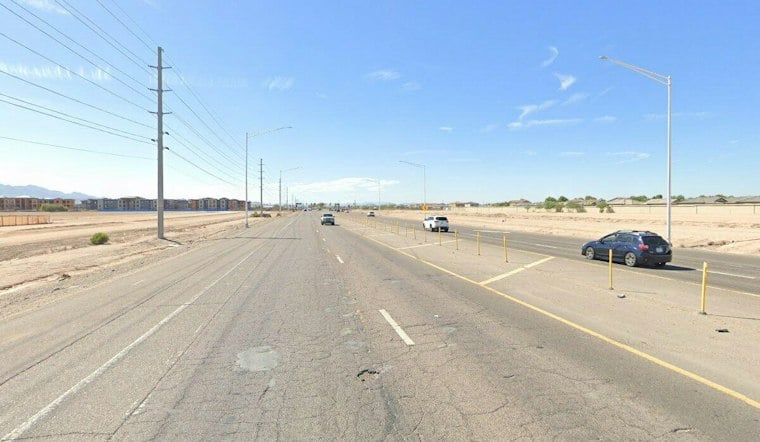
Crews working on a $322 million freeway extension in Phoenix's West Valley have finished a major structural milestone, completing reinforced concrete box culvert and U-channel drainage sections that will eventually sit within new frontage roads along State Route 303. The work clears the way for the next phases of construction on the roughly four-mile extension, which is scheduled for completion in 2030.
The project, known as the SR 303L MC 85 to Van Buren extension, is being built by Pulice under contract with the Arizona Department of Transportation, according to Construction Owners. Pulice, which operates as a FlatironDragados company, is responsible for extending State Route 303 by about four miles, connecting the MC 85 area to Van Buren Road. The newly completed drainage components are being installed ahead of the earthwork, utility relocation and roadway construction that will follow.
How the Drainage Work Came Together
Before any concrete went in, crews completed excavation, grading and foundation preparation, then installed reinforcing steel and formwork for the structures, per the same account. Ready-mix concrete was hauled to the site by mixer trucks and placed using concrete pumps, which supported continuous placement within the reinforced sections. Once the concrete reached the required strength, crews stripped the formwork and quality-control personnel inspected the finished structural sections.
Those drainage structures sit within the footprint of planned northbound and southbound frontage roads, and additional portions of the drainage system will be built as that frontage-road work advances, the report notes. The sequencing matters: getting the underground and structural drainage work done early is what allows the heavier earthwork and roadway construction phases to move forward on schedule.
A Bigger Push Along the 303 Corridor
The Pulice-led project is part of a broader build-out along the existing SR 303 corridor, which already spans approximately 35 miles and serves communities across Phoenix's West Valley, according to Construction Owners. The same project is also described as a $613 million Loop 303 southward expansion from Van Buren Street to Maricopa County 85, which ADOT says it launched over the summer, as reported by Construction Equipment Guide. That project's general contractor is FNF Construction Inc., and it spans about four miles largely following the current alignment of Cotton Lane, adding three general-purpose lanes in each direction between Van Buren Street and Lower Buckeye Road and two lanes in each direction between Lower Buckeye Road and MC 85.
The $613 million expansion also includes completing the southern half of the Van Buren Street interchange, building a full diamond interchange at Yuma Road, and creating a half diamond interchange at Lower Buckeye Road and Elwood Street, the trade outlet reports. Further north, a separate segment of the Loop 303 extension is set to begin in fiscal year 2027 at the eastern end between Loop 202 and 97th Avenue, while construction on the SR 30 segment connecting with Loop 303, between Loop 303 and Estrella Parkway, isn't slated to start until fiscal year 2033.
What Drivers Can Expect This Fall
Commuters in the area have been told to brace for shifting traffic patterns this fall as a new northbound frontage road is completed and Cotton Lane traffic is diverted onto it, according to YourValley.net. Construction of that new northbound frontage road was scheduled to begin this fall, per Construction Equipment Guide's reporting.
Lane restrictions and closures tied to the broader construction effort are expected to occur mostly overnight and on weekends, with some cross-street closures lasting up to 60 days, according to dxc.news. That outlet also reports the Loop 303 extension project is funded through the Maricopa Association of Governments' regional freeway plan, including Proposition 400 funds and an extension of the regional transportation sales tax that voters approved in 2024. As part of the design, the freeway will be elevated over cross streets and the Union Pacific Railroad tracks, with one-way frontage roads built for local access.




