

























































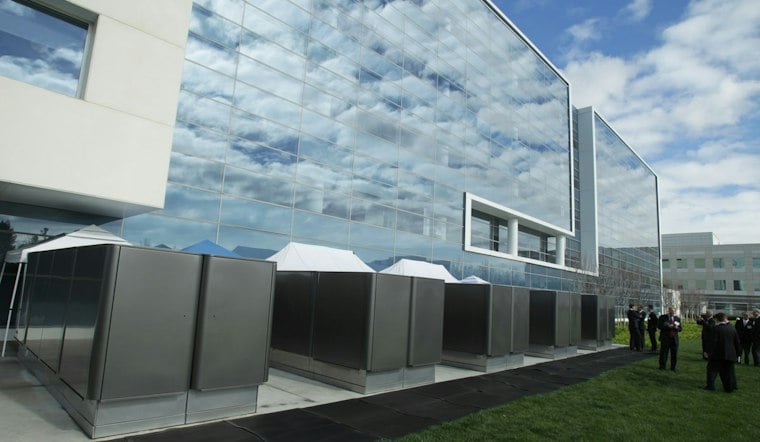
Quanta Computer's American manufacturing arm has agreed to pay about $367 million for two Bloom Energy fuel-cell microgrid systems, splitting the order between a California project worth roughly $249.9 million and a Tennessee project worth about $117.1 million. The deal, struck through subsidiary Quanta Manufacturing Nashville, marks the latest step in a string of agreements the AI-server giant has made with Bloom Energy to keep its factories running on-site power rather than wait on the public grid.
Quanta disclosed the purchase in a Taiwan Stock Exchange filing posted Wednesday at 1:57 p.m. Taiwan time, according to MLQ.ai. The filing, signed by Quanta chief financial officer Yang Chun-lieh, valued the order at NT$11.689 billion using an exchange rate of NT$31.85 per US dollar. The agreement covers two fuel-cell microgrid systems and includes technical services, and the filing states Quanta will pay according to the contracts and installation progress. Separately, Data Center Dynamics reported the same $367 million figure and the same California-Tennessee split for the two projects.
Quanta's filing says the order's purpose was operational needs, that the price was set by negotiation and approved by its chairman without requiring a board vote, and that the contract lists no restrictive terms. The filing also states that Bloom Energy is not a related party to Quanta. Notably, the disclosure does not specify the systems' power capacity in megawatts, nor does it identify which Quanta facilities the two systems will serve. As of Thursday, Bloom Energy had not announced the order itself, per the filing's reporting.
A Pattern Stretching Back to 2024
This is not Quanta's first fuel-cell purchase from Bloom Energy. The manufacturer has used Bloom's solid oxide fuel cells as on-site power for its server factories since 2024, starting with a $20 million deal for two microgrid systems that April, according to Data Center Dynamics. That was followed by an $80 million agreement for three more systems that October, the same outlet reported, and the solution supplied in that deal was described as a fully islanded microgrid meant to power Quanta's operations around the clock, every day of the year.
In November 2024, Bloom Energy said Quanta was expanding its existing installation by more than 150%, and the company attributed the expansion in part to costly interconnection delays with the local electric utility in Fremont, California. Bloom Energy's Aman Joshi said then that AI industry leaders like Quanta cannot afford to wait for conventional grid connections.
A later order, filed by Quanta Manufacturing Nashville on Dec. 30, 2025, saw the company agree to buy three more Bloom fuel-cell microgrid systems, including installation and technical services, valued at about $502.2 million, or NT$15.29 billion, per iTiger. That prior order covered California plant sites B18, B16 and B19, with B18 allocated $223.2 million, B16 allocated $167.4 million and B19 allocated $111.6 million, according to the same report. The newly disclosed $367 million deal is a separate transaction from that December 2025 order.
Why Data-Center-Scale Buyers Are Turning to Fuel Cells
The surge in fuel-cell purchases by companies like Quanta tracks a broader shift among power-hungry AI and data-center operators. Data-center grid connections can face delays, pushing developers toward on-site generation. Reuters reports that Rystad projects investment in fuel cells for data centers will climb to about $30 billion by 2030 from $2.8 billion in 2025, and that roughly 40% of projected US data-center capacity in 2030 could pursue dedicated on-site power rather than depend entirely on utilities.
A Wood Mackenzie analyst told Microgrid Knowledge that microgrid providers are increasingly offering natural-gas and fuel-cell solutions built for 24/7 operation specifically to address utility constraints facing large loads. Rystad also expects annual fuel-cell manufacturing capacity to grow to 4 GW by 2030 from about 1.8 GW today, per Reuters.
Bloom Energy itself has been riding that wave. The company's third-quarter revenue surged 138% to $1.24 billion, with net profit of $250.3 million compared with a year-earlier loss of $23.1 million, Reuters reported, and Bloom reported a record quarter earlier in November 2026. Beyond Quanta, Bloom has signed fuel-cell deals with Oracle and Nebius: Data Center Dynamics reported Bloom agreed to deploy 328 MW of capacity at an undisclosed Nebius site, while its Oracle agreement was expanded to supply up to 2.8 GW of capacity, building on an earlier deal for an initial 1.2 GW.
Quanta's Broader Momentum
The fuel-cell spending comes as Quanta Computer, one of the largest builders of AI servers, led Taiwan server makers as October revenue doubled from a year earlier. That growth underscores why the company keeps turning to Bloom Energy's microgrids: as AI server demand accelerates, so does Quanta's appetite for power it can control on its own timeline rather than wait on grid interconnection queues.





