

























































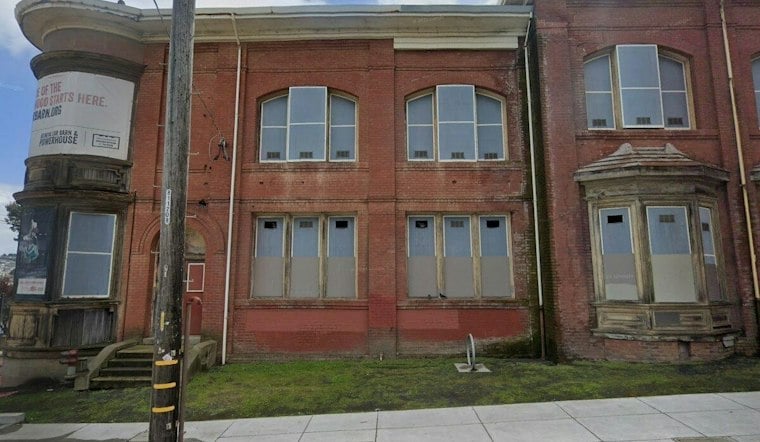
The Geneva Car Barn Powerhouse, a former transit building now used for arts programming, is the setting for “Every Grain of Us,” an evening-length work for three performers scheduled to premiere in San Francisco next weekend. The San Francisco Chronicle reports that choreographer Chinchin Hsu’s family story—her grandmother packed rice in her suitcase when she left Taiwan—provided a starting point for the piece.
The Chronicle reports that Hsu and her fellow dancers use bags of grain in the performance, where rice serves as both a physical material and a point of reflection. The work is scheduled for 3 p.m. and 7 p.m. Saturday, Nov. 14, and 3 p.m. Sunday, Nov. 15, at 2301 San Jose Ave., with tickets priced at $23.18, according to the San Francisco Chronicle. The venue, the Geneva Car Barn Powerhouse, is described by a DancersGroup page as a dance performance that invites audiences to experience the five senses — sight, sound, touch, smell, and taste of rice.
Hsu was previously a member of the Margaret Jenkins Dance Company. A 2017 DancersGroup account of a project marking the company’s 43rd anniversary listed her among seven dancers involved, alongside Brendan Bell, Kristen Bell, Corey Brady, Alex Carrington, Margaret Cromwell and Kelly Del Rosario. In that account, Margaret Jenkins described Hsu as someone “who was raised in Taiwan.” The Chronicle reports that Hsu’s choreography was also part of the 2022 FACT/SF Dance Festival.
Community Conversations Inform the Choreography
The Chronicle reports that Hsu organized “ImprovRice,” a series of San Francisco Chinatown gatherings where participants talked about their connections to rice. Those exchanges informed “Every Grain of Us.”
The Chronicle lists “Rice Field,” “Peel & Wash,” “Loosening Soil” and “Mochi / Sonic Mochi” among the work’s sections. Hong Kong-born electroacoustic composer Amma Ateria provides the live score.
A Repurposed Streetcar Barn as Backdrop
The Geneva Car Barn Powerhouse was renovated as a community venue. According to the San Francisco Recreation and Parks Department, Phase I improvements were completed and the space opened to the public in May 2020. The Excelsior venue has about 3,100 square feet and 35-foot-high ceilings, and arts groups can rent it for short-term events including rehearsals, performances and exhibitions.
A Neighborhood and a Building in Transition
The Excelsior’s population has changed over time. A San Francisco Planning Department landmark designation report notes that by the 1970s, Latinx and Filipino populations had overtaken Italians as the neighborhood’s dominant ethnic groups.
The building also has a transportation history: San Francisco Recreation and Parks says private railways owned the Geneva Car Barn Powerhouse until 1944, when Muni took it over and occupied it until 1989.
How the Powerhouse Became an Arts Venue
The Community Arts Stabilization Trust says it partnered with San Francisco Recreation and Parks in 2017 to renovate the former Muni warehouse. With support and advocacy from the Friends of Geneva Car Barn and Powerhouse, Performing Arts Workshop was selected that year as the venue’s sole tenant and program provider, according to CAST. The account identifies the partners and the tenant decision but does not specify a particular needs assessment behind the project.
Food as Memory and Connection
The DancersGroup event page also frames the performance through food’s role in family life, describing it as a way immigrant families express care and shared meals as occasions for intergenerational storytelling. That framing resonates with the family memory at the heart of Hsu’s work.




