

























































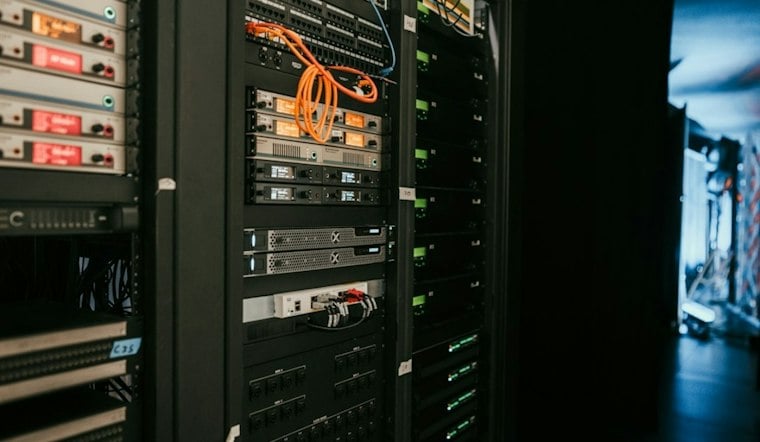
A Salt Lake City energy-storage startup just landed half a billion dollars to build a new kind of AI data center that comes with its own power supply built in. Torus said it raised $500 million in a Series C funding round to help launch Foundry, a shipping container-sized product that combines batteries with artificial-intelligence computing.
The round was led by investment firm Magnetar, with participation from Iconiq Capital, Origin Ventures and Trinity Capital, according to Bloomberg. Torus said the funds will support manufacturing of Foundry, and the company named Hydra Host, an AI infrastructure company, as among its customers. Torus already sells modular battery systems designed to help businesses and factories manage their energy use and reduce power bills, per the same report.
Why Battery-Backed Computing Is Catching On in Utah
The timing lines up with a power crunch rippling across Utah's booming data-center industry. A University of Utah report cited by the Deseret News counted 48 operational data centers in the state drawing 920 megawatts of power, with another 2,600 megawatts under construction — a buildout expected to more than triple the state's data-center capacity. Separately, reporting from the Salt Lake Tribune found that Utah's data centers could eventually consume as much as four times the electricity currently used by the state's residents and businesses combined.
That demand has pushed developers to look beyond the traditional grid. The Tribune reports that data-center developers in Utah have increasingly turned to generating their own electricity, mostly using natural gas, as a way to keep up with surging power needs. Torus's Foundry, which pairs batteries directly with AI computing hardware, fits into that same shift toward on-site power solutions rather than waiting on utility connections.
A National Pattern of Self-Powered Compute
Utah isn't alone in this trend. Trade publication IEEE Spectrum notes that data-center operators nationwide are increasingly exploring direct connections to power generation to avoid depending on the grid, a strategy that has gained attention as data centers struggle to secure new grid connections. San Francisco-based Rune Energy offers a comparable approach with its modular data centers, called Renewable Energy Linked Intelligent Compute, which connect directly to the direct-current electricity generated by a solar array.
Rune's modules can draw up to 100 kilowatts of power and can house anywhere from 128 Nvidia B300 GPUs to more than 2,000, according to the outlet. The company says it is planning to scale its operations to 100 megawatts of compute over the next 12 months. Whether Torus's Foundry will match that kind of output remains unclear, as Bloomberg's report did not detail the product's dimensions, computing capacity or price.
For now, the deal marks one of the larger recent funding rounds for a Utah-based startup positioning itself at the intersection of two booming industries: battery storage and artificial-intelligence infrastructure. With Hydra Host already on board as a customer, Torus's bet is that pairing power generation with computing hardware in a single package could offer a shortcut for an industry increasingly hemmed in by grid limits.





