

























































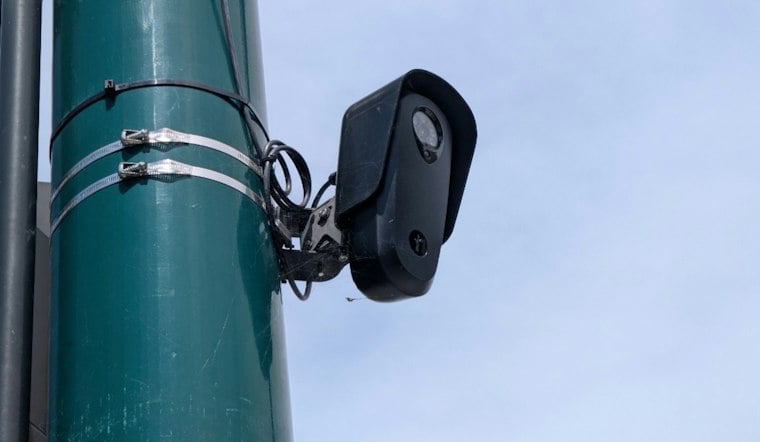
San Diego police internal investigators pulled up Flock license-plate camera data in August 2025 to check whether a domestic violence victim's car and the personal car of Officer Miguel Gonzalez had crossed paths. The search came amid a misconduct investigation into Gonzalez, who, according to that internal investigation, began a romantic and sexual relationship with a domestic violence victim and had sex with her while on duty on March 6, 2025.
The Flock search did not turn up evidence that the two cars were near each other, according to KPBS. But the broader internal investigation substantiated six allegations against Gonzalez, including that he took the victim's phone number from field interview notes and contacted her while on shift. The investigation found he made a separate stolen-car victim wait 51 minutes before arriving to take a report.
How the Flock Search Fit Into the Case
SDPD spokesperson Ashley Nicholes said searches of both the victim's and Gonzalez's license plates were allowed under department policy and procedures, telling KPBS that investigating specific allegations of officer misconduct falls within the system's authorized uses. The department's use policy allows Flock access for “legitimate purposes,” while its procedures permit use for “official investigations,” per the same reporting. Nicholes also said the police officers union signed off on Flock usage back in 2023.
Not everyone agrees the search was proper. Ted Womack Jr., vice chair of San Diego's Privacy Advisory Board, said the surveillance of the domestic violence victim seemed to violate the city's Flock use policy, the station reported. The dispute underscores a broader tension in how San Diego's camera network can be turned inward on its own officers, not just outward at the public.
SDPD has used Flock in internal investigations six separate times, according to Nicholes. Three of those searches returned no applicable information, two corroborated officers' accounts of events, and one — the Gonzalez case — substantiated misconduct that led to discipline, the outlet reported.
Union Pushes Back, Council Momentum Shifts
The San Diego Police Officers Association said using Flock to monitor officers' personal vehicles in non-criminal administrative investigations was never disclosed or negotiated with the union. The association's board, led by president Jared Wilson, demanded an end to using Flock for non-criminal administrative investigations that could lead to employee discipline, along with a transparent audit of prior Flock use and a meeting with the city — demands the city agreed to, per an email from the union's board cited in the reporting.
The revelations landed as political support for San Diego's Flock program was already eroding. Council member Raul Campillo withdrew his support for the program and demanded an immediate suspension along with an audit of its use inside the police department. A city council committee advanced a plan in October 2026 to cancel San Diego's Flock contract and ban automated license plate readers altogether, and council member Stephen Whitburn announced his own opposition that same month. Before Campillo's reversal, the council had five votes to cancel the contract — one short of the six needed to override a mayoral veto — and his defection gave opponents an apparent sixth vote.
Outside Agency Access Remains Disputed
How much outside access San Diego's camera network allows is itself contested. A separate account reported 62 SDPD shares with federal agencies in 2024. The San Diego Union-Tribune, however, reported that no outside agencies can directly access the city's ALPR network, while noting that requests from other California law enforcement agencies had to concern a limited type of crime. The two accounts describe the access question differently, and the dossier does not resolve which mechanism governs outside use of San Diego's data.
San Diego's network includes 500 Flock-enabled automated license plate readers, and the system retains camera footage for 30 days, according to KPBS. That data is used more broadly for locating stolen vehicles, identifying suspects' vehicles, responding to public threats, and working missing-person cases. A separate count from the Times of San Diego found SDPD officers searched the license plate readers 114,692 times since the start of the year, with 19,210 of those searches for stolen vehicles, 17,141 for arrest warrants, and 13,221 for gunfire or weapons offenses. The paper found the top three search reasons accounted for 43% of all ALPR searches from January through the end of July, while officers selected “other” as their reason 3,962 times from January through August without SDPD releasing further detail on those entries.
A Pattern of Misuse and Mistaken Identity
The Gonzalez case adds to a string of controversies that have dogged Flock nationally and locally. The Union-Tribune reported that Flock said it was shortening its recommended default data-retention period from 30 days to seven, though it noted that decision is ultimately up to each customer. The same report cited a Washington Post analysis of police and court records finding at least 50 law enforcement officers nationwide charged or accused of unauthorized use of license plate readers, and KPBS reported that activists nationwide have mobilized heavy opposition to the technology amid reports of officers using it to stalk romantic partners.
WebProNews reported that San Diego man Hugo Parra spent nearly a month in jail after being incorrectly identified as a suspect in an attempted carjacking in Golden Hill on November 26, 2025. The report said a Flock camera captured a red Alfa Romeo after police lost sight of a suspect; Parra, who was ultimately arrested, was reportedly five miles away when the crime occurred.





