

























































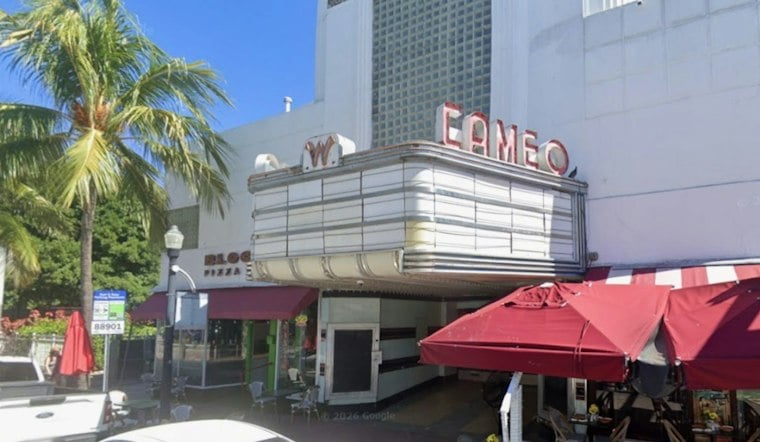
The Cameo Theater at 1445 Washington Avenue has sat mostly empty since its nightclub run ended in 2019, but Miami Beach's Planning Board just cleared the way for its next act: a 466-seat restaurant and lounge spread across two floors of the Art Deco building. The board approved the conversion by a unanimous 7-0 vote on November 3, according to the city.
What the Approved Plans Allow
The conditional use permit covers a 17,589-square-foot venue, with a 226-seat bar and lounge planned for the ground floor and a 240-seat restaurant upstairs, according to Commercial Observer. Romain Zago filed the plans, and the application also points to Miami real estate investor and developer Michael Konig as a partner in the venture. The outlet reports the space carries a license to sell alcohol until 5 a.m., and that the existing stage will remain on the ground floor.
Rather than framing the venue as a nightclub, the application describes a concept anchored by live theatrical performance rather than an open dance floor, the same report notes. That distinction matters for a building whose most recent chapter was built entirely around DJs, electronic music, and the kind of late-night dance scene it hosted under the name Crobar.
Conditions Attached to the Approval
Miami Beach's sign-off didn't come without strings attached. Per Cuba en Miami, approval conditions include restrictions on sidewalk queues outside the venue, required sound-system testing before a business license is issued, and ongoing municipal follow-up once operations begin. The outlet also reports that no official reopening date has been set, and that construction permits and renovations are still outstanding.
Miami Beach has separately said it is streamlining approvals to make it easier for restaurants and supper-club concepts to open in key commercial corridors, though that general policy description does not establish whether the Cameo project specifically used the expedited track.
Eight Decades Under One Marquee
The Cameo opened as a movie theater on November 4, 1938, with opening-night films including To the Victor and The Lie of Nina Petrovna, according to the Miami Herald. During World War II it hosted Sunday morning church services for soldiers stationed in Miami Beach, and it operated primarily as a movie house from the 1940s through the 1970s, with Wometco managing it from the late 1950s into the early 1960s.
In 1959, the Cameo screened The Diary of Anne Frank for a full year after the film opened there on April 20, about a month after its New York national debut, the Herald reports. The theater also hosted Yiddish vaudeville shows during that run and into the 1960s, before later screening 2001: A Space Odyssey in 1968, Death Wish in 1974, and Jaws in 1975.
From Punk Clubs to Pop Icons
The building's identity shifted again in the mid-1980s, when it was converted into a live-music venue for pop, rock, and punk rock acts, per the Herald's reporting. The Rhythm Foundation helped spearhead musical renovations there in the late 1980s, and in 1988, Elton John's music video for A Word in Spanish was filmed in front of the Cameo.
The venue drew a string of marquee names through the 1990s. Boy George performed at the Cameo in November 1995, reportedly telling the crowd, “Enough nostalgia. All the '80s ever gave us was Margaret Thatcher and Ronald Reagan. And me, but that doesn't count. It's now, now, now.” Sophie B. Hawkins played the Cameo in May 1996, and Bob Dylan sold out two shows there in just 18 minutes in March 1998, according to the same Herald account.
Not long after the millennium, the Cameo's era as a nightclub began, built around DJs and electronic music, and it later became known as the nightclub Crobar before that operation closed in 2019. Mainro Miami Holdings is now the entity behind the latest proposal to convert the shuttered Cameo into what the Herald describes as a potential $20 million supper club, though further building permits and renovations are still required before any reopening.




