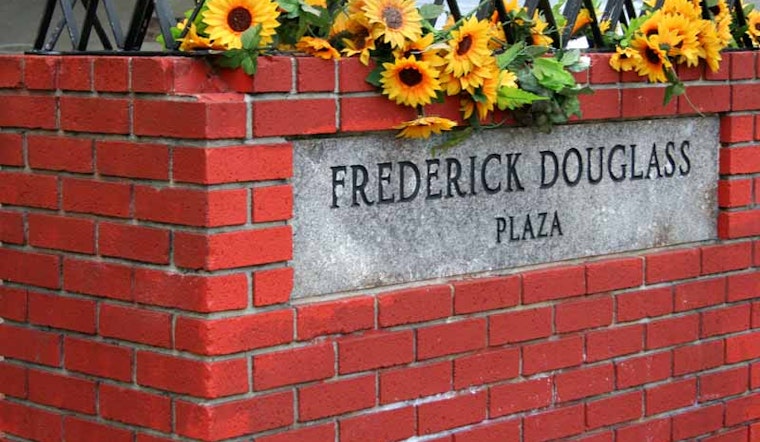
If you've ever passed by the intersection of Oak and Pierce, you may have noticed Frederick Douglass Plaza.
Or, you may not have.
Aside from brick bumpouts and some subtle signage on each corner, you may not realize that this one-block stretch of Pierce from Oak to Fell honors one of America's most important historical figures.
Today, while everyone's celebrating that other holiday, we honor what would have been Freddy's 193rd birthday with a quick look at Frederick Douglass and the plaza that bears his name.
Frederick Douglass, of course, was born a slave in Maryland, and was secretly taught to read at age 12 -- despite the fact that this was illegal -- by his master's wife. Douglass escaped slavery at age 19 by posing as a sailor and boarding a train to Delaware, and eventually ended up in New York, where he started giving lectures about his experiences as a slave. His speeches and writings, including his 1845 autobiography, not only gained him fame but helped propel the abolition movement. Douglass continued his speaking engagements through the end of slavery and into Reconstruction, emphasizing the importance of education and hard work in the face of racism and discrimination. He died in 1895 at age 76. It's said that Black History Month is set in February to honor the birthdays of two of the most important figures in African American history -- Abraham Lincoln, and Frederick Douglass.
 As far as we can tell, Frederick Douglass Plaza was designed in 1968 by Beverly Willis, whose other well-known projects in San Francisco include the San Francisco Ballet Building and Yerba Buena Gardens.
Why was this specific block dedicated to Frederick Douglass? We don't know. There's very little information available online -- if any readers out there have an answer (or theory), we're all ears.
In the meantime, though, while you're swimming in candy hearts and pink teddy bears today, take a moment to reflect on this lesser-known, less commercial reason that makes February 14th worth celebrating.
As far as we can tell, Frederick Douglass Plaza was designed in 1968 by Beverly Willis, whose other well-known projects in San Francisco include the San Francisco Ballet Building and Yerba Buena Gardens.
Why was this specific block dedicated to Frederick Douglass? We don't know. There's very little information available online -- if any readers out there have an answer (or theory), we're all ears.
In the meantime, though, while you're swimming in candy hearts and pink teddy bears today, take a moment to reflect on this lesser-known, less commercial reason that makes February 14th worth celebrating.
Frederick Douglass, of course, was born a slave in Maryland, and was secretly taught to read at age 12 -- despite the fact that this was illegal -- by his master's wife. Douglass escaped slavery at age 19 by posing as a sailor and boarding a train to Delaware, and eventually ended up in New York, where he started giving lectures about his experiences as a slave. His speeches and writings, including his 1845 autobiography, not only gained him fame but helped propel the abolition movement. Douglass continued his speaking engagements through the end of slavery and into Reconstruction, emphasizing the importance of education and hard work in the face of racism and discrimination. He died in 1895 at age 76. It's said that Black History Month is set in February to honor the birthdays of two of the most important figures in African American history -- Abraham Lincoln, and Frederick Douglass.