

























































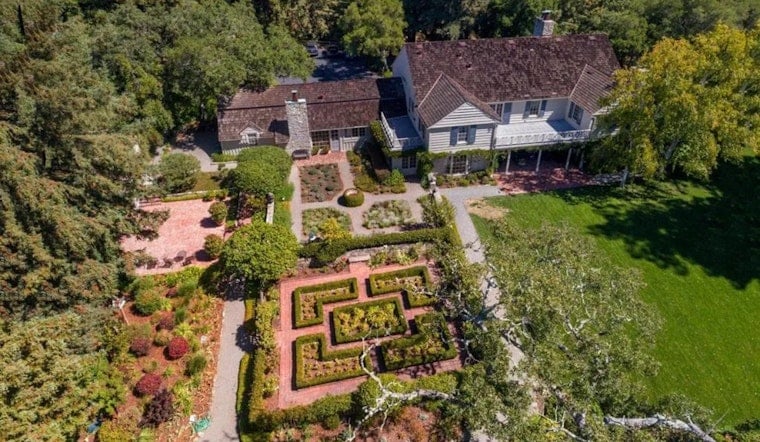
A 32-acre Woodside spread at 176 Harcross Road is quietly reappearing as a coming soon listing with a $50 million price tag, more than double what the property fetched in 2020. The 1930s Pennsylvania-Colonial main house sits amid sweeping lawns, formal gardens and wooded ridgelines, with seven bedrooms packed into roughly 7,200 square feet that feel almost modest compared with the grounds. In a town where privacy and preservation often win the argument, even small tweaks to a property like this can trigger very public fights.
Listing details
The "coming soon" entry on Redfin and the listing page on Compass both put the ask at $50,000,000 and identify Scott Dancer of Compass as the listing agent. The marketing materials and public-record snapshot describe a Pennsylvania-Colonial main residence built in 1933, measuring about 7,223 square feet with seven bedrooms and seven and a half baths on approximately 32 acres. Meeting minutes from the Town of Woodside show that as recently as 2024, a proposal for a new perimeter fence on the parcel turned into a formal dispute, a reminder that even low-key site work in Woodside invites close scrutiny.
Price history and local reaction
Public records and MLS history indicate the estate last changed hands in April 2020 for about $20.5 million, according to Realtor.com. Local brokers who spoke with The San Francisco Standard described the new $50 million asking price as aspirational. One broker put it this way: "It's better than treasuries and not quite as good as Google." That spread between the 2020 sale and the current list number highlights how subjective pricing gets when there are only a handful of comparable 30-plus-acre estates on the Peninsula.
Red tape and the fault line
Anyone eyeing a teardown-and-rebuild in Woodside is signing up for a marathon, not a sprint. The San Andreas Rift Zone cuts through much of the area and triggers extra geotechnical review and higher insurance considerations, according to federal mapping and regional studies from the U.S. Geological Survey. Brokers told The Real Deal that a teardown-and-rebuild project on a property of this scale could stretch toward five years once approvals, design work and construction are added up. That kind of timeline, along with the required soil, slope and seismic studies, helps explain why buyers tend to prize land they can largely use as is.
What buyers could do
Still, a 32-acre parcel in Woodside comes with options that smaller Peninsula lots simply do not. The town planning director told The San Francisco Standard that a future owner could apply for a conditional use permit to build a second main residence because the lot exceeds 10 acres. Any demolition of a structure older than 50 years would first require a historical evaluation report by a qualified architectural historian. While Woodside zoning does not allow multifamily buildings, the town’s accessory dwelling unit rules permit multiple ADUs on large parcels, according to the Town of Woodside. That mix of rare land, strict zoning and carefully controlled redevelopment is part of why owners sometimes test very high price ceilings.
Whether this $50 million listing finds a match will signal how far Peninsula buyers are willing to stretch for privacy, acreage and long-term potential. In Woodside, value is rarely just about the house. It is about the land, the rulebook that governs it and the patience required to see a big project all the way through.





