

























































According to the ACLU this is the first “civil suit in California to challenge warrantless cell phone searches at arrest.” In 2011, the California Supreme Court ruled in the case of People v. Diaz that arrestees’ phones can be searched without violating the United States Constitution.
“This suit brings a challenge under the California Constitution’s stronger guarantees of privacy and freedom from unreasonable search and seizure, as well as a challenge under the U.S. and California Constitutions’ guarantees of freedom of speech and association,” the ACLU wrote in a statement.
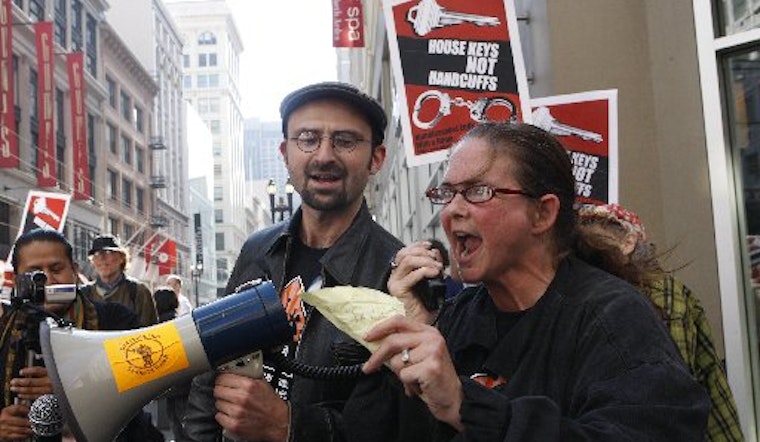
The January protest Mr. Offer-Westort took part in was a reaction to Sup. Scott Wiener's legislation around homeless citizens gathering at City parklettes and plazas-specifically Harvey Milk and Jane Warner Plazas-that managed to ban just about every activity conceivable in an attempt to make life so miserable for the homeless that they move on from any spot that has public furniture or space to rest.
This legislation was penned in an attempt to supplement SF's already restrictive and controversial 2010 No Sit/Lie Law. Chief Suhr had also sent specific requests to Sup. Wiener to make sure the new legislation included targeted time periods during the day from 9AM to 9PM.
 Mr. Offer-Westort, a well-known SF activist and member of the Coalition on Homelessness, pitched a tent in protest against this restrictive legislation at Jane Warner Plaza as part of a day of Citywide actions of civil disobedience against the legislation. He was eventually arrested by two SFPD officers and charged with a misdemeanor that carries up to a 500 dollar fine.
The rub of the lawsuit comes when one of the arresting policemen, identified only as Officer Chambers, started to go through his phone text messages. He had earlier been having a private exchange with a fellow activist in which they discussed the short comings of a local politician that Mr. Offer-Westort works with on an ongoing basis. He didn't want that conversation made public as it'd affect his ability to do his job. He told SFPD that they didn't have permission to look through his phone, but, they did anyway.
In the course of the warrantless search of Offer-Westort's cell phone Officer Chambers read messages authored by individuals other than Offer-Westort who had not been arrested and messages that were unrelated to the crime for which Offer-Westort was arrested.
The lawsuit challenges the earlier CA Supreme Court ruling and calls into question personal privacy not to mention Fourth and Fifth Amendment issues.
The City hasn't made comment on the lawsuit and SFPD policy excludes them from commenting on an ongoing lawsuit. It will be interesting to watch this case birthed at the corner of Market and Castro wind its way through the court to see what kind of historic and lasting changes it may have on future use of phone messages as evidence in the State and City.





