
























































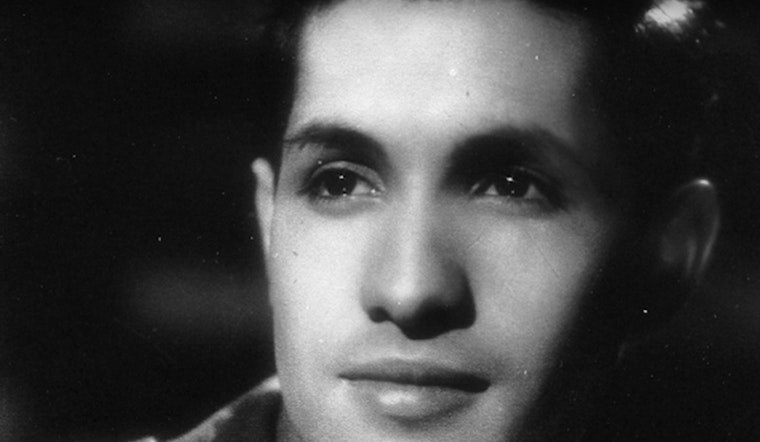
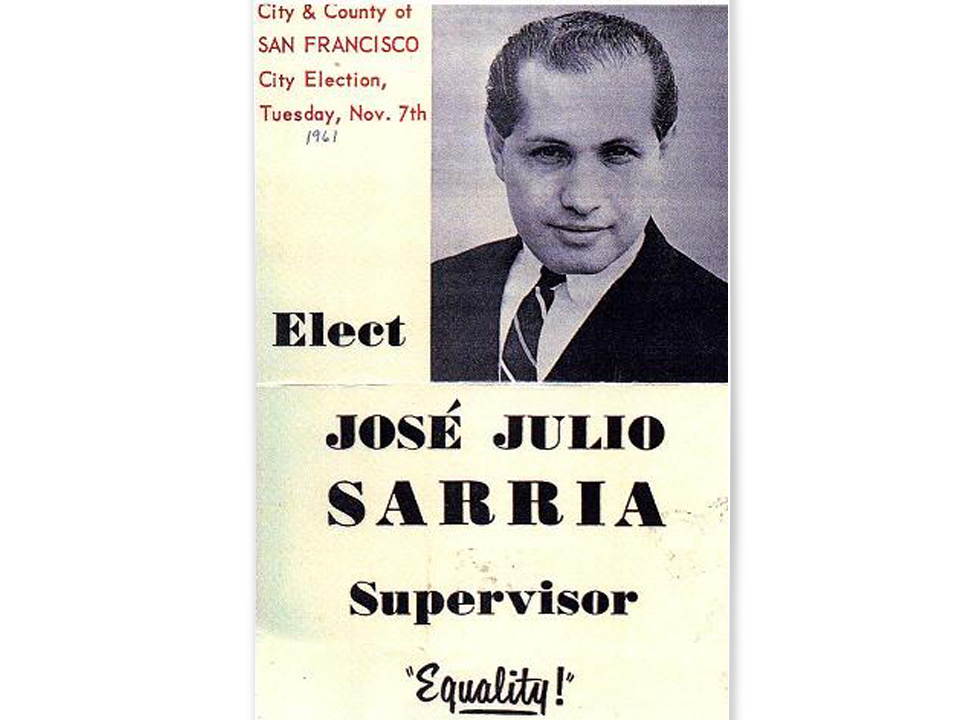
Looking back upon his colorful life today, it might be difficult for people to fully comprehend how courageous and groundbreaking José Sarria was. Sarria (1922-2013) was the first openly gay man in the United States to run for public office. His campaign for San Francisco's Board of Supervisors commenced in 1961, more than 15 years before Harvey Milk was elected to the Board.
Though Sarria didn't win the election, he garnered the attention of the press, and got more votes than anyone thought he would.
Tomorrow, April 30th, at 7pm, the GLBT History Museum will hold a special fundraising event to support filmmaker Dante Allencastre's upcoming feature-length Sarria documentary, Nelly Queen: The Life and Times of José Julio Sarria. The evening will be hosted by San Francisco Supervisor David Campos, who, like Sarria, is an openly gay Latino man.
As early as the 1950s, Sarria was out and proud. As popular drag performer at The Black Cat, a gay bar in North Beach, he mentored many young gay men at a time when simply sitting in a gay bar could get patrons arrested on morals charges. When Sarria passed away in 2013, many older gay men recalled that he was the first person to tell them it was okay to be who they are.
Ben Carlson, spokesperson for the GLBT History Museum, explained to Hoodline why Sarria is an important figure in LGBT history. "José was one of the founders of the Queer community we know today, standing up for equality when almost no one else would," Carlson said.
"It was a time of great oppression," Carlson pointed out. "Sarria founded and co-founded many important early LGBT organizations, including the Tavern Guild and the Imperial Court System. " The Court remains a powerful community voice today.
"He had a wonderful combination of creativity, pride, generosity, and bravery," Carlson said of Sarria's strength and character. "At a time when most LGBT people were in the closet, Sarria refused to live a double life, and he didn't think anyone should have to. He preached 'gay is good', and encouraged people to stand up for their rights. He inspired people and got them organized because he knew there was strength in numbers. He ran for public office—he made a statement every chance he got."
Dante Alencastre, who will speak at the GLBT Museum fundraiser, told Hoodline about what Sarria's legacy means to him. A native of Lima, Peru, Alencastre currently lives in Los Angeles, but he also spent twelve years in Amsterdam, making films and working in gay cable television.
"I have always been drawn to storytelling, which began in my college days and continues today," Alencastre said. "I am especially drawn to people's stories which are often underrepresented in the media. Non-conformity has been a trademark of my storytelling, and I like pushing the boundaries and rattling the cages of the established structures."
Alencastre also said that he looks for the "defiance, and the resilience" of individuals who are not considered part of the mainstream LGBT communities. "It's my goal to preserve and reclaim our queer stories for the present and future generations of gender non-conforming, gender queer, and trans youth," he explained.
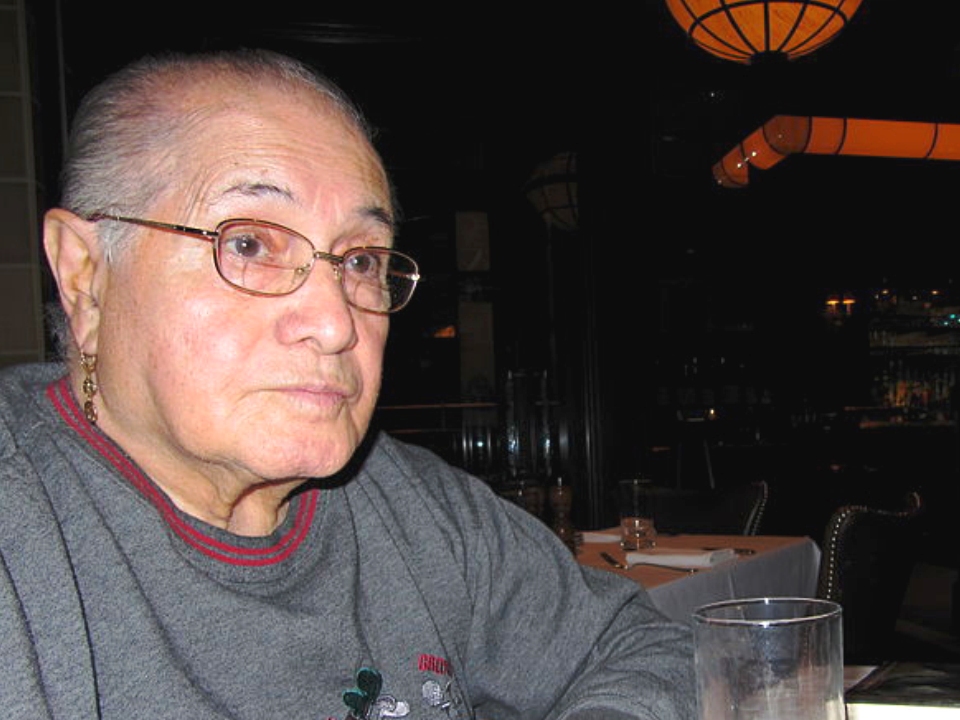 Photo: John Stephen Dwyer / Wikipedia
Alencastre's film, now in production, will tell the story of Sarria's life through home movie footage provided by Sarria's friend, Joe Castel, who serves as the film's executive producer.
In addition to Sarria's run for office, the film will recall his service during World War II, and his lifelong refusal to conform to what was expected of him. "As a feminine identified gay man, José's life teachings and defiant stance inspired me to embrace my feminine ways with pride and to find courage in his life lessons," Alencastre said.
The filmmaker pointed out that during Sarria's lifetime, being openly gay was frowned upon not only by mainstream society, but by gay men and lesbians who lived their lives deep in the closet. It was during these times that Sarria proudly labeled himself a "nelly queen".
"Dante's film will introduce José's story to a wider audience, which is terrific," said Carlson. "The medium of film is well suited to telling that story, because Sarria was a performer and singer. You can get to know him best by seeing and hearing him—we're fortunate that a lot of good footage of José exists."

Photo: José Sarria Memorial/Facebook
Carlson also said that the museum's extensive archives on Sarria were being made available to Alencastre.
"Sarria is as important today as he was back in 1961 when he ran for office," Alencastre said. "Nelly Queen is not just an LGBT history lesson; it's a triumphant story of the human spirit—a hero's journey of a man fighting unjust laws and uniting a fractured community. José stands as a courageous role model to people still struggling with their sexual identity and self esteem."
The GLBT History Museum is located at 4127 18th St. in the Castro. Tickets to the Nelly Queen fundraiser are $75 and can be purchased here.
There is also an active Indiegogo campaign for the film where you can learn more about the film and filmmakers, and a website where you can contribute.



